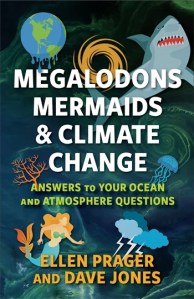
Written by a marine scientist and a meteorologist, this is an interesting introduction to the ocean and the atmosphere. It answers questions about topics including the sea, sea creatures, coral reefs, the supernatural (or is it?), lightning, hurricanes, weather forecasting, extreme events, climate change and the sun.
I love fun facts and there are plenty here.
You’re more likely to be killed by a toaster than by a shark.
The only whale with an esophagus big enough to swallow a human adult is the sperm whale but they “dive thousands of feet to catch prey” so you’re very, very unlikely to be on the menu, even accidentally.
Starfish aren’t called starfish anymore! They’re known as sea stars now.
As sunlight enters the ocean, short-waved light like green and blue penetrate deeper. Long-waved red light is absorbed more quickly. So, below about sixty feet, without artificial light, everything appears blue-green.
… This includes blood.
When I was a kid, I was always on the lookout for books like this for school project research but it was too advanced for kid me. Adult me wavered between Didn’t I learn this at school? and That’s really interesting. I should have studied science after it became an elective at school. It probably would have been just right for teenage me but they would’ve thought it looked too much like homework.
For readers who are craving more answers, there’s a fairly extensive list of sources and additional information at the back of the book.
Thank you so much to NetGalley and Columbia University Press for the opportunity to read this book.
Once Upon a Blurb
Could ancient giant sharks called megalodons still exist in the deep sea? What should you do if stung by a jellyfish? Can we predict lightning strikes and how is climate change affecting hurricanes?
With humour, easy to understand language, and fun illustrations, marine scientist Ellen Prager and meteorologist Dave Jones use frequently asked and zany questions about the ocean and atmosphere to combat misinformation and make science engaging and understandable for all. From dangerous marine life, coral reefs, and the deep sea to lightning, hurricanes, weather forecasting, the Sun, and climate change, they reveal what’s fact, what’s fiction, and how to find science-based answers. This book is perfect for anyone curious about the world around them, educators, science communicators, and even scientists who want to learn about and explain topics outside their expertise.
 Schizanthus Nerd