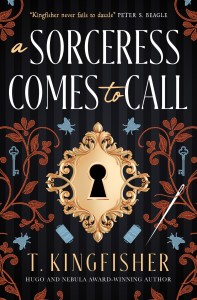
A Sorceress Comes to Call – T. Kingfisher

It’s never taken me three weeks to read a five star book before. That’s how good this book is. I know. That doesn’t make any sense. Here’s some context…

I started reading this book after attending a conference about coercive control. The day after. It wasn’t the proximity to the conference that affected me, though. It was the fact that I had listened to a series of experts discussing coercive control for two days, yet not one speaker was able to get inside the experience of coercive control in the way that this book does.

I felt the control Cordelia’s mother had over her and because her experience was so authentic (magic aside), I was only able to tolerate small amounts at a time. It got to the point where I would notice my body tense whenever Evangeline walked into a room and that, more than anything else, told me the author had well and truly done their job.

Cordelia’s mother makes her obedient, using her power as a sorceress to control her every action. When she’s obedient, Cordelia is a marionette in her mother’s hands.

Her body is not her own.

No one noticed that Cordelia moved in unison with her mother.

No one ever did.

Her voice is not her own.

Her tongue did not belong to her.

She fears her mother can hear her thoughts.

Cordelia is constantly on guard, monitoring her mother’s moods, her tone of voice, every word she says – searching for clues about her safety – later that day, that hour, the next moment.

Cordelia resists her mother’s violence in small and big ways. She makes herself inconspicuous. Her careful study of her mother has taught her the behaviours she needs to avoid to increase her safety.

Closing the door when she was home alone was as much rebellion as she dared.

Despite having been abused all of her life, Cordelia has strengths her mother has failed to stamp out. Cordelia can identify her mother’s attempts at gaslighting, even though she doesn’t know the terminology, and has been able to hold onto her sense of self in a way that most adults who experience coercive control are unable to.

Evangeline, like many abusers, keeps her daughter isolated, but that’s going to change. They’re about to meet Hester, a fifty one year old woman with bad knees, who’s going to seriously mess with the status quo.

“You can’t save everyone, you know.”

“I’m not trying to. But if someone who needs help falls in your lap, you help them. It’s what you do.”

We all need a Hester in our corner.

This book is about the insidious nature of abuse but it’s also about the seen and unseen ways that people who experience abuse resist. It’s about courage and resilience and hope.

It’s also about the responsibility we have as individuals to remove domestic and family violence from our too hard basket and respond safely if someone shares with you that they are experiencing abuse. If you’d like to explore this more, I can’t recommend Insight Exchange highly enough.

New fear unlocked: white horses. Thanks for that, Ursula. 😊

Thank you so much to NetGalley and Titan Books for the opportunity to read this book.

Rating: 5 out of 5.

Once Upon a Blurb

Cordelia knows her mother is unusual. Their house doesn’t have any doors between rooms — there are no secrets in this house! Cordelia isn’t allowed to have a single friend. The only time she feels truly free is on her daily rides with her mother’s beautiful white horse, Falada.

But more than a few quirks set her mother apart. Other parents can’t force their​ daughters to be silent and motionless — obedient — for hours or days on end. Other mothers aren’t … sorcerers. After a suspicious death in their small town, Cordelia’s mother insists they leave in the middle of the night, leaving behind all Cordelia has ever known. They arrive at the remote country manor of a wealthy older man, the Squire, and his unwed sister, Hester. Cordelia’s mother intends to lure the Squire into marriage. Cordelia knows this can only be bad news for the bumbling gentleman and his kind, intelligent sister.

Hester sees the way Cordelia shrinks away from her mother. How the young girl sits eerily still at dinner every night. She knows that to save her brother from bewitchment and to rescue the terrified Cordelia, she will have to face down a wicked witch of the worst kind.

Reclaim – Dr Ahona Guha

I’ve read books about complex trauma before. Most focus exclusively on those who have experienced trauma, classifying them as victims or survivors. They tend to talk about what happened to people and then discuss the various short and long term impacts, and offer suggestions for managing them.

I’ve also read books about perpetrators before, although these reads generally focus on serial killers, a result of my interest in criminal profiling. More often than not, a perpetrator is painted as only that. If mention is made of any victimisation that they have experienced, it’s in a reductive manner. This happened to this person as a child. Therefore, this person acted in this way as an adult.

This book is designed to be a guide to evidence-based psychological frameworks that can aid in understanding the nature of complex traumas, the tasks of recovery, the nature of those who perpetrate abuse, and broader issues involved in service provision and trauma management.

What drew me to this book was the fact that its author works as both a clinical and forensic psychologist. As someone with a trauma history, I’m always looking for new, better ways to manage its impacts. As someone with a psychology degree (the most expensive piece of paper I own), I am interested in the why behind the what when people act in ways that victimise others.

I love that this book delves into something that most people conveniently ignore: sometimes a person is both victim and perpetrator.

We have neat binaries in our minds: victims and perpetrators. Some people are both, and we struggle to know where to place these people and how to respond to them.

One of my favourite parts of this book was its exploration of the way the media highlights the stories of survivors of trauma whose impacts are socially acceptable; these are usually young, attractive, educated, heterosexual, white women. What’s lost in the narrative is everyone else, including those who are incarcerated, homeless, struggle with addiction or virtually any other impact that makes it easier for us to focus on someone’s behaviour at the risk of ignoring their underlying trauma.

When we think about complex trauma it is essential to hold all survivors in mind – not just those we judge to be worthy of healing (typically those we see as being most like us).

I also appreciated the acknowledgment that many perpetrators are very skilled at hiding their true colours from the people they’re not victimising. So many times when I’m reading news articles about a horrific crime, I see quotes from people who know the alleged perpetrator, who talk about what a nice, wonderful, community minded person they are. They can’t believe that their friend, coworker, family member or acquaintance would be capable of such violence.

People who engage in abusive acts often demonstrate situation and context-dependent behaviours, so that people who are not being victimised by them will often see very different behaviours.

A blend of theory and case studies (composites so as not to breach confidentiality), this book would be of interest to both trauma survivors and those who work in helping professions. I anticipate that readers who work with trauma survivors will find the information relating to managing vicarious trauma particularly helpful.

Thank you so much to Scribe Publications for the opportunity to read this book.

Rating: 4.5 out of 5.

Once Upon a Blurb

A groundbreaking book that will broaden and expand your thinking, whether you are a trauma survivor, a clinician, someone who loves a survivor, or someone seeking to understand abuse.

The relationship between trauma and mental health is becoming better recognised, but survivors and professionals alike remain confused about how best to understand and treat it. In Reclaim, through a series of case studies and expert analysis, Dr Ahona Guha explores complex traumas, how survivors can recover and heal, and the nature of those who abuse. She shines a light on the ‘difficult’ trauma victims that society often ignores, and tackles vital questions such as, ‘Why are psychological abuse and coercive control so difficult to spot?’, ‘What kinds of behaviours should we see as red flags?’, and ‘Why do some people harm others, and how do we protect ourselves from them?’

As a clinical and forensic psychologist, Dr Guha has had extensive experience in working with those who perpetrate harm – including stalkers, sex offenders, violent offenders, and those who threaten, bully and harass – and she has a deep understanding of the psychological and social factors that cause people to abuse others. In turn, her clinical work in the trauma treatment field has led her to recognise the enormous impacts of complex trauma, and the failures of systems when working with those who have been victimised.

By emphasising compassion above all, Dr Guha calls for us to become better informed about perpetrators and the needs of victims, so we might reclaim a safer, healthier society for everyone.

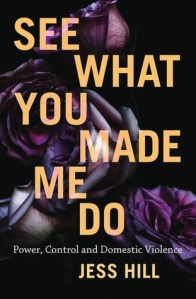
See What You Made Me Do – Jess Hill

We talk a lot about the danger of dark alleys, but the truth is that in every country around the world the home is the most dangerous place for a woman.

If you only ever read one book about domestic abuse, please make it this one. While I’d like everyone to read it, I think it should be mandatory for so many professions, including anyone involved in the judicial system, medicine, politics, teaching and counselling.

Domestic abuse is not just violence. It’s worse. It is a unique phenomenon, in which the perpetrator takes advantage of their partner’s love and trust and uses that person’s most intimate details – their deepest desires, shames and secrets – as a blueprint for their abuse.

I thought I knew a lot about domestic abuse already. I’ve experienced it firsthand. I’ve read plenty of fiction and non-fiction books that talk about it. I have a psychology degree. I worked in a women’s refuge for a short time. Yet I learned so much from this book.

What should surprise us about domestic abuse is not that a woman can take a long time to leave, but that she has the mental fortitude to survive.

When the author introduced Biderman’s ‘Chart of Coercion’, saying there are parallels between the experiences of returned prisoners of war and domestic abuse survivors, I admit I was a tad wary. Even as someone well versed in the experience of domestic abuse, I wasn’t sure how the two would or could line up. The way the author outlined the techniques, step by step, sucked me in though. It all made perfect sense and it was horrifying, but I was learning something new and I needed to find out more.

Accompanying extensive research are stories of people who have perpetrated and been victimised by domestic abuse. Prepare to brace yourself as you read these accounts as they are invariably brutal and heartbreaking, but please don’t bypass them, even though that would be easier. (Or else you risk missing out on aha! moments, like when emotional abuse is explained as someone bashing someone with their emotions instead of their fists.)

If you’ve experienced domestic abuse yourself, you will easily recognise the truth of these accounts. If you are fortunate enough to have made it this far without being impacted by this type of trauma, know that these stories are representative of so many people’s lives. Friends, family, neighbours …

I can’t imagine reading these accounts without having a visceral reaction and if you’re struggling to ‘witness’ them on the page, please be sure to practice self care. I don’t know if what helped me will apply to other readers but each time I came across something that was too difficult, I told myself that my discomfort wasn’t even in the same ball park as the horror of actually experiencing that firsthand.

The people who have told their stories have courage beyond my comprehension and I feel we owe it to them to not shy away from their words. It’s too easy to maintain the status quo; maybe what we all need is a wake up call to spur us into action.

There’s so much we still need to do. A recent Australian survey, conducted by White Ribbon, found that

Four in ten young men do not consider punching and hitting to constitute domestic violence

Source: The Sydney Morning Herald 25/10/2020

In NSW, Australia, coercive control is not even a criminal offence. Yet. Hopefully this will change, if proposed coercive control laws aren’t squished by the powers that be. You can find Women’s Safety NSW’s proposal here.

I want people to stop asking ‘Why does she stay?’ and start asking ‘Why does he do that?’

SURVIVOR, QUEENSLAND

P.S. There’s going to be a three part TV series in 2021 hosted by Jess Hill.

Rating: 5 out of 5.

Once Upon a Blurb

At the office of Safe Steps, Victoria’s dedicated 24/7 family violence response call centre, phone counsellors receive a call every three minutes. Many women are repeat callers: on average, they will go back to an abusive partner eight times before leaving for good.

‘You must get so frustrated when you think a woman’s ready to leave and then she decides to go back,’ I say.

‘No,’ replies one phone counsellor, pointedly. ‘I’m frustrated that even though he promised to stop, he chose to abuse her again.’

Women are abused or killed by their partners at astonishing rates: in Australia, almost 17 per cent of women over the age of fifteen – one in six – have been abused by an intimate partner.

In this confronting and deeply researched account, journalist Jess Hill uncovers the ways in which abusers exert control in the darkest – and most intimate – ways imaginable. She asks: What do we know about perpetrators? Why is it so hard to leave? What does successful intervention look like?

What emerges is not only a searing investigation of the violence so many women experience, but a dissection of how that violence can be enabled and reinforced by the judicial system we trust to protect us.

Combining exhaustive research with riveting storytelling, See What You Made Me Do dismantles the flawed logic of victim-blaming and challenges everything you thought you knew about domestic and family violence.