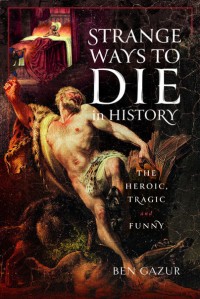
Strange Ways to Die in History – Ben Gazur

I’m always keen to learn about all things strange and unusual so the opportunity to discover some of the more bizarre ways that humans have met their end was too tempting to pass up. Here, you’ll learn about the often untimely deaths of people from the ancient world, the Middle Ages and the modern world.

It is estimated that since the human species first came into existence, slightly over 100 billion people have died. It would be surprising if at least some of the them did not do so in extraordinary, noteworthy, or downright comic ways.

This book’s dearly departed don’t always expire in ways that would result in a Darwin Award but they do run the gamut of deathly debacles, from war and disease to human stupidity.

In the ancient world, we have people being cooked by Brazen Bull, turned into a pillar of salt and torn apart by dogs. There’s death by elephant, roof tile and being fed to eels.

Sisamnes learned the hard way not to take a bribe. His throat was cut and he was flayed. As if that wasn’t bad enough, his skin was then made into a chair for the next governor to sit in. Who was the next governor? Sisamnes’ son.

In the Middle Ages, you could meet your maker by bucket, being quartered or by toilet, as was the case for sixty people who drowned during the Erfurt Latrine Disaster.

Then there was Charles II of Navarre who, covered in sores and boils, was “sewn into strips of linen at night that had been soaked in brandy.” The maid responsible for sewing Charles into his sack forgot her scissors one night so decided to burn a loose thread. This went as well as expected, with the king dying almost a month later as a result of his burns.

The modern world gives us technological advances but it also gives you death by scarf, turnip and clown.

Besides the potential to make you squeamish, György Dózsa teaches us that declaring yourself king can result in a truly memorable death. In all seriousness, if you’re squeamish, don’t Google him.

Now, to lighten the mood, there have been those who died from laughter. A mayor tripped over his beard and one king may have died by pudding. Others have been bested by lions and tigers and bears, oh my! Or by someone wearing a bear costume.

This was an entertaining read. The entries are succinct, providing a summary of the best/worst bits of the lives of some poor unfortunate souls. At times the writing could be a bit crude, especially when it wandered into toilet humour territory, but if you’re a reader who’s easily offended, it’s unlikely you’ll be picking this book up in the first place.

It ends with some famous last words. My favourite of the bunch came from a man whose death came by guillotine during the French Revolution.

When Thomas de Mahy was sentenced to death, he gave the order for his execution a read and handed it back, saying: ‘I see that you have made three spelling mistakes.’

Thank you so much to NetGalley and Pen & Sword History, an imprint of Pen & Sword Books, for granting my wish to read this book. 

Rating: 4 out of 5.

Once Upon a Blurb

Death comes for us all in the end. But it does not always come in a way you might expect. Throughout history there have been people who have suffered extraordinary, unusual, and downright weird demises. In Strange Ways to Die in History you will find out about the true stories behind unlikely stories of bizarre accidents, assassinations, and misadventures. Did a playwright really die from a tortoise being dropped on his head by an eagle? Why did an English vicar end up being eaten by lions? And what are the chances of fatality from falling into a toilet?

Looking at the lives that came before the deaths reveals some of histories most fascinating individuals. Some of those examined are well known. Some are remembered only for the odd way they departed this life. Some have been forgotten entirely. Sometimes how a person dies, and how history has recorded the event, can tell us a lot about society and how we remember.

This book uncovers eyewitnesses to the deaths described and contemporary reports from those who were left behind.

A Dark History of Sugar – Neil Buttery

There’s nothing sweet about the history of sugar. Having already read A Dark History of Chocolate, I had some idea of what to expect. 

Even so, it was horrifying reading chapter after chapter about slavery. Centuries worth of humans enslaving other humans to produce something that was once reserved for royalty but we all now have a taste for. Not content with the human cost of producing sugar, we’ve also done irreparable damage to the environment. 

Interestingly, it turns out a spoonful of sugar really does help the medicine go down.

description

Besides coating medicines in sugar to make them more palatable, it has also been used to ‘treat’ a number of conditions. One of my personal favourites was a remedy to treat conjunctivitis, “made up of powdered sugar, pearls and gold leaf that was blown directly into the eye.” It’s also been prescribed “to treat diseases of the loins, urinary tract, eyes and chest as well as headaches and inflammation.”

I learned how food manufacturers massage portion sizes so it appears their products contain less sugar than they really do and how they try to hide sugar in plain sight by calling it any number of things on the packaging. 

By 2018 there were at least fifty-six names in use for sugar in ingredients lists. 

This book, exploring both the production and consumption of sugar, was very well researched. It provides a detailed history but, for the most part, it’s just so depressing. 

The World Wildlife Fund reckons that sugar is ‘responsible for more biodiversity loss than any other crop.’ 

This is not an easy read but it is an eye opening one.

Thank you so much to NetGalley and Pen & Sword History, an imprint of Pen & Sword Books, for granting my wish to read this book. 

Rating: 3.5 out of 5.

Once Upon a Blurb

A Dark History of Sugar delves into our evolutionary history to explain why sugar is so loved, yet is the root cause of so many bad things.

Europe’s colonial past and Britain’s Empire were founded and fuelled on sugar, as was the United States, the greatest superpower on the planet – and they all relied upon slave labour to catalyse it.

A Dark History of Sugar focuses upon the role of the slave trade in sugar production and looks beyond it to how the exploitation of the workers didn’t end with emancipation. It reveals the sickly truth behind the detrimental impact of sugar’s meteoric popularity on the environment and our health. Advertising companies peddle their sugar-laden wares to children with fun cartoon characters, but the reality is not so sweet.

A Dark History of Sugar delves into our long relationship with this sweetest and most ancient of commodities. The book examines the impact of the sugar trade on the economies of Britain and the rest of the world, as well as its influence on health and cultural and social trends over the centuries.

Renowned food historian Neil Buttery takes a look at some of the lesser-known elements of the history of sugar, delving into the murky and mysterious aspects of its phenomenal rise from the first cultivation of the sugar cane plant in Papua New Guinean in 8,000 BCE to becoming an integral part of the cultural fabric of life in Britain and the rest of the West – at whatever cost. The dark history of sugar is one of exploitation: of slaves and workers, of the environment and of the consumer. Wars have been fought over it and it is responsible for what is potentially to be the planet’s greatest health crisis.

And yet we cannot get enough of it, for sugar and sweetness has cast its spell over us all; it is comfort and we reminisce fondly about the sweets, cakes, puddings and fizzy drinks of our childhoods with dewy-eyed nostalgia. To be sweet means to be good, to be innocent; in this book Neil Buttery argues that sugar is nothing of the sort. Indeed, it is guilty of some of the worst crimes against humanity and the planet.

A Dark History of Chocolate – Emma Kay

You know chocolate accompanied me on my journey through this book, don’t you? You might think that makes this book an outlier. You’d be so wrong. Professional chocoholic here! So much so that if you’re missing some chocolate, it’s fair to assume I‘m responsible.

What this book did give me was a new excuse for my binge reading, chocolate binge combo: immersive reading. You can’t read a book about chocolate without eating some. That would be like watching Willy Wonka & the Chocolate Factory while eating cabbage soup.

I enjoyed learning about chocolate’s dark history, with the obvious exception of the information concerning slavery. In this book, you’ll learn about chocolate’s role in history, from crime to the arts.

Pirates raided ships with cacao on board. Jeffrey Dahmer worked in a chocolate factory. Chocolate is a final meal choice for many death row inmates.

Poisoned chocolate remains one of the most common methods of murder throughout history.

Chocolate was on the menu both the day the Hindenburg crashed and the Titanic sunk.

Chocolate is practically everywhere, it seems. It’s even accompanied astronauts into space.

There was the seemingly ingenious marketing idea of having chocolate rain down from planes, which may have worked better if the ‘bombs’ didn’t result in people below being badly bruised.

Chocolate laced with methamphetamine was marketed to “German homemakers, along with the strap line ‘Hildebrand chocolates are always a delight’. Two to three chocolates a day were recommended to make housework more fun!”

I was sometimes amused and often flabbergasted by the conditions chocolate has been used to ‘treat’ over the years, from headaches, fevers and infections to asthma, heart conditions and burns. It’s also been used as a slimming aid and to “Cleanseth the Teeth”.

Chocolate has even been ‘prescribed’ as a love potion. Handy hint: don’t eat love potion chocolate. You don’t want to know the other ingredients it may contain.

Scattered throughout the book are a bunch of recipes, from Chocolate Creams to the more dubious Chocolate Coated Candied Garlic.

Thank you so much to NetGalley and Pen & Sword History, an imprint of Pen & Sword Books, for granting my wish to read this book.

Rating: 4 out of 5.

Once Upon a Blurb

A Dark History of Chocolate looks at our long relationship with this ancient ‘food of the Gods’. The book examines the impact of the cocoa bean trade on the economies of Britain and the rest of Europe, as well as its influence on health, cultural and social trends over the centuries. Renowned food historian Emma Kay takes a look behind the façade of chocolate – first as a hot drink and then as a sweet – delving into the murky and mysterious aspects of its phenomenal global growth, from a much-prized hot beverage in pre-Colombian Central America to becoming an integral part of the cultural fabric of modern life.

From the seductive corridors of Versailles, serial killers, witchcraft, medicine and war to its manufacturers, the street sellers, criminal gangs, explorers and the arts, chocolate has played a significant role in some of the world’s deadliest and gruesome histories.

If you thought chocolate was all Easter bunnies, romance and gratuity, then you only know half the story. This most ancient of foods has a heritage rooted in exploitation, temptation and mystery.

With the power to be both life-giving and ruinous.