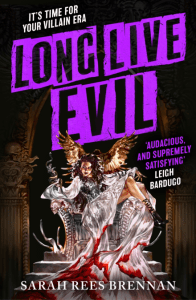
Time of Iron #1: Long Live Evil – Sarah Rees Brennan

When you’re given the opportunity to turn your impending The End into To be continued…, you take it.

Rae, who life cruelly cast in the role of the character most likely to stop breathing by the end of the chapter, is very nearly at the end of her story when she rediscovers something she hasn’t felt for the better part of three years: hope. Rae enters the pages of her favourite series and proceeds to set about rewriting her story.

Being cast as the villain is an upgrade for this once upon a cheerleader. Rae takes her new found energy (and breasts) and runs with it. Of course, things go off script quicker than you can say ‘plot twist’ but being the villain is complicated. There’s the scheming, the management of other’s expectations, the inconvenient feelings…

“Don’t you dream of the forbidden? Choose wrong. Choose evil. Let’s do it together.”

Rae is so relatable and there were other characters I met in the pages, like Key and the Golden Cobra, who I definitely need to spend more time with. It didn’t hurt that this portal fantasy takes place in one of my book nerd dreams, the pages of a beloved book. Oh, the places I would go…

But villains. Because ethics aren’t as high on their agenda, villains tend to be more interesting, complicated characters and I’m an absolute sucker for mwa-ha-ha moments. I’ve got to be honest with you, though. I keep hoping I’ll encounter a villain that gives me Hans Gruber vibes and I don’t think I’ll be completely satisfied until I find one.

This book was a bit of a complicated read for me. I was absolutely hooked by the beginning and the end but the middle contained sections that dragged on for me. For a while it felt like the entire reason for Rae being there was put on hold to focus on the dramas playing out between other characters, but when it got going again it really got going.

It wasn’t until I was about halfway through that I realised this was the first in a series. (Apparently my attention to detail is not what it used to be.) I found this frustrating because by the time the next book is released the urgency to need to know what happens next may have faded. With how this book ends, I hope I don’t have to wait too long.

“Time to take evil to the next level.”

Thank you so much to NetGalley and Orbit, an imprint of Little, Brown Book Group, for the opportunity to read this book.

Rating: 4 out of 5.

Once Upon a Blurb

A tale for anyone who’s ever fallen for the villain…

When her whole life collapsed, Rae still had books. Dying, she seizes a second chance at living: a magical bargain that lets her enter the world of her favourite fantasy series.

She wakes in a castle on the edge of a hellish chasm, in a kingdom on the brink of war. Home to dangerous monsters, scheming courtiers and her favourite fictional character: the Once and Forever Emperor. He’s impossibly alluring, as only fiction can be. And in this fantasy world, she discovers she’s not the heroine, but the villainess in the Emperor’s tale.

So be it. The wicked are better dressed, with better one-liners, even if they’re doomed to bad ends. She assembles the wildly disparate villains of the story under her evil leadership, plotting to change their fate. But as the body count rises and the Emperor’s fury increases, it seems Rae and her allies may not survive to see the final page.
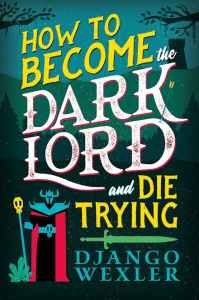
Dark Lord Davi #1: How to Become the Dark Lord and Die Trying – Django Wexler

Davi’s got attitude. But so would you if you’d done this over 230 times before and it ended with you being skewered or dissected or [insert your favourite manner of death here]. Every. Single. Time.

This time Davi’s trying something different. If you can’t beat them, become them?

“Hello, my friends! I am the next Dark Lord! Will you join me?”

I’m a big fan of time loops so I loved watching Davi try and fail over and over until she didn’t.

What I’m not a big fan of are books where the characters walk for a very long time, arrive at a destination, stay there for a bit for some action/drama, then walk some more. This meant there were entire chapters where, no matter who I met or what happened, my brain was on an ‘are we there yet?’ loop. My brain came back online once everyone stopped walking.

When I first read the blurb and decided that this was the book for me, I didn’t realise it was the first in a duology. This means you’re not getting all of the answers at the end of this book, or really any of the big ones. I enjoyed the end enough to want to keep reading, though.

I’m usually all for footnotes in novels and I was here too for a while. I continued to read them but they didn’t scream Bonus Content as much as I’d hoped.

What this book did scream was that the female main character was written by a man. I’m all for characters embracing their sexuality but Davi’s hypersexuality ended up making her feel more like a caricature than someone I could relate to.

Although the world literally revolves around Davi, I didn’t love her. Who I did love was Droff, a stone-eater who enjoys nothing more than counting.

I’m pretty sure I’ll end up being there for the second book. I’m hoping for more answers, less walking and more conversations with Droff.

Thank you so much to NetGalley and Orbit, an imprint of Little, Brown Book Group, for the opportunity to read this book.

Rating: 3.5 out of 5.

Once Upon a Blurb

Davi has done this all before. She’s tried to be the hero and take down the all-powerful Dark Lord. A hundred times she’s rallied humanity and made the final charge. But the time loop always gets her in the end. Sometimes she’s killed quickly. Sometimes it takes a while. But she’s been defeated every time.

This time? She’s done being the hero and done being stuck in this endless time loop. If the Dark Lord always wins, then maybe that’s who she needs to be. It’s Davi’s turn to play on the winning side. 

Lost & Found – Helen Chandler-Wilde

Welcome to my stop on the Lost & Found blog tour. 

My relationship with my stuff over the years has been complicated, contradictory and, at times, confounding.

I rebelled against my family’s bah humbug spirit by decorating my entire bedroom each Christmas as a teenager. I went through a stage in my 20’s where I attempted to recapture my childhood Disneyana style.

When I’m fidgety, I love nothing more than sorting through and throwing out stuff I don’t need anymore. I don’t plan on stopping adding to my book collection until I’m crushed under its weight. My stuff was in a storage unit for over six months during lockdown and I was surprised by how few items I use on a daily basis.

It’s pretty safe to say this book and I were destined to find one another.

This was a fascinating read, combining memoir and investigation. The author lost almost all of her belongings in a storage unit fire in her 20’s. Just thinking about that makes me want to hug my Nan’s paintings.

This experience has given the author a unique perspective regarding what our stuff means to us and how it changes over time.

Possessions can fix a memory, for good or bad. They make one version of the past permanent, giving it an outsized importance that it hasn’t earned, while other memories fall away.

Each chapter tackles our “thoughts and behaviours around our possessions”, beginning with an item lost in the fire that’s relevant to the lesson. The author explores her own relationship to her possessions as well as sharing what insights fields such as neuroscience, psychology and philosophy have to offer.

Looking at the role social status and nostalgia play in how and why we accumulate stuff, as well as delving into scarcity and hoarding, I don’t think you could read this book without examining your own experiences and maybe taking some action. I was compelled to stop reading mid chapter to tackle some items I’d been meaning to sort through for months and I felt so much better afterwards.

Handy hint: If you want to buy something, holding off for just 72 hours can be enough for you to determine if it’s something you really want or an impulse spend.

We can choose things that please us or help us to feel that yesterday wasn’t so long ago. If chosen smartly, they can please us for a while, but they will never be the centre of our lives.

Thank you so much to Random Things Tours and Aster, an imprint of Octopus Publishing Group, for the opportunity to read this book.

Rating: 5 out of 5.

Once Upon a Blurb

An exploration into why we keep holding on to material things and what they mean to us

On New Year’s Eve of 2018, journalist Helen Chandler-Wilde lost everything she owned in a storage unit fire in Croydon, where she’d stowed all her possessions after a big break-up. She was left devastated, and forced to re-evaluate her relationship with owning material things. 

A mix of memoir, self-help and journalism, Lost & Found explores the psychological reasons for why we buy and keep the things we do, and explains how we can liberate ourselves from the tyranny of ‘too much’. Helen interviews people from all walks of life, including behavioural psychologists on the science of nostalgia, a nun on what it’s like to own almost nothing and consumer psychologists on why we spend impulsively, to help us better understand why we’re surrounded by clutter and what we can do to change it.

This smart-thinking book explains the sociological quirks of human nature and the fascinating science behind why we buy and hold onto things. By the end of it, your relationship with your belongings will be changed forever.

Lost & Found Blog Tour

Robert Grim #2: Oracle – Thomas Olde Heuvelt

Translator – Moshe Gilula

How could a sound that had ceased forty years ago suddenly echo again on a cold winter morning … and feel so wrong?

Luca and Emma weren’t expecting to find a ship in a tulip field on their way to school. It wasn’t there yesterday and it seems pretty impossible that it’s there now.

This sounds like a job for Robert Grim.

I can’t say that Robert Grim was exactly enjoying his retirement or even remembering much of it. He doesn’t live in Black Spring anymore, though, so that’s progress.

He’s not exactly advertising his services but even he can’t deny he has a unique skill set. His involvement in this investigation isn’t what you’d call voluntary. That’s not how these things work.

This is one of those rare series where I enjoyed the sequel more than the first book. I was all about the mystery of the ship but it turns out that’s only the beginning of this story.

While this book was still dark, there was some hope to be found. I had Luca, a gutsy kid, to cheer on and I needed that.

I struggled with the fictional animals meeting their maker in HEX. There was some of that here too but none that I’d built a relationship with first so that made it easier.

If you absolutely had to, you could read this book without having read HEX but you would be missing out. It provides much needed context for the character of Robert Grim. This book also includes spoilers for the first so you won’t want to read them out of order.

Supernatural phenomena followed their own set of rules … until they didn’t.

I spent the whole book trying to figure out how Robert Grim survived the Black Rock Witch and I was given an explanation but I need to know more. Thankfully this book ends with an opening for another so I may get to explore this further.

Oftentimes when I’m reading a book, I think about what I would do if I was plonked into the storyline. If I had made my way to Every Man’s End, I would unquestionably not be here to tell you about it. I would have investigated the ship that shouldn’t have been, the bell would have tolled and, well, if you read the book you’ll know what would’ve happened next.

‘And what did you think?’

‘That they should have listened to the kid, dammit.’

Thank you so much to NetGalley and Hodder & Stoughton for the opportunity to read this book.

Rating: 4 out of 5.

Once Upon a Blurb

On a foggy winter morning two children discover the impossible: the wreck of an eighteenth-century ship stranded in a field.

One enters the hatch on the deck and is never seen again. And she isn’t the last to disappear…

Soon a government agency begins to investigate, determined to uncover the ship’s secrets before a media storm erupts. They enlist Robert Grim, a retired specialist of the occult, to unravel the mystery, who soon realises the ship could be a harbinger of an ancient doom awakened under the sea. 

In a maelstrom of international intrigue and pure terror, Grim must race against time as he comes face to face with an open doorway to the apocalypse.

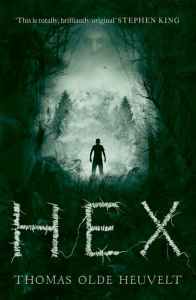
Robert Grim #1: HEX – Thomas Olde Heuvelt

Translator – Nancy Forest-Flier

“Nothing’s normal here.”

Katherine van Wyler was sentenced to death for witchcraft in 1664 but that’s not where her story ends. Hundreds of years later, the Black Rock Witch remains, her eyes and mouth sewn shut.

Once you move to Black Spring, you will never live anywhere else. The residents of this insular community are used to living alongside this emaciated, chained woman but they’ve been lulled into a false sense of security. If Katherine’s eyes ever open, her power will be unleashed.

This book has been on my radar for years and waited patiently on my Kindle for two. The upcoming release of the sequel gave me the perfect excuse to dive in and then I almost didn’t finish it. To be honest, if I hadn’t already committed to reviewing the sequel, I probably wouldn’t have.

“She’s not going to let you go. You live in Black Spring now. That means the curse is on you as well.”

It’s rare for a book to have a negative impact on me. Reading is my joy. Even when I read memoirs of people who have experienced the horrific, I find hope in their resilience.

This book, though, had a significant impact on my mental health. You could say it did its job, with the witch reaching out from the pages to infect me with her curse. It got to the point where, each time I started reading, I’d think ‘Abandon all hope, ye who enter here.’

But nothing was all right, nothing could ever be all right

I don’t think of myself as a reader with many rules. I’m happy to wander between genres and dip my toe into unfamiliar territory. Do what you want to the humans, especially if we’re in a slasher, and I’ll likely forgive you. I may even cheer you on. If you harm my fictional animals, though, we’re going to have a problem. I had a big problem with what the animals, one in particular, experienced in this book.

I don’t want you to think this wasn’t a good book. It was. It was well written. I got attached to a couple of the characters. I needed to know what hell was going to be unleashed once Katherine’s eyes opened. But wow, it really did a number on me.

“Peacocks. You know what that means, right?”

Rating: 3.5 out of 5.

Once Upon a Blurb

Whoever is born here, is doomed to stay until death. Whoever comes to stay, never leaves.

Welcome to Black Spring, the seemingly picturesque Hudson Valley town haunted by the Black Rock Witch, a seventeenth-century woman whose eyes and mouth are sewn shut. Blind and silenced, she walks the streets and enters homes at will. She stands next to children’s beds for nights on end. So accustomed to her have the townsfolk become that they often forget she’s there. Or what a threat she poses. Because if the stitches are ever cut open, the story goes, the whole town will die.

The curse must not be allowed to spread. The elders of Black Spring have used high-tech surveillance to quarantine the town. Frustrated with being kept in lockdown, the town’s teenagers decide to break the strict regulations and go viral with the haunting. But, in so doing, they send the town spiralling into a dark nightmare.

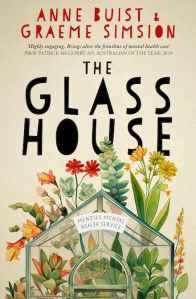
The Glass House – Anne Buist & Graeme Simsion

We meet Hannah a few weeks after she begins working as a registrar in the Mental Health Services’ Acute Unit at Menzies Hospital.

Acute psychiatry is the emergency medicine of mental health: for the stuff nobody saw coming. Until someone close to them becomes paranoid or overdoses or begins cutting themselves.

We follow Hannah as she finds her feet in this role while working towards her goal of being accepted into the psychiatry training program. Along the way, we’re introduced to Hannah’s colleagues and patients. It’s confronting meeting people experiencing some of the worst moments of their lives and throughout this book you’ll witness what mental health emergencies can look like.

I got off on the wrong foot with Hannah. Her appearing to casually ‘diagnose’ a colleague she barely knows and her blind spot about how beneficial therapy could be for her irked me.

As for getting therapy myself, it’s not at the top of my to do list right now.

Her ability to put off getting therapy surprised me too. The people I know who work as psychologists and social workers all have regular supervision appointments. I expected to be attending the psychiatry equivalent with Hannah, even if she didn’t go to therapy herself, but if this was part of her life she didn’t invite me along.

Hannah slowly grew on me as I made my way through the book but my own bias prevented me from warming to her much. I’ve noticed in my own life that people in helping professions who are hesitant to work on themselves are less likely to be able to sit alongside me as I work on myself. Hannah’s reluctance to do so, while I knew there’d be a reason behind this, meant that I never really trusted her.

It didn’t help that sometimes her judgements about patients and lack of sensitivity infuriated me.

‘How can she bear to be so pathetic?’

This is challenged by a coworker. Thank you, Jon.

Connecting with a main character isn’t essential, though. I’ve liked plenty of books where I didn’t and liking Hannah isn’t necessary to enjoy this book. There are so many other people to meet, both patients and staff.

There were some, like Nash and his clear disregard for the value of social work, that I wanted to steer clear of. Then there were others I wanted to spend all of the book with.

Carey’s insight made me want to get to know them better and I loved Elena’s ability to think and work outside the box. I wanted to go back in time and advocate for Chloe and Brianna.

This book provides a rare glimpse at what working in this field is like, from an insider’s perspective. You feel the pressure of making the right call because the wrong one could result in someone’s death. You witness the struggle to free up beds to work within the parameters of a healthcare system that’s flawed at best. You see the power struggles amongst the staff and are wearied by the politics.

I found it interesting that by beginning the chapters with just a snippet of conversation or a scenario about someone we don’t know yet, it invites you to make a judgement call on what diagnosis the patient will be given, and indeed who the patient will be. It’s easy to start seeing people as diagnoses, not people, like when Nash talks about patients as PD’s (meaning personality disorders), stripping them of their humanity.

I don’t have a problem per se with diagnoses or with appropriate mental health treatment. My bugbear is when peoples’ normal and expected responses to trauma are given a diagnosis that’s then used to discredit their character and reliability. This didn’t play out as much as I expected here but I still cringed whenever a personality disorder was diagnosed.

I kept thinking that this is what a mental health spinoff of 24 Hours in A&E might look like. This book provided mini case studies that ran the gamut of mental health emergencies.

I can see this working well as the first in a series. I’d be interested in watching Hannah grow in both her personal and professional life over time.

Thank you so much to NetGalley and Hachette Australia for the opportunity to read this book.

Rating: 4 out of 5.

Once Upon a Blurb

Psychiatry registrar Doctor Hannah Wright, a country girl with a chaotic history, thought she had seen it all in the emergency room. But that was nothing compared to the psychiatric ward at Menzies Hospital.

Hannah must learn on the job in a strained medical system, as she and her fellow trainees deal with the common and the bizarre, the hilarious and the tragic, the treatable and the confronting. Every day brings new patients: Chloe, who has a life-threatening eating disorder; Sian, suffering postpartum psychosis and fighting to keep her baby; and Xavier, the MP whose suicide attempt has an explosive story behind it. All the while, Hannah is trying to figure out herself.

With intelligence, frankness and humour, eminent psychiatrist Anne Buist tells it like it is, while co-writer Graeme Simsion brings the light touch that made The Rosie Project an international bestseller and a respected contribution to the autism conversation.

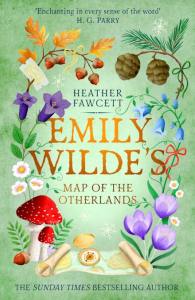
Emily Wilde #2: Emily Wilde’s Map of the Otherlands – Heather Fawcett

“We are about to involve ourselves in a great deal of danger, much of it strange and unsettling.”

It’s time for Emily and Wendell to search for Wendell’s door and I, for one, am thrilled to have been invited to tag along for this quest. My enthusiasm may not be as contagious as that of Ariadne, Emily’s niece, but I have more field experience than her, having already accompanied Emily and Wendell to Ljosland, so my excitement is tempered by a tad of caution.

I also have some insider knowledge; Wendell’s stepmother is sending assassins to dispatch of him but my clothing is inside out so I’m confident I will be successful in evading any of the Folk’s attempts to enchant me.

“Oh, what a quest this is!”

The grumpy romance of the first book blindsided me in the best way possible. I wasn’t expecting it, thank goodness, or I probably wouldn’t have picked up the book in the first place. I actively avoid books that contain romance, which brings me to the second part of the blindsiding. I learned that I love grumpy romances, or at the very least, I love Emily and Wendell’s grumpy romance.

Their romance wasn’t quite as grumpy in this book, although they did have their moments. Their relationship has grown more comfortable since we first met them. That doesn’t mean we’re grumpless, though. Rose, who I absolutely adored, despite trying my hardest not to care a jot about him, does his very best to bring the grumpy with him wherever he goes.

I’m usually quite wary of sequels of my favourite books. They come with an almost impossibly high expectation of brilliance, having to compete with the joy of discovery you felt with the first book. This sequel didn’t disappoint.

In fact, I’m having trouble figuring out which book I loved more. There was the comfort in already knowing the main characters alongside the introduction of new characters, who managed to hold their own.

I love Emily. She’s lousy at small talk but is getting better at insults, her aim needs improvement and her journals contain footnotes. I adore the footnotes and need more of them!

Meanwhile, Wendell is a man after my own heart.

“There is nothing trivial about good coffee.”

If anything ever happens to Shadow, I will be bereft. I’d also like to put it out there that Poe can bake for me anytime.

I’d appreciate someone sharing Knight College’s postal address with me so I can submit my application to study dryadology.

If you have not already met Emily and Wendell, please make their acquaintance in preparation for this quest as there is prerequisite knowledge that will make this one more fulfilling.

Ensure you pack some carrots and maybe don’t look too closely at the faerie art. Be sure to bring enough pencils.

“Give me another pencil.”

“I only had the one on me!”

“One? Who are you?”

Handy hint: Do not allow Professor Eustacia Walters access to any of your books. If you ask me, she’s the true villain of this book.

If it is at all convenient, I would very much like to read the third book immediately.

Thank you so much to NetGalley and Orbit, an imprint of Little, Brown Book, for the opportunity to be delighted by this book.

Rating: 5 out of 5.

Once Upon a Blurb

Emily Wilde is a genius scholar of faerie folklore, and has catalogued many secrets of the Hidden Folk in her encyclopaedia with her infuriatingly charming fellow scholar, Wendell Bambleby, by her side.

But Bambleby is more than just a brilliant and unbearably handsome scholar. He’s an exiled faerie king on the run from his murderous mother, in search of a door back to his realm. 

By lucky happenstance, Emily’s new project, a map of the realms of faerie, will take them on an adventure to the picturesque Austrian Alps, where Emily believes they may find the door to Bambleby’s realm, and the key to freeing him from his family’s dark plans. 

But with new friendships for the prickly Emily to navigate and dangerous Folk lurking in every forest and hollow, Emily must unravel the mysterious workings of faerie doors, and of her own heart.

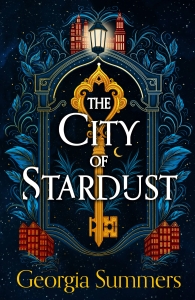
The City of Stardust – Georgia Summers

A curse can be many things.

I loved the concept of this book. It’s a fairytale come to life. It’s curses and magic. It’s impossible doorways to other worlds. It’s a bookish girl on a quest.

It appears The City of Stardust has already divided the book world in two. There are those who have fallen in love with it and those whose expectations didn’t match reality. Unfortunately, I’m one of the latter.

This book had so much potential but, although the individual elements were right up my alley, it didn’t come together like I’d hoped it would. In saying that, though, I want to acknowledge that I have been in a reading slump recently so this may well have distorted my view.

I usually love the bookish girl, if only because she’s bookish, but I never really felt like I got to know Violet.

The romance didn’t work for me and neither did the friendship, for that matter. Sure, they both have pain. Violet’s been abandoned and Aleksander’s been abused. However, he betrays her time and time again, and every time she forgives him. I’m not someone whose first instinct is violence but Violet’s naivety and gullibility frequently combined to make me wish I could hit her across the head with one of her books. Preferably a hardcover.

I have so many unanswered questions: about scholars, reveurite, Marianne Everly, the way this world works.

I most wanted to know more about Penelope, who has the ability to hold a grudge for all eternity. She has her reasons and I understood those but I craved more depth from her.

I’d be interested in reading more books by this author and I’m considering a reread once my reading no longer slumps to see if this changes my experience of the Everly curse but, for now at least, I’m chalking this one up to not for me at this time.

‘Hello, little dreamer’

Thank you so much to NetGalley and Hodderscape, an imprint of Hodder & Stoughton, for the opportunity to read this book.

Rating: 3 out of 5.

Once Upon a Blurb

For centuries, Everlys have seen their brightest and best disappear, taken as punishment for a crime no one remembers, for a purpose no one understands. Their tormentor is a woman named Penelope, who never ages, never grows sick – and never forgives a debt.

Ten years ago, Violet Everly’s mother left to break the curse, and never returned. Now Violet must find her mother, or she will be taken in her place.

Her hunt leads her into a seductive magical underworld of power-hungry scholars, fickle gods, and monsters bent on revenge. And into the path of Penelope’s quiet assistant, Aleksander, who she knows cannot be trusted – and yet to whom she finds herself undeniably drawn.

Tied to a very literal deadline, Violet will travel to the edges of the world to find her mother and the key to the city of stardust, where the Everly story began…

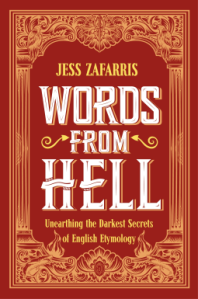
Words From Hell – Jess Zafarris

This isn’t your usual etymology book. Here you’ll find the histories of words relating to swearing, body parts and functions, sexuality, insults, slurs, racism, ableism, pirate talk, war and all things supernatural.

I found a few new favourites along the way, most notably brainsquirt, a word used about 350 years ago meaning “a feeble or abortive attempt at reasoning.” There’s also ignivomous, “spitting or vomiting fire”.

Then there were surprises, like discovering that in the 14th century, bowel meant tenderness or compassion.

The word “shark” (or “sharker”) first appeared in English in the 1400’s, and at that time it meant “scoundrel”, “villain” or “swindler”. It wasn’t a word for the animal in English until the 1700’s.

My favourite part of this book was the folktale about the jack-o’-lantern, where Jack successfully tricks Satan more than once, but at a price.

In hindsight, it probably would have been better if I’d dipped in and out of this book over a few weeks, reading about a handful of words each time. Reading from cover to cover, I ended up a bit bogged down.

Thank you so much to NetGalley and Chambers, an imprint of John Murray Press, for the opportunity to read this book.

Rating: 3.5 out of 5.

Once Upon a Blurb

The English language is where words go to be tortured and mutilated into unrecognisable shadows of their former selves. It’s where Latin, Greek, and Germanic roots are shredded apart and stitched unceremoniously back together with misunderstood snippets of languages snatched from the wreckage of conquest and colonialism. It wreaks merciless havoc upon grammar and spelling. It turns clinical terms into insults and children’s tales into filthy euphemisms.

With an emphasis on understanding where the foulest words in the English language came from – and the disgusting and hilarious histories behind them – this book demonstrates the true filth of our everyday words. But this book is more than just a list of vulgar words and salacious slang. It’s a thoughtful analysis of why we deem words as being inappropriate as well as revealing ‘good words’ that have surprisingly naughty origins.

Dirty-minded word nerds and lewd linguistics lovers will derive unadulterated pleasure in leering at the origins of swear words, sexual lingo, inappropriate idioms, violent vocabulary, and terminology for bodily functions – not to mention the unexpectedly foul origins of words you thought were perfectly innocent. If it’s inappropriate, stomach-churning, uncomfortable, or offensive, this book reaches into the dark recesses of history and exposes them for all to see.

Emily Wilde #1: Emily Wilde’s Encyclopaedia of Faeries – Heather Fawcett

“One doesn’t need magic if one knows enough stories”

This book made a liar out of me. I’ve been proudly declaring my romantiphobia for years. I’ve gleefully avoided books that even hint at a romance in the blurb. When I find undisclosed mushy bits, I feel cheated.

And all of this time it turns out that I absolutely adore grumpy romances. Or maybe it’s just Emily Wilde and Wendell Bambleby’s snarky banter that I’ve waiting for my entire life.

Eight years ago, Emily, then 22, was Cambridge’s youngest adjunct professor. She’s still hoping to receive tenure. Bambleby is her friend, her only friend. You can’t exactly accuse them of being warm and fuzzy.

The problem with Bambleby, I’ve always found, is that he manages to inspire a strong inclination towards dislike without the satisfaction of empirical evidence to buttress the sentiment.

Bambleby, for his part, gives as good as he gets.

‘We cannot all be made of stone and pencil shavings’

Grumpy banter is my new favourite thing. I love these two!

For the past nine years, Emily, who has a “heart filled with the dust of a thousand library stacks”, has been hard at work, researching and writing her book. She’s only got one chapter to go, which is why she finds herself in the “delightful winter wasteland” that is Hrafnsvik, Ljosland.

Emily is loveable in all of her social awkwardness. Practically as soon as she meets some villagers, she finds a way to accidentally alienate herself.

How was it that in trying to remove my foot from my mouth, I invariably managed to shove it in even deeper?

There are faeries (obviously) and other magical beings, there’s danger and adventure and just so much snark. And there’s Shadow, who I adored.

I wasn’t entirely sure if this would be the book for me when I started reading but it utterly enchanted me. I can’t wait to spend more time with these grumps!

“How does one manage to affix toast to the ceiling?”

Rating: 5 out of 5.

Once Upon a Blurb

Cambridge professor Emily Wilde is good at many things: She is the foremost expert on the study of faeries. She is a genius scholar and a meticulous researcher who is writing the world’s first encyclopaedia of faerie lore. But Emily Wilde is not good at people. She could never make small talk at a party – or even get invited to one. And she prefers the company of her books, her dog, Shadow, and the Fair Folk to other people.

So when she arrives in the hardscrabble village of Hrafnsvik, Emily has no intention of befriending the gruff townsfolk. Nor does she care to spend time with another new arrival: her dashing and insufferably handsome academic rival Wendell Bambleby, who manages to charm the townsfolk, muddle Emily’s research, and utterly confound and frustrate her.

But as Emily gets closer and closer to uncovering the secrets of the Hidden Ones – the most elusive of all faeries – lurking in the shadowy forest outside the town, she also finds herself on the trail of another mystery: Who is Wendell Bambleby, and what does he really want? To find the answer, she’ll have to unlock the greatest mystery of all – her own heart.