
My introduction to bird lore was watching cartoon storks deliver baby after baby but never stopping by my house to deliver the sister I’d been hoping for.
My next bird related memory is slightly less hopeful: the albatross in The Rime of the Ancient Mariner. The albatross is “associated with heavy, inescapable burdens – especially those of a psychological nature.” At the time I couldn’t believe someone could write such a long poem and, if I’m being honest, it freaked me out but it was my beloved Nan who introduced me to this poem so it quickly became a favourite.
It wasn’t until I read this book that I thought about how integral birds are to our folklore, mythology and history. We know the story of the ugly duckling and we want to be as happy as a lark. Birds feature in religious texts and literature. They warn us of danger, inspire us and feature in tales of morality.
There were many connections I’ve never made before. One that stood out to me was Peter denying Jesus in the lead up to His crucifixion and weathercocks.
In the ninth century, Pope Nicholas I decreed that a rooster be placed atop every church in Europe as a reminder of this betrayal. Because weather vanes were already present on many church steeples, roosters were added to the devices, creating the now ubiquitous “weathercock.” The oldest surviving weathercock, the Gallo di Ramperto, was installed around the year 820 atop the bell tower of a church in Brescia, Italy.
My favourite entry was the Māori legend relating to the kiwi, which I had heard before but appreciated more with this reading.
Tāne Mahuta, the father of the forest, discovered that insects were eating his trees and making them ill. He called upon his brother, Tāne Hokahoka, the god of the birds, for help. Together, they asked if a bird would come down from the sky and live on the forest floor to eat the destructive insects. Only the brave kiwi agreed. Although he knew this meant he would never fly again, he chose to protect the forest.
With a focus on America and Europe, most of the birds I’ve come across weren’t included. There were even some birds I’d never heard of before. That didn’t make the book any less entertaining, although I’m keen to learn the stories behind the birds I know.
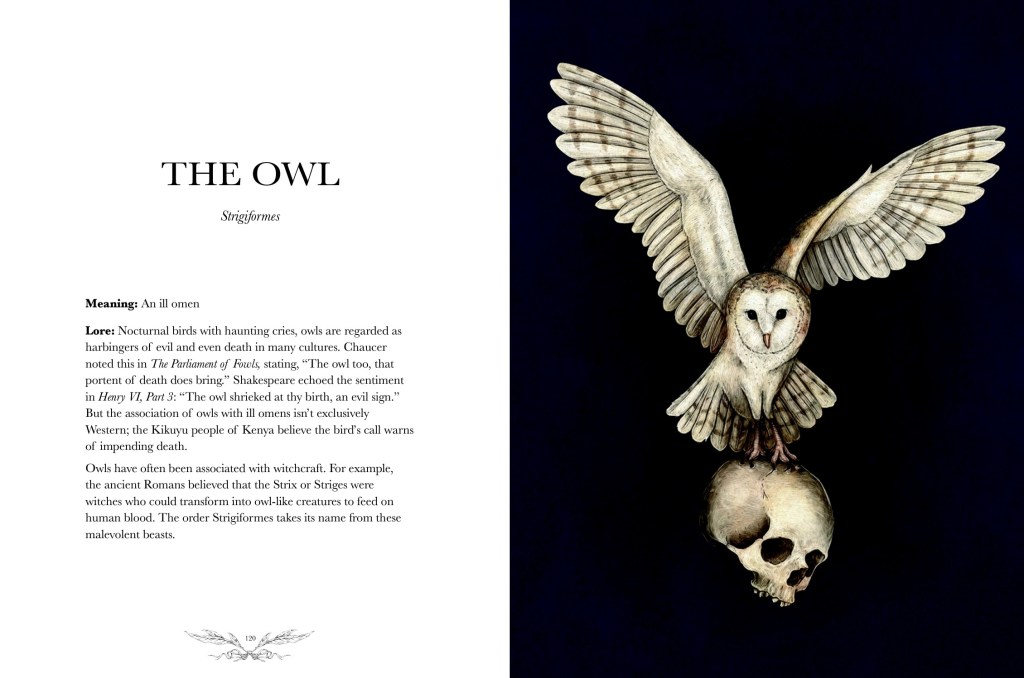
The cover image, which is what initially drew me to the book, is indicative of the illustrations you’ll find accompanying the information about the one hundred birds you’ll meet within its pages. I particularly liked the details that line up with the lore of that bird, for example, the skull pictured with the owl.
Thank you so much to NetGalley and Andrews McMeel Publishing for the opportunity to read this book.
Once Upon a Blurb
From the creator of Floriography and the Woodland Wardens Oracle Deck comes this beautifully illustrated exploration of the folklore, mythology, and history surrounding our favourite winged companions.
Birds have inspired us since the dawn of time: their elegance in flight, captivating colours, and delicate mannerisms spark hope, joy, and delight. Cultures around the world have historically looked to birds as sacred messengers, intermediaries between earth and sky, including them in myths and legends and using them to teach moral lessons and historical truths.
In Jessica Roux’s Ornithography, each of 100 entries focuses on one bird species, featuring a full-page colour illustration in her detailed, darkly romantic style and the lore behind each bird.
The perfect gift for birdwatchers, gardeners, and history buffs, as well as all readers who appreciate nature, mythology, and art, Ornithography is as intriguing and playful as the feathered muses that fill its pages.












 Schizanthus Nerd