Cerulean Chronicles #2: Somewhere Beyond the Sea – TJ Klune

The best book hug I’ve read in a long time has a sequel and it’s a book hug too!

“I have returned to this place in hopes of making it more than it was.”

When Arthur returned to Marsyas Island after 28 years, he brought memories of an abusive childhood and a dream of creating a home where kids like he once was have a safe, nurturing environment to help them grow into who they are.

He and Linus, the love of Arthur’s life who learned to live in colour in the first book, are raising six eggstraordinary kids. Or six of the worst of the worst who are destined to bring about the end of the world… Depending on who you believe.

Picking off after the events of the first book (please read this first), we’re introduced to David, a yeti who embraces being a monster, much to Arthur’s horror. We don’t use the ‘m’ word at Marsyas.

While it would be lovely to simply watch David learn to trust a bunch of strangers, find safety and belonging in his new home, and enjoy the interactions between him and the other kids, the government just can’t leave a found family that is clearly working, quirks and all, alone.

“I’ll never understand humans”

So we have to deal with yet another investigation, with yet another grey government lackey reporting back to the big wigs that be so this home filled with love and acceptance can be shut down for good. While I want nothing more than for this family to finally get a break, I have to admit I loved watching them rise to this challenge.

“Stab her with kindness!”

We rail against hatred and bigotry and divisiveness, and we band together, proud of who we are, refusing to diminish ourselves when people with loud voices and narrow minds demand it. We feel the fear but we don’t let it control us.

Along the way we learn that socks are feet gloves (they won’t be known by any other name from this day forward) and we make sure everyone is aware that we don’t eat Frank the fish.

We spend time with some of the townsfolk we met in the first book. J-Bone is still “saving the universe through music”, Helen has a larger role in this book (woohoo!) and you might like to warn Merle that I’m going to give him the biggest hug the next time I see him.

“You ever get the feeling you became sentient right in the middle of something?”

I had use for some oh, that’s so beautiful tissues in both books. I get all melty whenever I spend time with the Baker-Parnassus family so may need to ask David if I can hang out in his room for a bit to recover.

These books are hugs, absolutely. They’re also underdogs pulling together against all odds, when those in power want nothing more than to crush their spirit and keep them down. They’re learning to believe in yourself and standing up for what’s right. They’re hope and love and one of the best examples I know of the type of family we all deserved to grow up with, whether that was our reality or not.

If anyone needs me, I’m moving to Marsyas.

I am found because I refuse to be in black and white, or any shade of gray.

I am color. I am fire.

I am the sun, and I will burn away the shadows until only light remains.

And then you will have no choice but to see me.

Thank you so much to Pan Macmillan for the opportunity to read this book.

Rating: 5 out of 5.

Once Upon a Blurb

A magical house. A secret past. A summons that could change everything.

Arthur Parnassus has built a good life on the ashes of a bad one. He’s headmaster at an orphanage for magical children, on a peculiar island, assisted by love-of-his-life Linus Baker. And together, they’ll do anything to protect their extraordinary and powerful charges.

However, when Arthur is forced to make a public statement about his dark past, he finds himself fighting for those under his care. It’s also a fight for the better future that all magical people deserve. Then when a new magical child joins their island home, Arthur knows they’ve reached breaking point. The child finds power in calling himself a monster, a name Arthur has tried so hard to banish to protect his children. Challenged from within and without, their volatile family might grow stronger. Or everything Arthur loves could fall apart.

Somewhere Beyond the Sea is a story of resistance, lovingly told, about the daunting experience of fighting for the life you want to live and doing the work to keep it.
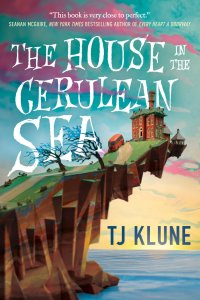
Cerulean Chronicles #1: The House in the Cerulean Sea – TJ Klune

Change often starts with the smallest of whispers. Like-minded people building it up to a roar.

This is the best book hug I’ve had in a long time. There’s power in found family: home can be a place of refuge, with kindred spirits who accept for who you are in your entirety. Even your weirdness. Especially your weirdness. You have room to grow and become more you. You are wanted and loved and chosen. This is what awaits you at Marsyas Island.

Arthur cares for six orphans, categorised by a government department as the worst of the worst. Linus, a representative of said government department, has been sent to the island with the mandate to report on the goings on.

Linus, who has existed in a world of grey, enters a world of colour. The rules and regulations that govern his life aren’t easily applied here.

I love every single inhabitant of the island. I love Helen and J-Bone. I’ve also got a soft spot for grumpy Merle. I want to live on Marsyas Island.

Books like this scare me, but not for any reason you’re probably imagining. I preordered both a signed copy of this book and the Kindle. They’ve both been sitting there unread for four years. Four years! That was before I read the first The Extraordinaries book. What other books have been waiting for me to fall in love with them and what if I never read them? That, my friends, is what terror is made of.

If you need a breath of fresh air and the following quote feels like it was written with you in mind, this is the book for you.

He couldn’t believe it was only Wednesday. And it was made worse when he realised it was actually Tuesday.

If you need some colour in your life, this is the book for you.

If you need a bookish hug is, this is it.

This is what hope looks like.

Don’t you wish you were here?

Rating: 5 out of 5.

Once Upon a Blurb

A magical island. A dangerous task. A burning secret.

Linus Baker leads a quiet, solitary life. At forty, he lives in a tiny house with a devious cat and his old records. As a Case Worker at the Department in Charge Of Magical Youth, he spends his days overseeing the well-being of children in government-sanctioned orphanages.

When Linus is unexpectedly summoned by Extremely Upper Management he’s given a curious and highly classified assignment: travel to Marsyas Island Orphanage, where six dangerous children reside: a gnome, a sprite, a wyvern, an unidentifiable green blob, a were-Pomeranian, and the Antichrist. Linus must set aside his fears and determine whether or not they’re likely to bring about the end of days.

But the children aren’t the only secret the island keeps. Their caretaker is the charming and enigmatic Arthur Parnassus, who will do anything to keep his wards safe. As Arthur and Linus grow closer, long-held secrets are exposed, and Linus must make a choice: destroy a home or watch the world burn. 

An enchanting story, masterfully told, The House in the Cerulean Sea is about the profound experience of discovering an unlikely family in an unexpected place — and realising that family is yours.

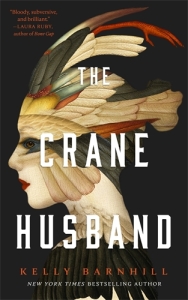
The Crane Husband – Kelly Barnhill

Cover image of The Crane Husband by Kelly Barnhill

I should have been worried about the crane.

Our unnamed protagonist is fifteen when the crane arrives but they were parentified long before. Her mother, so entrenched in trauma generations in the making, doesn’t have the capacity to be there in a meaningful way for her children. It’s up to our fifteen year old to parent her younger brother, Michael, as well as herself.

This novella is a retelling of The Crane Wife and I still don’t know what to do with this story a week after I finished reading it.

It’s haunting and horrifying. It tackles domestic violence, which is ugly, no matter what form it takes.

There was no one to tell. So I told no one.

In the hands of Kelly Barnhill, though, even disturbing stories like this one contain beauty and that, my friend, is what cognitive dissonance is made of.

It’s the daughter doing everything in her power to protect her brother. It’s how she resists the violence that has invaded her home. But it’s also the way the author creates with words, so it feels like they’re dancing around me.

It’s fitting that the teller of this story doesn’t have a name. Women in her family are the subject of gossip and rumours but they don’t have identities outside of their roles: mother, artist, daughter, sister.

Her brother has a name. The sheep have names. The women do not.

I knew when I read When Women Were Dragons that I’d found a new favourite author. This book confirmed it while reminding me that I still need to read everything else Kelly Barnhill has ever written. I need those stories in my heart, even if they hurt.

Rating: 5 out of 5.

Once Upon a Blurb

“Mothers fly away like migrating birds. This is why farmers have daughters.”

A fifteen-year-old teenager is the backbone of her small Midwestern family, budgeting the household finances and raising her younger brother while her mum, a talented artist, weaves beautiful tapestries. For six years, it’s been just the three of them — her mum has brought home guests at times, but none have ever stayed.

Yet when her mum brings home a six-foot tall crane with a menacing air, the girl is powerless to prevent her mum letting the intruder into her heart, and her children’s lives. Utterly enchanted and numb to his sharp edges, her mum abandons the world around her to weave the masterpiece the crane demands.

In this stunning contemporary retelling of “The Crane Wife” by the Newbery Medal-winning author of The Girl Who Drank the Moon, one fiercely pragmatic teen forced to grow up faster than was fair will do whatever it takes to protect her family — and change the story.

Consent Laid Bare – Chanel Contos

We sat through a single, excruciating sex ed lesson in high school. An embarrassed teacher bumbled their way through a bunch of slides on a projector. The boys were all bravado, laughing and making out that they knew everything there was to know already. The girls either laughed along with the boys or shrank in their seats.

I waited all lesson for the teacher to talk about what to do if someone does something you don’t want to. It was never mentioned. I wonder how many lives would look different today if it had been.

From the Teach Us Consent website:

In February 2021, Chanel Contos posted an Instagram story asking followers if they or someone close to them had been sexually assaulted by someone when they were at school. Within 24 hours, over 200 people replied ‘yes’.

Overwhelmed, but unsurprised by the response, Chanel launched a petition calling for more holistic and earlier consent education in Australia, as well as teachusconsent.com, a platform where people could share anonymous testimonies of sexual assault.

The petition, which gathered over 44,000 signatures, and a further 6,600 personal stories of sexual assault were presented to MPs around the country to advocate for this critical education to be included in the national curriculum.

In February 2022, we did it. Ministers of Education from around Australia unanimously committed to mandating holistic and age appropriate consent education in every school, every year, from foundation until Year 10, beginning in 2023.

In this book, you’ll learn about this. You’ll learn about sexual violence, the patriarchy and the ways that the internet has been instrumental (not in a good way) in changing expectations around sexual activity.

From Chanel’s initial Instagram post to comments made in this book, it’s clear the world she grew up in was one of privilege. She mentions in the book that most women over 40 where she grew up had had some sort of cosmetic procedure. On Instagram, she specifically asked about experiences of sexual assault perpetrated by “someone who went to an all boys school”.

This initially made it difficult to feel like this book would be relatable for someone who attended public school. There were some moments where I definitely felt like this wasn’t my world she was talking about but the concepts themselves rang true.

There wasn’t a lot of information that was new to me but if I’d read this book as a teenager it would have been an eye opener.

There’s one particular quote that’s sticking with me, mostly because of how depressing it is.

Only 1.7 per cent of cases in Australia result in a conviction, and it is estimated that only 5 per cent of people report their rape to the police. Not all cases make it to court. On top of this, it is impossible to know the exact number of people who have been subjected to sexual violence, especially when so many are not equipped with the language to be able to identify what happened to them, and when these acts have been normalised and being subjected to them is too often understood as an unavoidable part of womanhood. All of this together means that we have essentially decriminalised rape in Australia. This is rape culture.

I was an avid reader growing up and had a pretty decent vocabulary as a result. I knew the word ‘consent’. I never heard it used in the context of sexual activity, though, until I’d been an adult as long as I’d been a child. Sure, I knew about sexual assault but, let me tell you, that Tea and Consent video was an eye opener.

It’s only really been in the last couple of years, when I’ve learned more about consent, that I feel I’ve finally got more of a hold on what it is, and what it isn’t.

While there is a lot of good information in this book, there wasn’t a handy one or two page summary of what consent is and isn’t. In case I’m not the only one who would have found that useful, here’s an excerpt from 1800RESPECT’s website about consent.

What does it mean to consent?

If you consent to sex it means you want to have sex at that time with that person.

If you do not give your consent to have sex with that person at that time, but sex or sexual things happen, it is sexual violence.

If you are forced to have sex, you have not given your consent.

Consent means more than just saying yes or not being forced. Consent must be informed.

‘Informed consent’ means there is nothing stopping you from giving consent or understanding what you are consenting to.

Informed consent cannot be given if:

  • you are passed out or unconscious due to drugs, alcohol or a violent assault
  • you are asleep
  • you are conscious, but the effects of alcohol or drugs mean you are unable to say what you do or don’t want
  • the other person tricks you into thinking they are someone else
  • the other person makes you feel too scared to say no. This might be due to a fear that they will:
    • hurt or kill you
    • hurt, kill or take away your children or pets
    • tell other people private or damaging things about you
    • share private or damaging information, photos or videos of you on the internet
    • take away
      • your money
      • access to medical treatment
      • care or other crucial support
  • the number of people wanting you to have sex or do sexual things makes you too scared to refuse or resist, or make it impossible for you to do so.

Time will tell how effective the introduction of consent education in schools has been. I’m cautiously optimistic, though.

Rating: 4 out of 5.

Once Upon a Blurb

The game-changing book about sex and consent that every woman – and man – should read

In 2021, Chanel Contos posted on Instagram asking people to share their stories of sexual assault during their schooling years. This post unexpectedly went viral and almost 7000 people sent in testimonies describing behaviour that constitutes rape. Virtually none of these instances were reported, and almost all of them were by people they knew. 

How and why is this happening in an era of growing equality? Chanel Contos argues that when it comes to sex, we are still working with an outdated social contract that privileges men’s pleasure at the expense of women’s humanity. 

Consent Laid Bare challenges the lingering inequality that reinforces this behaviour. It asks if consent is possible in a world where female sexuality has been hijacked by forces such as porn, patriarchy and male entitlement. It gives girls and women the encouragement to seek sex that is truly enjoyable and equips them with the information they need to properly consent. It asks boys and men to become advocates for sex centered around intimacy rather than fuelled by aggression.

It is a battle cry from a generation no longer prepared to stay silent.

The Kamogawa Food Detectives – Hisashi Kashiwai

Translator – Jesse Kirkwood

Kamogawa Diner – Kamogawa Detective Agency – We Find Your Food

The Kamogawa Detective Agency is run by Nagare Kamogawa and his daughter, Koishi. Their advertisement is cryptic so you’ll need to be determined to find their door. Your perseverance will be worth it, though, because Nagare and Koishi can recreate that dish you’ve been craving.

This father and daughter team track down the exact flavours the diners in this book are seeking, but it’s not just a meal to them. What they’re really searching for is a taste of nostalgia.

Whether that’s someone who is about to embark on the next chapter of their life, wondering about the road not taken or remembering the warmth of kindness in their early life, Nagare and Koishi will track down the correct ingredients.

This was a quick, light read. It quickly became obvious why this book is being compared to Before the Coffee Gets Cold. In both books, you meet a new character, learn enough about their backstory to know why they have sought out the cafe/diner and witness the resolution.

Due to the format, you don’t get to spend a lot of time with each person seeking a connection. This resulted in me staying more on the surface of the chapters. I didn’t become emotionally invested with anyone, although I remained interested throughout each of their stories.

While the food connected the people to their loved ones, I would have preferred getting to meet them and eavesdrop on their conversations.

I’m not sure if you can read a book like this without thinking about the dish that you would hire the Detective Agency to track down for you.

The first thing that came to mind for me was my Nan’s lasagne but my experience doesn’t really fit the criteria. After she died, I searched her cookbooks for the recipe that I knew wouldn’t be there because she was a make it up as you go along cook.

Then I realised that I watched Nan make lasagne so many times throughout my childhood that I knew the measurements, the brands she used and the steps. I was able to make it from memory the first time I tried and every time I make it I feel connected to her.

What I’d be looking for is an experience the Kamogawa Diner can’t provide, the opportunity to watch my Nan cook one last time, not because of the food but to have one more conversation with her.

Regardless of my own impossible wish not fitting the scope of the magic Nagare and Koishi create in the lives of their customers, I enjoyed seeing how the right combination of ingredients can have the power to transform a life.

‘So, hoping we can track down a dish from your past, by any chance?’

Thank you so much to Pan Macmillan for the opportunity to read this book.

Title: The Kamogawa Food Detectives

Author: Hisashi Kashiwai

Translator: Jesse Kirkwood

Publisher: Pan Macmillan Australia

Imprint: Mantle

Published: 10 October 2023

RRP: AUD $19.99 (paperback)

Rating: 4 out of 5.

Once Upon a Blurb

Down a quiet backstreet in Kyoto exists a very special restaurant called the Kamogawa Diner run by Koishi Kamogawa and her father Nagare. Customers who can find the hidden diner are treated to an extravagant meal, but it’s not the main reason for visiting…

The father-daughter duo have started advertising their services as ‘food detectives’, capable of recreating a dish from their customers’ pasts that may well hold the key to forgotten memories and ongoing happiness.

From the widower looking for a specific noodle dish that his wife used to cook to a first love’s beef stew, the restaurant of lost recipes provides a link to the past and a way to a more contented future.

A bestseller in Japan, The Kamogawa Food Detectives is a celebration of good company and the power of a delicious meal.

Rental Person Who Does Nothing – Shoji Morimoto

Translator – Don Knotting

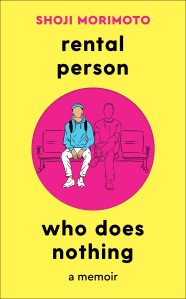
Cover image of Rental Person Who Does Nothing by Shoji Morimoto

‘Hello, I’m Rental Person.’

The novelty was what drew me to this book. I wondered what a rental person would even do and had fun imagining what I would hire someone to do if I had the opportunity. I eventually settled on a bucket list item I haven’t managed to convince anyone in my life to do with me, a shark cage dive. The people in my life are so sensible… Anyway, the possibilities made this one of my most anticipated reads of the year.

Although I enjoy lazy days as much as the next person, I don’t understand “a wish to live without doing anything”. My interest in reading about people who see the world differently to me was a draw card as well.

I thought I’d caught Morimoto out because surely writing a book constitutes doing something. Although a part of me wishes he had written this book with the hope of gaining more insight into his life, I couldn’t help but chuckle when I read that he provided simple answers to a writer and editor, who then wrote his book for him. Doing nothing? Goal achieved.

When I read about what people requested from Rental Person, I was struck by the simplicity of a lot of the requests: waving goodbye to them at a train station, helping them finish a drink, saving a place for them in a busy park. I also reconsidered my Rental Person wish; I’m pretty sure cage diving would constitute doing something unless Rental Person simply watched me do it. And where’s the fun in that?! I’d be wanting a shared experience with someone.

I began to marvel at the bravery of people sending a request to a stranger, asking them to be there with them as they did something that was important to them.

Every so often, I’d be struck by a gem like this:

Depth of discussion and depth of relationship don’t always go hand in hand.

Then I’d be puzzled by the detached vibe that came across elsewhere.

People might think I’m cold for saying this, but when I’m listening to clients, I’m thinking, That would be interesting to tweet, or Good, that’s great material. Maybe I’m less emotional than other people, or perhaps I’m simply not affected by other people’s emotions. I think this makes me suited to being Rental Person. I don’t get too involved in the client’s world.

I’m not naturally responsive. It doesn’t really matter to me what people do or say.

I’m not sure why this was the case but I had assumed Rental Person was a single man in his early 20’s. I was surprised to learn that when this book was written, he was 35 and had a wife and child.

When he started ‘Do-nothing Rental’ in June 2018, Morimoto charged train fare and the cost of food (if applicable). He mentioned he was living off his savings at the time and I wondered about the sustainability of this.

According to his Twitter profile, Morimoto now charges a request fee of 30,000 yen, transportation expenses from Kokubunji station and expenses such as food and drink (if applicable). For corporate use, the cost begins at 100,000 yen. I know he needs to make a living but if you’re asking him to help you finish a drink, that makes it a pretty expensive drink. I wonder if the introduction of the request fee has changed the types of things people are requesting.

In the book, I got the impression that Morimoto wasn’t especially keen on repeat business. A 2022 Fortune article changed my understanding of this as Morimoto said that “one in four of his clients were repeat customers, including one who had hired him 270 times”.

As someone who doesn’t understand small talk, I wondered why people would hire someone who only provides simple responses. It wasn’t until I made it to the section about how reciprocity works in Japanese society that I finally understood why it would be so valuable (no pun intended) to spend time with someone with no expectations attached to the interaction. I get it now.

After all of my musings about cage diving and other bucket list items, I’ve decided that making a Rental Person request isn’t for me. I can definitely see how this would be helpful for other people, though, if they can afford it.

I couldn’t do anything, so I started ‘doing nothing’.

Thank you so much to Pan Macmillan Australia for the opportunity to read this book.

Title: Rental Person Who Does Nothing

Author: Shoji Morimoto

Translator: Don Knotting

Publisher: Pan Macmillan Australia

Imprint: Picador

Published: 11 July 2023

RRP: AUD $29.99 (trade paperback)

Rating: 3.5 out of 5.

Once Upon a Blurb

Today, I’m starting a ‘rent a person who does nothing‘ service … Except for very simple conversation, I’m afraid I can do nothing.

Shoji Morimoto was constantly being told that he was a ‘do-nothing’ because he lacked initiative. Dispirited and unemployed, it occurred to him that if he was so good at doing nothing, perhaps he could turn it into a business. And with one tweet, he began his business of renting himself out … to do nothing.

Morimoto, aka Rental Person, provides a fascinating service to the lonely and socially anxious. Sitting with a client undergoing surgery, accompanying a newly-divorced client to her favourite restaurant, visiting the site of a client’s suicide attempt are just a few of his thousands of true life adventures. He is dependable, non-judgemental and committed to remaining a stranger and the curious encounters he shares are revelatory about both Japanese society and human psychology.

In Rental Person Who Does Nothing, Morimoto chronicles his extraordinary experiences in his unique line of work and reflects on how we consider relationships, jobs and family in our search for meaningful connection and purpose in life.

Edinburgh Nights #3: The Mystery at Dunvegan Castle – T.L. Huchu

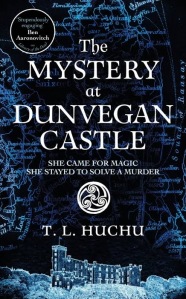
Cover image of The Mystery at Dunvegan Castle by T.L. Huchu

As part of her internship, Ropa finds herself playing host to a bunch of hoity-toity magicians at Dunvegan Castle. She’s not getting paid so she plans on liberating a little bit of something for her efforts. Before she can get her hands on anything shiny, the entire event turns into a locked room mystery: magic edition.

‘Everyone is a suspect.’

I absolutely adore Ropa. She has a distinctive voice, her education is pretty much courtesy of the school of hard knocks and she’s currently sporting orange dreadlocks and black lipstick.

One of the things I love about this series is Ropa’s relationships with her Gran and younger sister, Izwi. While both were mentioned in this book, neither had page time and I really missed their interactions. I also missed River, Ropa’s vulpine companion. Thankfully, Ropa’s friends, Priya and Jomo, are Under the Dome with her, as are the Hamster Squad, who we met in the second book.

They’re the admin gophers where I work.

Ropa is a ghostalker. She puts food on the table by delivering messages from ghosts to their loved ones. There was less ghostalking in this book than the previous ones.

Whenever there’s a list of who’s who in the zoo before you get to the first chapter, a part of my brain shuts down. I assume that if there are so many people I need to know about that I need a list to help me, I’m never going to be able to remember them all. This then becomes a self fulfilling prophecy. I’m pretty sure I ignored the lists in the previous books and didn’t have a problem. Here, there were details of the principal magical institutions, places and characters. I read them all carefully. My brain then went into panic mode and never recovered.

There was a lot of discussion about the history of magic, which I found interesting, and I learned of the existence of the biblioparadise, where I’ll be spending my afterlife.

A realm within the astral plane where every book written and unwritten sits on shelves high enough to touch the sky.

This book felt like a bridge between what we already knew about Ropa’s world and something big that’s on the horizon. Ropa seemed to tread water a bit in this book and as a result I wasn’t as invested as I usually am in this series. I am absolutely ready for what’s coming, though, and am really looking forward to the next book.

Favourite no context quote:

Thing about kangaroo courts is, the conclusion’s baked in before the dough’s in the oven.

Thank you so much to NetGalley and Tor, an imprint of Pan Macmillan, for the opportunity to read this book.

Rating: 3.5 out of 5.

Once Upon a Blurb

Ropa Moyo is no stranger to magic or mysteries. But she’s still stuck in an irksomely unpaid internship. So she’s thrilled to attend a magical convention at Dunvegan Castle, on the Isle of Skye, where she’ll rub elbows with eminent magicians.

For Ropa, it’s the perfect opportunity to finally prove her worth. Then a librarian is murdered and a precious scroll stolen. Suddenly, every magician is a suspect, and Ropa and her allies investigate. Trapped in a castle, with suspicions mounting, Ropa must contend with corruption, skulduggery and power plays. Time to ask for a raise?

Legends & Lattes – Travis Baldree

After twenty-two years of adventuring, Viv had reached her limit of blood and mud and bullshit. An orc’s life was strength and violence and a sudden, sharp end – but she’d be damned if she’d let hers finish that way.

It was time for something new.

If you’d told me a couple of days ago that I’d be recommending a cozy fantasy book to everyone who crosses my path, I doubt I would have believed you. But here we are.

An orc walks away from her old life to open a coffee shop.

“Oh, and hey! What in the eight hells is coffee?”

In a city where almost no one has even heard of “exotic bean water”.

And that’s pretty much the crux of the story, give or take. At face value it sounds kinda cute but nothing I’d expect to be enthusiastically shoving in people’s faces, telling them how much they’ll love it.

Viv’s story felt like a comfort read from very early on and I can easily see this being a go to read when I need some time out.

I adored Viv, Tandri, Hem, Thimble, Pendry and Cal individually but together this diverse group of kindred spirits felt like home (the good kind).

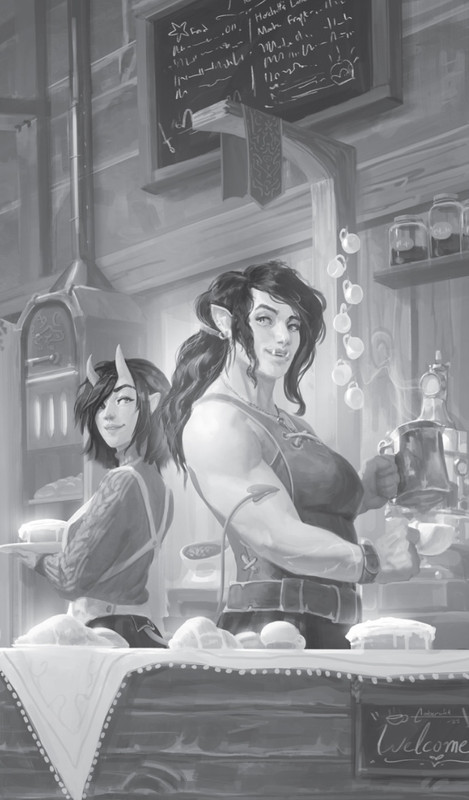
description

I love that Viv was able to let go of the life that was expected of her and find a bunch of supportive friends who could see beyond her past to who she truly was, friends that encouraged her in her new venture and who had her back.

“If mortal danger threatens us, I promise to hide behind you. Deal?”

While Tandri was my favourite character, I also had a soft spot for Pendry. I enjoyed cheering them on as they gained the confidence to step outside their comfort zone.

I absolutely need a dire-cat in my life.

Favourite no context quote:

“Things don’t have to stay as what they started out as”

I’m giving this book however many hm’s it takes to fill five stars and can’t wait to meet more of Thune’s inhabitants in the author’s next book.

In the meantime, I’d like to order a bean water with milk and a heavenly frosted cinnamon pastry please.

Thank you so much to NetGalley and Tor, an imprint of Pan Macmillan, for the opportunity to read this book.

Rating: 5 out of 5.

Once Upon a Blurb

High fantasy, low stakes – with a double-shot of coffee.

After decades of adventuring, Viv the orc barbarian is finally hanging up her sword for good. Now she sets her sights on a new dream – for she plans to open the first coffee shop in the city of Thune. Even though no one there knows what coffee actually is.

If Viv wants to put the past behind her, she can’t go it alone. And help might arrive from unexpected quarters. Yet old rivals and new stand in the way of success. And Thune’s shady underbelly could make it all too easy for Viv to take up the blade once more.

But the true reward of the uncharted path is the travellers you meet along the way. Whether bound by ancient magic, delicious pastries or a freshly brewed cup, they may become something deeper than Viv ever could have imagined.

Before the Coffee Gets Cold – Toshikazu Kawaguchi

Translator – Geoffrey Trousselot

It takes courage to say what has to be said.

I recently ventured into a bookstore for the first time since COVID and proceeded to go into what can only be described as a book frenzy. I was only looking for one particular book but wound up adopting six. Half were this series. When I picked up this book I didn’t think it would be coming home with me. Then I learned it contained two of my very favourite things: coffee and time travel.

‘Please send me back to the past!’

Cafe Funiculi Funicula opened in 1874. It’s small, there’s no air conditioning and, at Nagare’s insistence, only serves mocha. If you sit in one specific seat, though, and follow a very specific set of rules, you can travel to the past.

The Rules

🪑 You can only meet people who have visited the cafe.
🪑 Nothing you do when you’re in the past will change the present.
🪑 You have to sit in a specific seat to time travel and you must remain seated when you’re in the past.
🪑 You have to drink the entire cup of coffee before it gets cold.

After my initial excitement at finding a time travel book I’d never heard of before, I settled in to read the first of the four stories contained in this book.

The Lovers had me questioning all of my life choices, primarily my rashness in buying three books in a series I knew nothing about other than their blurbs. Had I only read this story, I probably never would have wanted to read the other books. It made me so mad!

A week ago, Fumiko’s long term boyfriend, Goro, told her over coffee he was moving to America for work. When he was on his way to the airport! If he was my boyfriend I’d be incensed! No way would I want him back. Fumiko clearly sees this situation differently than I do because she’s our first time traveller. I questioned more than one of Fumiko’s life choices; she has a limited time in the past but decided to add milk to her coffee, making it cool even quicker and shortening her time there. Ugh!

In the first page it’s said that Fumiko is Goro’s “girlfriend of three years” but later it’s said (twice) that Fumiko met Goro two years ago. I wondered if three years was a typo. Then, because time was so important in this book, I questioned if the discrepancy was simply two people with different perceptions of time in their relationship. Maybe the relationship felt to Goro like it dragged on a year longer than it actually did?

Despite my early frustration, I persevered. I enjoyed the second and third stories more than the first and by the time I finished the fourth story, I wanted to continue with the series and reread this book to see what details I may have missed the first time around.

In Husband and Wife, Fusagi has a letter in the present that Kohtake hopes to receive in the past. I wondered if Kohtake received the letter in the past and brought it back with her to the present, would that result in there being two letters in the present? Kohtake tiptoes around her conversation with Fusagi in the past, which disappointed me.

In The Sisters, one sister goes back in time to speak to her sister one last time. I loved how the mystery visitor to the cafe in this story helps complete another story.

Mother and Child made me cry and is the main reason I’m remembering this book with fondness rather than my initial disappointment.

My favourite character was Hirai, who fascinated me. She seemed to openly delight in Fumiko’s misery and has a backstory I learned more about throughout the book. I most want to learn the full story of the woman reading the book.

I had some time travel question marks.

Some travellers returned to a time when their past self was at the cafe. Encountering yourself in the past is generally a time travel no no. None of our travellers meet their past selves so I wondered whether the future self replaced the past self in this world.

Why doesn’t everyone get the stick that sounds the alarm just before the coffee gets cold? That would be so helpful.

One of my big takeaways from this book isn’t the details of any one story but the concept of emotional gravity, which was explained in a beautiful way and holds such truth.

Water flows from high places to low places. That is the nature of gravity. Emotions also seem to act according to gravity. When in the presence of someone with whom you have a bond, and to whom you have entrusted your feelings, it is hard to lie and get away with it. The truth just wants to come flowing out. This is especially the case when you are trying to hide your sadness or vulnerability. It is much easier to conceal sadness from a stranger, or from someone you don’t trust.

I haven’t read many books that have been translated from Japanese but the ones I’ve encountered have a gentle quality to them. They don’t seem to be in a hurry to get where they’re going and I don’t feel any urgency when I’m reading them. It’s like I’ve been invited to witness a snippet of someone’s life and I leave with a sense of calm, regardless of how emotionally charged the content is. I’m not sure how that works but I’ve started seeking it out.

About the cover image: The seat that transports you through time is upholstered in moss-green fabric on the seat and back. I wish that had matched one of the seats on the cover.

Handy hint: Pay attention to the background characters and the details of what’s happening outside of the main storyline. They may be relevant later in the book.

But Kazu still goes on believing that, no matter what difficulties people face, they will always have the strength to overcome them. It just takes heart.

Rating: 4 out of 5.

Once Upon a Blurb

What would you change if you could go back in time? 

In a small back alley in Tokyo, there is a café which has been serving carefully brewed coffee for more than one hundred years. But this coffee shop offers its customers a unique experience: the chance to travel back in time.

In Before the Coffee Gets Cold, we meet four visitors, each of whom is hoping to make use of the café’s time-travelling offer, in order to: confront the man who left them, receive a letter from their husband whose memory has been taken by early onset Alzheimer’s, to see their sister one last time, and to meet the daughter they never got the chance to know.

But the journey into the past does not come without risks: customers must sit in a particular seat, they cannot leave the café, and finally, they must return to the present before the coffee gets cold …

Toshikazu Kawaguchi’s beautiful, moving story explores the age-old question: what would you change if you could travel back in time? More importantly, who would you want to meet, maybe for one last time?

Our Wives Under the Sea – Julia Armfield

Miri’s wife was supposed to be gone for three weeks but was missing for six months. Biologist Leah, engineer Matteo and marine ecologist and conservationist Jelka were conducting research for the Centre for Marine Enquiry but things didn’t exactly go to plan. 

“I think,” she says, “that there was too much water. When we were down there. I think we let it get in.” 

Hypochondriac Miri thought she’d never see her wife again. Now Leah has returned but the Leah who left is not the one that returned. 

The problem, of course, was that nothing was wrong, aside from the fact of the obvious. 

With the narrative alternating between Miri and Leah, the author explores the history of their relationship and the incomprehensible changes in Leah. 

“How will we ever explain this” 

The deliciously unsettling cover image and quotable beginning set my expectations unreasonably high. I was ready for creepy and claustrophobic. I wasn’t expecting so much of the story to be about the relationship between the wives. That’s not to say I didn’t enjoy this book (I did), only that it wasn’t the read I thought I was signing up for. 

It isn’t that her being back is difficult, it’s that I’m not convinced she’s really back at all. 

The author really captured the feeling of being alone in the presence of others. The pain that accompanies loss, whatever form it takes. The struggle to hold on to what no longer exists. The resistance against letting go. 

“I think,” Juna says after a pause, “that the thing about losing someone isn’t the loss but the absence of afterwards. D’you know what I mean? The endlessness of that.” 

You will find answers in this book but not all of them. If there’d been even a teensy bit more of a focus on what happened in the depths of the ocean, I would not have been okay with this. At all. 

Because I became invested in the aftermath, I was able to sit more comfortably in the ambiguity. That’s not to say that I’d turn away anyone who wanted to spoon-feed the rest of the answers to me.

This book is really quotable, as I’m sure you’ve already picked up from my review. The first sentence, though, it’s a doozy. I’ve seen it quoted in so many reviews already but it’s what sucked me in so I have to share it too. 

The deep sea is a haunted house: a place in which things that ought not to exist move about in the darkness. 

Now, this is not important in the scheme of things but it’s still running through my head so I’m passing it along to you: Miri wonders why so many people keep bringing her coffee. I’m wondering how I can get more people to bring it to me.

Rating: 4 out of 5.

Once Upon a Blurb

Miri thinks she has got her wife back, when Leah finally returns after a deep-sea mission that ended in catastrophe. It soon becomes clear, though, that Leah is not the same. Whatever happened in that vessel, whatever it was they were supposed to be studying before they were stranded on the ocean floor, Leah has brought part of it back with her, onto dry land and into their home.

Moving through something that only resembles normal life, Miri comes to realise that the life that they had before might be gone. Though Leah is still there, Miri can feel the woman she loves slipping from her grasp.

Our Wives Under The Sea is the debut novel from Julia Armfield, the critically acclaimed author of salt slow. It’s a story of falling in love, loss, grief, and what life there is in the deep deep sea.