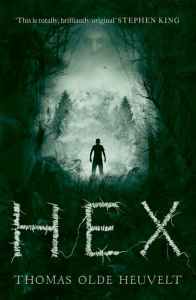
Robert Grim #2: Oracle – Thomas Olde Heuvelt

Translator – Moshe Gilula

How could a sound that had ceased forty years ago suddenly echo again on a cold winter morning … and feel so wrong?

Luca and Emma weren’t expecting to find a ship in a tulip field on their way to school. It wasn’t there yesterday and it seems pretty impossible that it’s there now.

This sounds like a job for Robert Grim.

I can’t say that Robert Grim was exactly enjoying his retirement or even remembering much of it. He doesn’t live in Black Spring anymore, though, so that’s progress.

He’s not exactly advertising his services but even he can’t deny he has a unique skill set. His involvement in this investigation isn’t what you’d call voluntary. That’s not how these things work.

This is one of those rare series where I enjoyed the sequel more than the first book. I was all about the mystery of the ship but it turns out that’s only the beginning of this story.

While this book was still dark, there was some hope to be found. I had Luca, a gutsy kid, to cheer on and I needed that.

I struggled with the fictional animals meeting their maker in HEX. There was some of that here too but none that I’d built a relationship with first so that made it easier.

If you absolutely had to, you could read this book without having read HEX but you would be missing out. It provides much needed context for the character of Robert Grim. This book also includes spoilers for the first so you won’t want to read them out of order.

Supernatural phenomena followed their own set of rules … until they didn’t.

I spent the whole book trying to figure out how Robert Grim survived the Black Rock Witch and I was given an explanation but I need to know more. Thankfully this book ends with an opening for another so I may get to explore this further.

Oftentimes when I’m reading a book, I think about what I would do if I was plonked into the storyline. If I had made my way to Every Man’s End, I would unquestionably not be here to tell you about it. I would have investigated the ship that shouldn’t have been, the bell would have tolled and, well, if you read the book you’ll know what would’ve happened next.

‘And what did you think?’

‘That they should have listened to the kid, dammit.’

Thank you so much to NetGalley and Hodder & Stoughton for the opportunity to read this book.

Rating: 4 out of 5.

Once Upon a Blurb

On a foggy winter morning two children discover the impossible: the wreck of an eighteenth-century ship stranded in a field.

One enters the hatch on the deck and is never seen again. And she isn’t the last to disappear…

Soon a government agency begins to investigate, determined to uncover the ship’s secrets before a media storm erupts. They enlist Robert Grim, a retired specialist of the occult, to unravel the mystery, who soon realises the ship could be a harbinger of an ancient doom awakened under the sea. 

In a maelstrom of international intrigue and pure terror, Grim must race against time as he comes face to face with an open doorway to the apocalypse.

Robert Grim #1: HEX – Thomas Olde Heuvelt

Translator – Nancy Forest-Flier

“Nothing’s normal here.”

Katherine van Wyler was sentenced to death for witchcraft in 1664 but that’s not where her story ends. Hundreds of years later, the Black Rock Witch remains, her eyes and mouth sewn shut.

Once you move to Black Spring, you will never live anywhere else. The residents of this insular community are used to living alongside this emaciated, chained woman but they’ve been lulled into a false sense of security. If Katherine’s eyes ever open, her power will be unleashed.

This book has been on my radar for years and waited patiently on my Kindle for two. The upcoming release of the sequel gave me the perfect excuse to dive in and then I almost didn’t finish it. To be honest, if I hadn’t already committed to reviewing the sequel, I probably wouldn’t have.

“She’s not going to let you go. You live in Black Spring now. That means the curse is on you as well.”

It’s rare for a book to have a negative impact on me. Reading is my joy. Even when I read memoirs of people who have experienced the horrific, I find hope in their resilience.

This book, though, had a significant impact on my mental health. You could say it did its job, with the witch reaching out from the pages to infect me with her curse. It got to the point where, each time I started reading, I’d think ‘Abandon all hope, ye who enter here.’

But nothing was all right, nothing could ever be all right

I don’t think of myself as a reader with many rules. I’m happy to wander between genres and dip my toe into unfamiliar territory. Do what you want to the humans, especially if we’re in a slasher, and I’ll likely forgive you. I may even cheer you on. If you harm my fictional animals, though, we’re going to have a problem. I had a big problem with what the animals, one in particular, experienced in this book.

I don’t want you to think this wasn’t a good book. It was. It was well written. I got attached to a couple of the characters. I needed to know what hell was going to be unleashed once Katherine’s eyes opened. But wow, it really did a number on me.

“Peacocks. You know what that means, right?”

Rating: 3.5 out of 5.

Once Upon a Blurb

Whoever is born here, is doomed to stay until death. Whoever comes to stay, never leaves.

Welcome to Black Spring, the seemingly picturesque Hudson Valley town haunted by the Black Rock Witch, a seventeenth-century woman whose eyes and mouth are sewn shut. Blind and silenced, she walks the streets and enters homes at will. She stands next to children’s beds for nights on end. So accustomed to her have the townsfolk become that they often forget she’s there. Or what a threat she poses. Because if the stitches are ever cut open, the story goes, the whole town will die.

The curse must not be allowed to spread. The elders of Black Spring have used high-tech surveillance to quarantine the town. Frustrated with being kept in lockdown, the town’s teenagers decide to break the strict regulations and go viral with the haunting. But, in so doing, they send the town spiralling into a dark nightmare.

The Kamogawa Food Detectives – Hisashi Kashiwai

Translator – Jesse Kirkwood

Kamogawa Diner – Kamogawa Detective Agency – We Find Your Food

The Kamogawa Detective Agency is run by Nagare Kamogawa and his daughter, Koishi. Their advertisement is cryptic so you’ll need to be determined to find their door. Your perseverance will be worth it, though, because Nagare and Koishi can recreate that dish you’ve been craving.

This father and daughter team track down the exact flavours the diners in this book are seeking, but it’s not just a meal to them. What they’re really searching for is a taste of nostalgia.

Whether that’s someone who is about to embark on the next chapter of their life, wondering about the road not taken or remembering the warmth of kindness in their early life, Nagare and Koishi will track down the correct ingredients.

This was a quick, light read. It quickly became obvious why this book is being compared to Before the Coffee Gets Cold. In both books, you meet a new character, learn enough about their backstory to know why they have sought out the cafe/diner and witness the resolution.

Due to the format, you don’t get to spend a lot of time with each person seeking a connection. This resulted in me staying more on the surface of the chapters. I didn’t become emotionally invested with anyone, although I remained interested throughout each of their stories.

While the food connected the people to their loved ones, I would have preferred getting to meet them and eavesdrop on their conversations.

I’m not sure if you can read a book like this without thinking about the dish that you would hire the Detective Agency to track down for you.

The first thing that came to mind for me was my Nan’s lasagne but my experience doesn’t really fit the criteria. After she died, I searched her cookbooks for the recipe that I knew wouldn’t be there because she was a make it up as you go along cook.

Then I realised that I watched Nan make lasagne so many times throughout my childhood that I knew the measurements, the brands she used and the steps. I was able to make it from memory the first time I tried and every time I make it I feel connected to her.

What I’d be looking for is an experience the Kamogawa Diner can’t provide, the opportunity to watch my Nan cook one last time, not because of the food but to have one more conversation with her.

Regardless of my own impossible wish not fitting the scope of the magic Nagare and Koishi create in the lives of their customers, I enjoyed seeing how the right combination of ingredients can have the power to transform a life.

‘So, hoping we can track down a dish from your past, by any chance?’

Thank you so much to Pan Macmillan for the opportunity to read this book.

Title: The Kamogawa Food Detectives

Author: Hisashi Kashiwai

Translator: Jesse Kirkwood

Publisher: Pan Macmillan Australia

Imprint: Mantle

Published: 10 October 2023

RRP: AUD $19.99 (paperback)

Rating: 4 out of 5.

Once Upon a Blurb

Down a quiet backstreet in Kyoto exists a very special restaurant called the Kamogawa Diner run by Koishi Kamogawa and her father Nagare. Customers who can find the hidden diner are treated to an extravagant meal, but it’s not the main reason for visiting…

The father-daughter duo have started advertising their services as ‘food detectives’, capable of recreating a dish from their customers’ pasts that may well hold the key to forgotten memories and ongoing happiness.

From the widower looking for a specific noodle dish that his wife used to cook to a first love’s beef stew, the restaurant of lost recipes provides a link to the past and a way to a more contented future.

A bestseller in Japan, The Kamogawa Food Detectives is a celebration of good company and the power of a delicious meal.

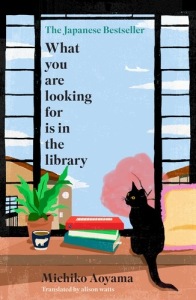
What You Are Looking for is in the Library – Michiko Aoyama

Translator – Alison Watts

How uncanny the way what one reads can sometimes synchronise with reality.

A book about books and a librarian who recommends the right one at the right time is always going to be a must read for me. I’ve experienced bookish transformative magic and have long suspected some librarians are particularly gifted in wielding it.

This book introduces you to five people who are at a crossroads in their life. Whether they’re unsatisfied with their job, wanting to follow a dream or are searching for purpose, they all find their way to the librarian.

‘What are you looking for?’

After a short conversation with Sayuri Komachi, the librarian, she produces a list of books on the subject they have requested but invariably also sneaks in a surprise title that appears entirely irrelevant. It is this title that leads the reader on a journey of self discovery, while trying to decipher the meaning of the librarian’s bonus gift.

The comparisons between this book and Before the Coffee Gets Cold made sense early on. Each chapter focuses on a specific individual, although as you make your way through the book you discover connections between characters and their backstories. One of my favourite things about this book was searching for the ways in which the seemingly unconnected stories interwove.

One description, which initially niggled at me, became something that impacted my enjoyment of the book. Every character, upon seeing the librarian for the first time, noted their shock at her appearance. She’s described as “huge”, “really huge”, “large” (multiple times), “very large” (more than once) and “humungous”. She has “plump fingers”. Characters are surprised she can move quickly and that she is capable of the fine work of felting.

The paleness of her skin was also consistently commented one; it reminded one character of a “white glutinous rice cake”.

Comparisons are made between her and a polar bear, the Stay-Puft Marshmallow Man, Disney’s Baymax and Genma Saotome from Ranma ½. While I’m usually up for any Ghostbusters reference, all of the comparisons felt disparaging rather than descriptive.

I haven’t been able to find a better word to describe my experience of this book as a whole than ‘soft’. It’s easy to read. The characters aren’t difficult to get to know and you don’t need to think deeply to follow the story. It’s a nice, feel-good read and there are sentences that leave you feeling warm and squishy. Ultimately, though, while I will remember how it made me feel, I don’t think any of the individual stories are going to linger with me long term.

Everybody should have their own story.

Thank you so much to NetGalley and Doubleday, an imprint of Transworld Publishers, for the opportunity to read this book.

Rating: 3.5 out of 5.

Once Upon a Blurb

Sayuri Komachi is no ordinary librarian. Sensing exactly what someone is searching for in life, she provides just the book recommendation to help them find it.

In this uplifting book, we meet five of Sayuri’s customers, each at a different crossroads:

– the restless retail assistant eager to pick up new skills
– the mother faced with a demotion at work after maternity leave
– the conscientious accountant who yearns to open an antique store
– the gifted young manga artist in search of motivation
– the recently retired salaryman on a quest for newfound purpose

Can she help them find what they are looking for? 

What You Are Looking For is in the Library is about the magic of community libraries and the discovery of connection. Already loved by thousands of readers all over the world, this inspirational tale shows how, by listening to our hearts, seizing opportunity and reaching out, we too can fulfil our long-held dreams.

Which book will you recommend?

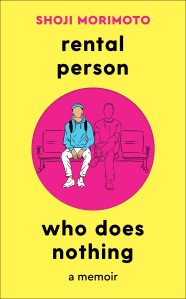
Rental Person Who Does Nothing – Shoji Morimoto

Translator – Don Knotting

Cover image of Rental Person Who Does Nothing by Shoji Morimoto

‘Hello, I’m Rental Person.’

The novelty was what drew me to this book. I wondered what a rental person would even do and had fun imagining what I would hire someone to do if I had the opportunity. I eventually settled on a bucket list item I haven’t managed to convince anyone in my life to do with me, a shark cage dive. The people in my life are so sensible… Anyway, the possibilities made this one of my most anticipated reads of the year.

Although I enjoy lazy days as much as the next person, I don’t understand “a wish to live without doing anything”. My interest in reading about people who see the world differently to me was a draw card as well.

I thought I’d caught Morimoto out because surely writing a book constitutes doing something. Although a part of me wishes he had written this book with the hope of gaining more insight into his life, I couldn’t help but chuckle when I read that he provided simple answers to a writer and editor, who then wrote his book for him. Doing nothing? Goal achieved.

When I read about what people requested from Rental Person, I was struck by the simplicity of a lot of the requests: waving goodbye to them at a train station, helping them finish a drink, saving a place for them in a busy park. I also reconsidered my Rental Person wish; I’m pretty sure cage diving would constitute doing something unless Rental Person simply watched me do it. And where’s the fun in that?! I’d be wanting a shared experience with someone.

I began to marvel at the bravery of people sending a request to a stranger, asking them to be there with them as they did something that was important to them.

Every so often, I’d be struck by a gem like this:

Depth of discussion and depth of relationship don’t always go hand in hand.

Then I’d be puzzled by the detached vibe that came across elsewhere.

People might think I’m cold for saying this, but when I’m listening to clients, I’m thinking, That would be interesting to tweet, or Good, that’s great material. Maybe I’m less emotional than other people, or perhaps I’m simply not affected by other people’s emotions. I think this makes me suited to being Rental Person. I don’t get too involved in the client’s world.

I’m not naturally responsive. It doesn’t really matter to me what people do or say.

I’m not sure why this was the case but I had assumed Rental Person was a single man in his early 20’s. I was surprised to learn that when this book was written, he was 35 and had a wife and child.

When he started ‘Do-nothing Rental’ in June 2018, Morimoto charged train fare and the cost of food (if applicable). He mentioned he was living off his savings at the time and I wondered about the sustainability of this.

According to his Twitter profile, Morimoto now charges a request fee of 30,000 yen, transportation expenses from Kokubunji station and expenses such as food and drink (if applicable). For corporate use, the cost begins at 100,000 yen. I know he needs to make a living but if you’re asking him to help you finish a drink, that makes it a pretty expensive drink. I wonder if the introduction of the request fee has changed the types of things people are requesting.

In the book, I got the impression that Morimoto wasn’t especially keen on repeat business. A 2022 Fortune article changed my understanding of this as Morimoto said that “one in four of his clients were repeat customers, including one who had hired him 270 times”.

As someone who doesn’t understand small talk, I wondered why people would hire someone who only provides simple responses. It wasn’t until I made it to the section about how reciprocity works in Japanese society that I finally understood why it would be so valuable (no pun intended) to spend time with someone with no expectations attached to the interaction. I get it now.

After all of my musings about cage diving and other bucket list items, I’ve decided that making a Rental Person request isn’t for me. I can definitely see how this would be helpful for other people, though, if they can afford it.

I couldn’t do anything, so I started ‘doing nothing’.

Thank you so much to Pan Macmillan Australia for the opportunity to read this book.

Title: Rental Person Who Does Nothing

Author: Shoji Morimoto

Translator: Don Knotting

Publisher: Pan Macmillan Australia

Imprint: Picador

Published: 11 July 2023

RRP: AUD $29.99 (trade paperback)

Rating: 3.5 out of 5.

Once Upon a Blurb

Today, I’m starting a ‘rent a person who does nothing‘ service … Except for very simple conversation, I’m afraid I can do nothing.

Shoji Morimoto was constantly being told that he was a ‘do-nothing’ because he lacked initiative. Dispirited and unemployed, it occurred to him that if he was so good at doing nothing, perhaps he could turn it into a business. And with one tweet, he began his business of renting himself out … to do nothing.

Morimoto, aka Rental Person, provides a fascinating service to the lonely and socially anxious. Sitting with a client undergoing surgery, accompanying a newly-divorced client to her favourite restaurant, visiting the site of a client’s suicide attempt are just a few of his thousands of true life adventures. He is dependable, non-judgemental and committed to remaining a stranger and the curious encounters he shares are revelatory about both Japanese society and human psychology.

In Rental Person Who Does Nothing, Morimoto chronicles his extraordinary experiences in his unique line of work and reflects on how we consider relationships, jobs and family in our search for meaningful connection and purpose in life.

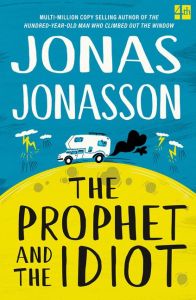
The Prophet and the Idiot – Jonas Jonasson

Translator – Rachel Willson-Broyles

So, let’s talk about the elephant in the room … the last word in the title. It’s offensive. It’s awful. I hate it.

If I hadn’t told someone that yes, I was absolutely going to read a Jonas Jonasson book, my journey with this book would have ended as soon as I read that word. Because more than a year has passed since I made my bookish commitment, I moved on to reading the blurb and it intrigued me. It’s a shame, really, because I expect a lot of people won’t make it past the title.

If you do manage to put blinders on every time you come across that word, this is actually a fun read. The characters are quirky, there’s a road trip in an RV with a super fancy kitchen and there are wrongs to put right because the world is ending.

Everything felt right.

At which point nothing went as planned. It rarely does.

Johan, who the offensive word refers to, believes that’s what he is because his brother has called him that his entire life. Johan is not book smart but he’s a genius when it comes to combining ingredients in unique and apparently delectable way. I would very much like to sample his mango bread. Johan has also memorised a bunch of American movies.

Petra is convinced the sky is falling. Literally. And very soon. She has the calculations to prove it.

‘Who’s going to what now?’

‘The atmosphere. It will fall flat to the ground and the temperature will drop to 273.15 degrees below freezing. In a split second.’

‘Where?’

‘Everywhere.’

‘Indoors as well?’

Besides being a doomsday prophet, Petra is also a very big fan of flowcharts.

At 75, retired manufacturess Agnes’ hair is more violet than it used to be. Her alter ego, ‘Travelling Eklund’, has seen much more of the world than she has, although that’s about to change.

This is a book with grappa decisions, an endangered bird and unfinished cheese business. A bunch of famous people have parts to play, including Obrama, which, even though it very much looks like it, is not a typo.

Our road trip takes us to multiple countries and the impact of this found family is felt worldwide, even as they paint themselves into so many corners you begin to wonder how they can ever get out of them.

Ultimately, this book encourages you to live your life while you have the chance because you never know when a prophet’s calculations are going to be correct.

‘Isn’t now the time to embrace the world? With what little time you have left.’

Although I still hate the title, I enjoyed spending time with this unlikely trio.

Thank you so much to NetGalley and 4th Estate, an imprint of HarperCollins Publishers, for the opportunity to read this book.

Rating: 4 out of 5.

Once Upon a Blurb

Sweden, late summer of 2011. Self-taught astrophysicist Petra has calculated that the atmosphere will collapse on the 21st of September that year, around 21.20 to be more precise, bringing about the end of times.

Armed with this terrible knowledge, Petra meets Johan and Agnes, a widow of 75 who has made bank living a double life on social media as a young influencer. Together, the trio race through Europe as they plan to make the most out of the time they have left, in more ways than one.

But of course, things rarely go to plan, even the end of the world…

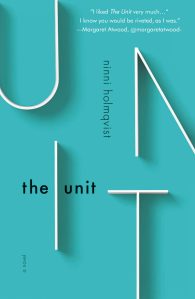
The Unit – Ninni Holmqvist

Translator – Marlaine Delargy

Dorrit is dispensable. Society says she’s not needed because she unmarried, childless and doesn’t work in one of the specified professions that would give her an exemption for failing to fulfil her duties as a woman. Having just turned fifty, Dorrit has earned herself a one way trip to the Second Reserve Bank Unit for biological material.

From now on it was important that I was kept in good condition and good health in every way. That was the whole point, after all.

It’s almost like an all expenses paid resort, where your food, entertainment, medical expenses and even shopping are on the house. All it costs is your life.

A dystopia for the childless, this book introduces readers to a democratic society that’s come to the conclusion that every body is a commodity. Those who have been designated dispensable – fifty year old women and sixty year old men who don’t have children – have all of their needs met as they participate in drug trials and experiments, and ‘donate’ their organs to the indispensable.

The best dystopias are the ones you can imagine happening. The worst dystopias are the ones you can imagine happening. This is a best-worst dystopia.

I liked Dorrit and, despite the circumstances, enjoyed seeing her belong for the first time in her life. I loved the camaraderie between her and the friends she made at the Unit. I had such hope for her when she found love.

Then I remembered this was a dystopia and all of the things I loved about this book became things that could be taken away from Dorrit and, by extension, myself as I became more and more invested in her story.

Interestingly, while I liked most of the characters, I didn’t become emotionally attached to any of them. When I learned about various characters having made their final donation I was interested but didn’t need a single tissue.

Considering how much money was being invested in keeping dispensables as healthy as possible for as long as possible (alcohol isn’t even allowed), I wondered how management would feel about the potential drug trials had to destroy previously viable organs.

Thank you so much to NetGalley and Oneworld Publications for the opportunity to read this book.

Rating: 4 out of 5.

Once Upon a Blurb

In paradise, nobody can hear you scream.

Ninni Holmqvist’s eerie dystopian novel envisions a society in the not-so-distant future where men and women deemed economically worthless are sent to a retirement community called the Unit. With lavish apartments set amongst beautiful gardens and state-of-the-art facilities, elaborate gourmet meals, and wonderful music and art, they are free of financial worries and want for nothing. It’s an idyllic place, but there’s a catch: the residents – known as dispensables – must donate their organs, one by one, until the final donation. When Dorrit Weger arrives at the Unit, she resigns herself to this fate, seeking only peace in her final days. But she soon falls in love, and this unexpected, improbable happiness throws the future into doubt.  

Clinical and haunting, The Unit is a modern-day classic and a spine-chilling cautionary tale about the value of human life.

Enola Holmes: The Graphic Novels, Book Two – Serena Blasco

Translator – Tanya Gold

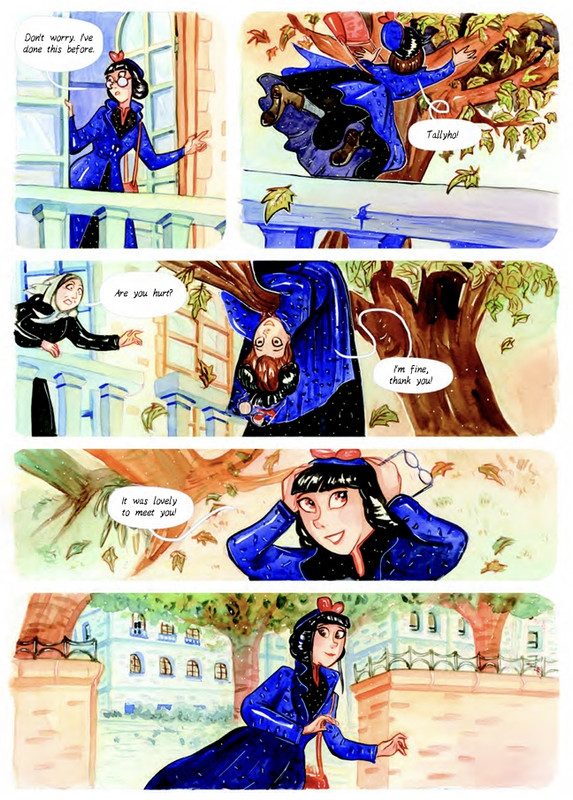
I was introduced to Enola Holmes in the first graphic novel collection, which are based on the first three books of Nancy Springer’s The Enola Holmes Mysteries. This collection adapts the final three books in the series: The Case of the Peculiar Pink Fan, The Case of the Cryptic Crinoline and The Case of Baker Street Station.

When we catch up with Enola at the beginning of this collection, she has yet to find her mother.

And finding someone who doesn’t want to be found is complicated.

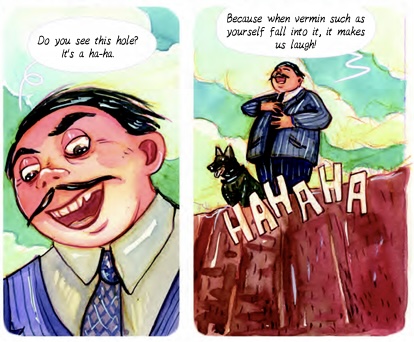
In her first case, which begins in an unusual location (London’s first ladies’ public lavatory), Enola encounters a lot of pink. She also meets a man who’s the spitting image of Gomez Addams.

description

Enola’s second case involves a kidnapping. The victim? Her landlady, Mrs. Tupper. If you believe Florrie, the list of suspects includes anarchists and Jack the Ripper. Assisting Enola with this case is none other than Florence Nightingale. Enola makes a hasty exit.

description

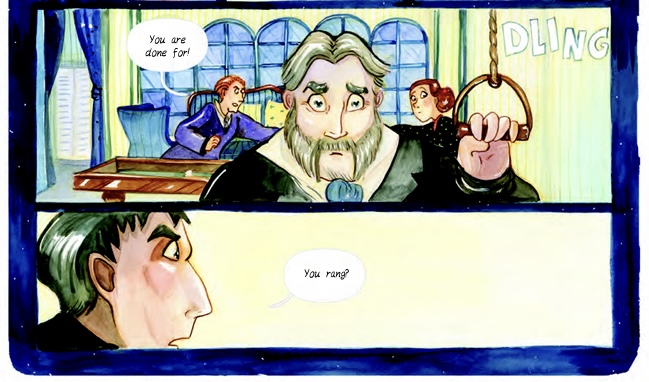
Continuing with the Addams Family references, Lurch makes a cameo in the second case.

description

I kid you not. The character’s name is Lurch!

In her final case, Enola needs to find Lady Blanchefleur. Along the way, she learns her fortune.

“I see a dagger in your heart and a raven on your shoulder.”

Sounds kinda ominous.

Enola discovers the price of fashion and deciphers the most important message of her life. I haven’t found anything Addams adjacent in this story. Yet.

I’ve enjoyed getting acquainted with Enola in these graphic novels. While I’m confident I now know the basics of her story, I’m keen to read Nancy Springer’s books to get to know her better. Hopefully by the time I get to the final novel the way the big mystery of the series resolved will only be a fuzzy memory.

Thank you so much to NetGalley and Andrews McMeel Publishing for the opportunity to read this graphic novel.

Rating: 4 out of 5.

Once Upon a Blurb

In Book Two of the series, Enola is back on the case, deciphering clues and developing leads in each of three new mysteries. What she doesn’t know is that she, too, is being pursued – by her own brother! Once again, Sherlock Holmes’ brilliant, strong-willed younger sister takes centre stage in this delightfully drawn graphic novel based on Nancy Springer’s bestselling mystery series.

London, 1889. A woman is being held prisoner while she awaits a forced marriage. Another has been kidnapped, and yet another disappears…

As Enola seeks to rescue the three women, her brother embarks on a quest of his own. When Sherlock receives a mysterious package, he knows he’ll need Enola’s help to decipher its meaning. In the end, the three Holmes siblings will have to work together to answer the question that started it all: What happened to their mother?

Book Two contains three engrossing mysteries: The Case of the Peculiar Pink Fan, The Case of the Cryptic Crinoline, and The Case of Baker Street Station.

Before the Coffee Gets Cold – Toshikazu Kawaguchi

Translator – Geoffrey Trousselot

It takes courage to say what has to be said.

I recently ventured into a bookstore for the first time since COVID and proceeded to go into what can only be described as a book frenzy. I was only looking for one particular book but wound up adopting six. Half were this series. When I picked up this book I didn’t think it would be coming home with me. Then I learned it contained two of my very favourite things: coffee and time travel.

‘Please send me back to the past!’

Cafe Funiculi Funicula opened in 1874. It’s small, there’s no air conditioning and, at Nagare’s insistence, only serves mocha. If you sit in one specific seat, though, and follow a very specific set of rules, you can travel to the past.

The Rules

🪑 You can only meet people who have visited the cafe.
🪑 Nothing you do when you’re in the past will change the present.
🪑 You have to sit in a specific seat to time travel and you must remain seated when you’re in the past.
🪑 You have to drink the entire cup of coffee before it gets cold.

After my initial excitement at finding a time travel book I’d never heard of before, I settled in to read the first of the four stories contained in this book.

The Lovers had me questioning all of my life choices, primarily my rashness in buying three books in a series I knew nothing about other than their blurbs. Had I only read this story, I probably never would have wanted to read the other books. It made me so mad!

A week ago, Fumiko’s long term boyfriend, Goro, told her over coffee he was moving to America for work. When he was on his way to the airport! If he was my boyfriend I’d be incensed! No way would I want him back. Fumiko clearly sees this situation differently than I do because she’s our first time traveller. I questioned more than one of Fumiko’s life choices; she has a limited time in the past but decided to add milk to her coffee, making it cool even quicker and shortening her time there. Ugh!

In the first page it’s said that Fumiko is Goro’s “girlfriend of three years” but later it’s said (twice) that Fumiko met Goro two years ago. I wondered if three years was a typo. Then, because time was so important in this book, I questioned if the discrepancy was simply two people with different perceptions of time in their relationship. Maybe the relationship felt to Goro like it dragged on a year longer than it actually did?

Despite my early frustration, I persevered. I enjoyed the second and third stories more than the first and by the time I finished the fourth story, I wanted to continue with the series and reread this book to see what details I may have missed the first time around.

In Husband and Wife, Fusagi has a letter in the present that Kohtake hopes to receive in the past. I wondered if Kohtake received the letter in the past and brought it back with her to the present, would that result in there being two letters in the present? Kohtake tiptoes around her conversation with Fusagi in the past, which disappointed me.

In The Sisters, one sister goes back in time to speak to her sister one last time. I loved how the mystery visitor to the cafe in this story helps complete another story.

Mother and Child made me cry and is the main reason I’m remembering this book with fondness rather than my initial disappointment.

My favourite character was Hirai, who fascinated me. She seemed to openly delight in Fumiko’s misery and has a backstory I learned more about throughout the book. I most want to learn the full story of the woman reading the book.

I had some time travel question marks.

Some travellers returned to a time when their past self was at the cafe. Encountering yourself in the past is generally a time travel no no. None of our travellers meet their past selves so I wondered whether the future self replaced the past self in this world.

Why doesn’t everyone get the stick that sounds the alarm just before the coffee gets cold? That would be so helpful.

One of my big takeaways from this book isn’t the details of any one story but the concept of emotional gravity, which was explained in a beautiful way and holds such truth.

Water flows from high places to low places. That is the nature of gravity. Emotions also seem to act according to gravity. When in the presence of someone with whom you have a bond, and to whom you have entrusted your feelings, it is hard to lie and get away with it. The truth just wants to come flowing out. This is especially the case when you are trying to hide your sadness or vulnerability. It is much easier to conceal sadness from a stranger, or from someone you don’t trust.

I haven’t read many books that have been translated from Japanese but the ones I’ve encountered have a gentle quality to them. They don’t seem to be in a hurry to get where they’re going and I don’t feel any urgency when I’m reading them. It’s like I’ve been invited to witness a snippet of someone’s life and I leave with a sense of calm, regardless of how emotionally charged the content is. I’m not sure how that works but I’ve started seeking it out.

About the cover image: The seat that transports you through time is upholstered in moss-green fabric on the seat and back. I wish that had matched one of the seats on the cover.

Handy hint: Pay attention to the background characters and the details of what’s happening outside of the main storyline. They may be relevant later in the book.

But Kazu still goes on believing that, no matter what difficulties people face, they will always have the strength to overcome them. It just takes heart.

Rating: 4 out of 5.

Once Upon a Blurb

What would you change if you could go back in time? 

In a small back alley in Tokyo, there is a café which has been serving carefully brewed coffee for more than one hundred years. But this coffee shop offers its customers a unique experience: the chance to travel back in time.

In Before the Coffee Gets Cold, we meet four visitors, each of whom is hoping to make use of the café’s time-travelling offer, in order to: confront the man who left them, receive a letter from their husband whose memory has been taken by early onset Alzheimer’s, to see their sister one last time, and to meet the daughter they never got the chance to know.

But the journey into the past does not come without risks: customers must sit in a particular seat, they cannot leave the café, and finally, they must return to the present before the coffee gets cold …

Toshikazu Kawaguchi’s beautiful, moving story explores the age-old question: what would you change if you could travel back in time? More importantly, who would you want to meet, maybe for one last time?

Beneath the Trees #4: First Spring – Dav

Translator – Mike Kennedy

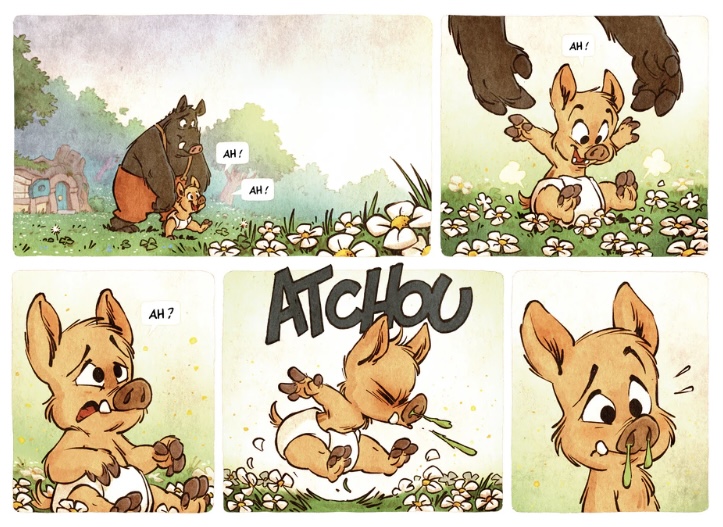
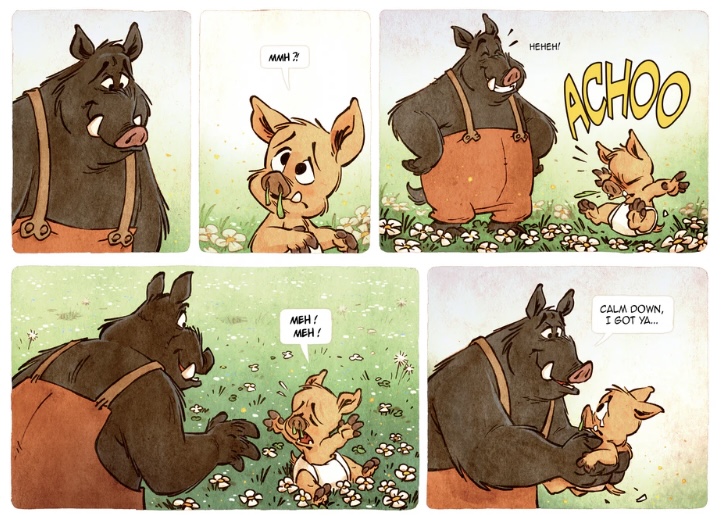
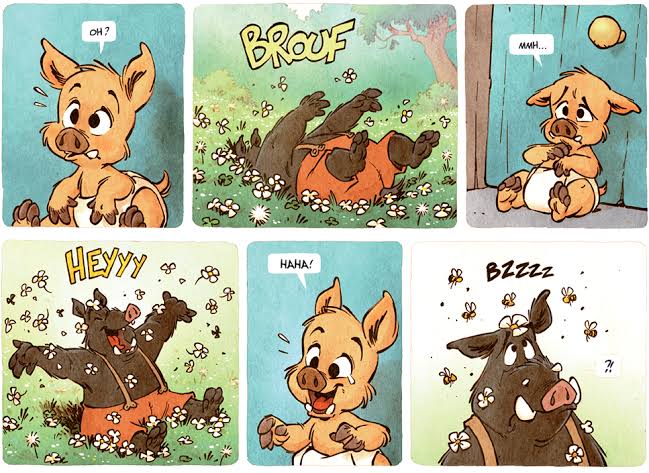
It’s spring and all Mr Warthog wants to do is pick a bunch of flowers for his son’s mother. This isn’t as easy as it sounds because baby warthog has allergies but Mr Warthog is determined.

In between all of the sneezing, the wonders of spring are also evident. There are surprise butterflies. The kids in the neighbourhood are playing in the sunshine. The flowers are beautiful.

description

But then I learned why it was so important for Mr Warthog to pick the flowers and, I’ll be honest, a part of me broke at that point. After having seen other characters in the series frustrated and cranky, I’d expected some emotional component to this story but I didn’t expect to feel so sad reading a book about spring.

Despite the sadness, and maybe even partially because of it, I was able to appreciate the efforts of a father doing his best to comfort and take care of his son.

description

Like the rest of the series, the text is minimal in this book. The majority of the story, especially the emotion, is told through the images.

description

Being spring, there are plenty of yellows and greens. When the weather and mood change, there’s a darker palette.

Having now made my way through all of the seasons, I’m having trouble picking a favourite. However, I expect this is the story that’s going to stay with me the longest.

Bonus fun fact: Baby warthogs are called piglets.

Thank you so much to NetGalley, Magnetic Press and Diamond Book Distributors for the opportunity to read this picture book.

Rating: 4 out of 5.

Once Upon a Blurb

Winter has thawed and Spring has sprung! The forest is turning green again and no one is more excited to experience it than Mr Warthog and his brand new baby boy who gets to experience the great big outdoors for the very first time!