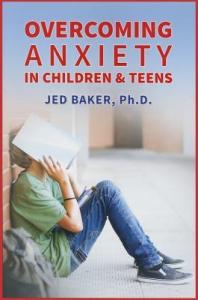
Overcoming Anxiety in Children & Teens – Jed Baker

In Overcoming Anxiety in Children & Teens, Jed Baker both outlines theory and provides practical advice for parents with anxious kids. The aim of treatment is realistic in that it doesn’t promise to eradicate anxiety completely as we all experience anxiety at times. The goal is to help the child/teen no longer be controlled by it.

Baker differentiates between true alarms and false alarms. True alarms are when someone is actually in danger. When someone experiences false alarms, reacting with anxiety over events that present no actual danger, gradual exposure therapy can reduce their anxiety. Cognitive behavioural therapy (CBT) aims to assist the individual to manage their fears by challenging their thoughts rather than allowing thoughts and emotions to rule their behaviour.

Touching on medications that may assist in the management of anxiety as well as their side effects but recommending they be used after trying other tools first, the author also outlines non-pharmacological alternatives such as exercise, meditation, mindfulness and neurofeedback. I’m not sure how I’d react as a parent being told in a book about anxiety that one of the possible side effects of medication use for my child is problems with their sexual performance. 😂

Baker describes his approach to making therapy less threatening to young people by initially focusing on their strengths while also addressing challenges (things that can prevent someone from reaching their goals) and the importance of taking into account other areas of a person’s life that may be contributing to their anxiety levels. Information is also given about how fear ladders can work to assist a child to gradually face their fears from least to greatest.

Intrinsic and extrinsic rewards for climbing the fear ladder steps were outlined. Personally I have some issues with a couple of the extrinsic rewards. Linking food rewards to preferred behaviour reminded me too much of Pavlov’s dogs and I wondered about the wisdom of rewarding children with junk food.

I can certainly see the benefit of rewarding them with time spent doing activities they enjoy but I baulked at the idea of paying kids for taking steps to overcome fear. Granted this is a different situation but it reminds me of a girl I played netball with whose father paid her $1 per goal she got each game. Naturally it made no difference to the girl if a teammate was in a better shooting position; she took every shot because she wanted her $1. We were kids in the 80’s and let me tell you that $1 was a lot of money to us at the time! Speaking of junk food, $1 could buy you 20 lollies of your choice in a white paper bag at the local shop.

I’m also not keen on 1 to 5 rating scales. This isn’t a specific problem with this book although it does use them but a pet peeve in general. My argument against these is twofold. People invariably will rate the same thing differently; what is an anxiety level of 2 out of 5 for one person, another may rate as 4 out of 5. Also, even an individual’s rating may not be consistent and could be affected by so many variables including whether or not they’ve had a good day, if they’re hungry or if they got enough sleep the night before.

Specific attention is given in this book to providing tools to manage fear for children who are less verbal, including those with autism. Chapters also provide case studies of the author’s work with children with specific anxieties – simple phobia, social anxiety, selective mutism, separation anxiety and school refusal, panic disorder, Obsessive Compulsive Disorder (OCD), somatic symptom disorder and/or illness anxiety disorder, Generalised Anxiety Disorder (GAD), perfectionism and other common fears that don’t fall into disorders outlined in the DSM-5, including fear of others’ aggression and fear of unexpected changed in schedule or routine.

The case studies, whilst fairly repetitive in parts, would be useful for parents who could read the first section of the book and then focus on the chapter that specifically covers their child’s experience with anxiety. I would anticipate that by reading an outline of a child facing a similar situation and what steps were taken to reduce their anxiety, this would provide much needed hope to a parent that their child will be able to replicate this success.

Having studied anxiety disorders fairly extensively, this book didn’t break any new ground for me but I found its concepts were explained in an approachable way, steering clear of the scientific mumbo jumbo that can put off people who just want answers.

Quoting from other people’s studies and theories (along with plugging their own books several times) the author doesn’t appear to be claiming they’re coming up with a new model for treating anxiety in children but instead explaining existing models and showing parents how they can be applied by using case study examples. While the majority of the references cited throughout the book are ten or more years old, additional tools were also provided in the form of potentially useful websites and apps.

Time is spent explaining how to get the child on board but fails to provide any information regarding what a parent is supposed to do if their child refuses to cooperate with the treatment plan.

I wasn’t a fan of the photographs used in this book. They silently scream, “Dodgy clichéd stock images!” Personally I’d prefer no images over ones that make me roll my eyes. However, this isn’t a photography book so the images have no bearing on my rating.

I particularly liked the scripts that parents and teachers can use to guide children through relaxation, breathing techniques and mindfulness. I’ve read ones similar to these before but have never come across ones written specifically for use with children and found the explanations of the techniques well done.

Thank you so much to NetGalley and Future Horizons for the opportunity to read this book.

Rating: 3.5 out of 5.

Once Upon a Blurb

The key to this book is that it outlines both the science and art of anxiety therapy. The science of overcoming anxiety is using the well researched approach called gradual exposure therapy which involves helping individuals gradually face their fears. The art of therapy is figuring out how to actually convince someone to face their fears. Jed describes motivational techniques, cognitive behavioral strategies, exercises, relaxation and mindfulness guides to lower anxiety to the point where individuals can begin to confront their fears. The book covers: simple phobias, social phobia, selective mutism, separation anxiety and school refusal, panic disorder, obsessive compulsive disorder, somatic symptom disorder and/or illness anxiety disorder, generalized anxiety disorder, perfectionism, and other common fears.

The A to Z of Eating Disorders – Emma Woolf

In The A to Z of Eating Disorders Emma Woolf tackles the whole alphabet, including those pesky consonants Q (quinoa), X (xerophagy) and Z (zinc). Using personal experience along with recent neurological discoveries and the changes to classifications in the DSM-5, Emma’s dictionary takes a whole body approach to explaining risk factors, along with the experience of and recovery from eating disorders.

Covering topics focusing on physical, psychological, neurological, social, emotional, mental, behavioural and societal issues surrounding these disorders, this is a helpful tool for those wanting to learn more about eating disorders or those experiencing them firsthand.

E is for extremes
A is for alexythymia
T is for teeth
I is for insula
N is for neuroscience
G is for gastrointestinal complications

D is for dishonesty
I is also for impromptu
S is for selenium
O is for Obsessive Compulsive Disorder (OCD)
R is for recovery
D is also for deprivation
E is also for emotional eating
R is also for refeeding
S is also for set point theory

S is also for self-compassion
U is for urination
C is for carbohydrates
K is for Key’s classic study

Naturally, there is no substitute available for professional advice and supervision but this book provides useful supplementary information and guidance.

Having said that, I personally know that books can benefit someone with an eating disorder greatly. While it didn’t cure my eating disorder a young adult novel (before the genre existed) was the catalyst that stopped me vomiting after eating. It was 1993 when I read about oesophageal tears for the first time and became so terrified of them I stopped that behaviour immediately. If anyone is interested that lifesaving book was Please Don’t Go by Katherine Applegate and I originally found it at my local library. Yay libraries! I’ve since bought my own copy and will never part with it.

I’ve read many books about eating disorders since they came into my life 25 years ago (geez, that makes me feel old!) but I learned a lot personally from reading Emma’s book. I really nerded out during the explanations of how different vitamins impact on the brain’s functions. Some complex ideas are explained in ways that are accessible to those without scientific backgrounds.

I never realised that the brain uses 50% of the body’s blood sugar, even when you’re at rest and that fat makes up 60% of the dry weight of the brain. Just those two points explain so much about the behaviour and thought patterns of people with food starved brains.

I wasn’t aware of the correlation between disordered eating and hoarding tendencies, although given the similarities in traits between the two it shouldn’t have been a surprise. It also turns out there are many “rexia’s” I’d never heard of including bigorexia, drunkorexia, orthorexia and pathorexia, along with terms like Veganuary and Flexitarianism. I guess I’ve been away from social media just about the right length of time if I’m becoming out of touch with the social world.

I found this book’s no nonsense approach to be refreshing. It encourages accountability and taking steps to help yourself along with obtaining much needed support from professionals. It provides empowerment rather than condescension, hope rather than condemnation, and talks to rather than at you.

I loved the explanation of the role of control in eating disorders. Those with anorexia in particular can feel that their lives are out of control and the only thing they can control is food – what they eat, when they eat and how much they restrict, but in fact this is an illusion. Emma made a 💡 lightbulb moment 💡 point for me, that it’s actually the eating disorder that controls you, not the other way around.

I don’t personally believe the superfood hype so to read that Popeye was right made my heart sing. 🎶 Spinach is more nutritious than kale! 🎶 I detest kale!

My small gripe with this book is the lack of references. The author will say that “studies have shown…” but doesn’t back her statement up with citations which could diminish the credibility of these claims in the eyes of the reader. So unfortunately I can’t tell you the details of the studies that debunk kale, but I want to believe!

Thank you so much to NetGalley and Sheldon Press for the opportunity to read this book. I’m definitely interested in reading more from this author.

Rating: 4 out of 5.

Once Upon a Blurb

Are you worried about your food intake? Do you weigh yourself most days and feel guilty if you gain half a pound? Do strict rules dominate your mealtimes and life, just so you can feel more in control?

The A to Z of Eating Disorders is a road map for anyone who wants a way out of the bewildering world of disordered eating and body-image anxiety.

From anorexia, bingeing and clean eating, to social media, yo-yo dieting and size zero, this book explores these complex conditions from a range of angles, offering valuable insights and hope.

In this inspiring, impeccably researched book, renowned writer and broadcaster Emma Woolf says, ‘Eating disorders cause untold misery and can affect anyone at any time of life. As someone who has lived through anorexia and recovery, I receive emails every day from those desperate for guidance. The A to Z of Eating Disorders helps to demystify disordered eating and sets you back on the path to a happy, healthy relationship with food.’

Choosing to Live: Stories of Those Who Stepped Away from Suicide – Clifford Williams

Content Warning: Please be aware that if you find a topic triggering, you will most likely find it in this book. Topics include alcoholism, drug addiction, self-harm, all kinds of abuse, domestic violence, bullying, eating disorders, and of course, suicide attempts and suicidal ideation.

I applaud the intention of Choosing to Live: stories of those who stepped away from suicide. This book is aimed at reducing the stigma associated with talking about suicide and is marketed toward anyone who has ever had or now has suicidal feelings, families and friends of those people, therapists and psychology students and professors.

I would like to give acknowledgement to the courage of the individuals who told their stories for this book, and compassion to the families and friends of Hannah and Alistair who are grieving their loss.

The stories in this book are from people ranging from 18 to 61, with various precipitating factors that led to their suicide attempt/s. The following questions were asked to each participant:

  • What led up to your suicide attempt?
  • What keeps you alive now?

Told in sections, the individual stories are grouped by themes of rejection, overwhelming stress, bullying, not feeling good enough, painful memories, teenage stresses, ups and downs, a strange impulse, parental abuse, depression and anxiety, break up of a significant relationship, ambivalence, lack of support, shame and addiction, dysfunctional relationships, suicide of a parent, medical conditions, and being in hospice care. Of course, there are overlaps with some stories fitting just as well in multiple categories.

The From Despair to Hope chapter towards the end of the book has answers from survivors to the following questions:

  • What did you feel like when you were struggling with despair and hopelessness?
  • What did you feel when you realised you were still alive?
  • What do you like most about living now?

There is also a chapter that asks survivors what they would have wanted someone to do or say to them when they were suicidal. Finally, there is a chapter giving tips on how to deal with someone who is suicidal and American phone and internet resources.

Overall the stories, while painful and heartbreaking, are definitely useful teaching tools for anyone who wants to understand what would cause someone to make an attempt on their life, what may prevent it from happening, and what may help after an attempt has been made.

However, there were a few pretty big concerns I had about this book.

  1. Specific mention is made in the introduction that none of the participants were interviewed while they were suicidal and they were reflecting on previous experiences. I was surprised when I read later in the book that some participants had only attempted suicide a matter of weeks prior to being interviewed and questioned the judgement used in choosing participants this soon after such an experience.
  2. I personally feel it is reckless to recommend a book to people who have been suicidal or currently are that contains so much detail about how the individual attempts were made. I understand that part of each person’s story includes the method they used but there are ways to do this without it reading like a ‘How To’ manual. Surely it would have been more prudent to say someone attempted suicide by overdosing rather than specifying how many tablets they took and which class of medication it was. Of course if someone is determined to die they will find a way to do it but in a book that is hoping to prevent deaths it just doesn’t seem wise to include such detail.

This last point is more a small marketing concern. If I saw this book surrounded by others on the subject I doubt I would pick it up. This sounds really petty but I really do judge books by their cover and the cover design of this book is clichéd and doesn’t scream, “Hey, you! Pick me! Pick me!” A more professional looking cover would help draw people to it.

Thank you very much to NetGalley and Smith Publicity for the opportunity to read this book.

Rating: 3 out of 5.

Once Upon a Blurb

Choosing to Live contains stories about people who tried to commit suicide, told in their own words, based on the author’s interviews with them. Each story serves as a source of encouragement and speaks with a clear voice to all those who struggle with suicide to assure them that they are not alone. 

Choosing to Live is a must-read for individuals with suicidal feelings and for their relatives and friends who have suffered with them. Caregivers will gain new insights into the mental anguish that taunts individuals who battle the inner turmoil of facing each new day. 

The author believes that people crave to tell the story of their lives, even if it involves wanting to die. The names of the people involved have been changed, including identifying details, to preserve anonymity. 

Specific topics include: rejection, overwhelming stress, bullying, painful memories, teenage stresses, ups and downs, parental abuse, depression and anxiety, breakup of a significant relationship, lack of support, shame and addiction, dysfunctional relationships, and suicide of a parent. 

Choosing to Live provides a voice to those who have attempted suicide. It will serve as a valuable resource for psychiatrists, social workers, crisis counselors, clergy, medical practitioners, social welfare personnel, human service workers, and primary care providers.

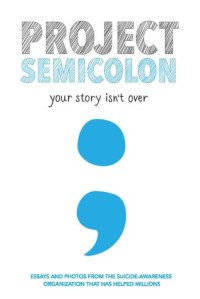
Project Semicolon: Your Story Isn’t Over – Amy Bleuel

If you don’t take anything else away from this review, please know:

  • You are not alone
  • There is help available
  • You deserve it. Yep, even you! 😃

If you need immediate help and you live in Australia, please contact Lifeline at 13 11 14 or online at http://www.lifeline.org.au. If your life is in danger, please call 000.

The note at the beginning of Project Semicolon says it much better than I could …

“WARNING: If you suffer from suicidal ideation or mental illness, some of the stories that follow may trigger an adverse reaction. If you feel this kind of content may be triggering, we advise that you consider not reading this book. And if you do read and a story is beginning to upset you, please stop reading immediately.”

There are a multitude of potential triggers in this book. They include suicide, grief, mental illness, self harm, bullying, abuse, addiction, eating disorders, and plenty of family dysfunction. If you’re looking for a hopeful, lovely read, this is not the book for you. If you want to gain understanding about what leads to someone wanting to take their own life or what life is like for the friends and family members of those who have, this is the one. This is a super duper important book.

Whoever you are and whatever your background, please be safe while reading this book. It’s full of people courageously sharing some of the most difficult life experiences anyone can go through. There is hope but there’s more pain. This is an upsetting book. There’s no way it can’t be.

I would have personally preferred for there to be fewer stories but more detail in this book. Often I felt like the stories were written with a focus on the pain and ended with either the writer saying things have or haven’t improved but I would have liked for there to have been a greater focus on the steps in the journeys that helped each individual. While no book is a substitute for medical advice or counselling, I feel it would have been useful for people looking for hope in their own lives to be able to clearly identify what worked for each writer so they could implement the tools that they feel may be beneficial to them in their own lives.

If you need support after reading any part of it, please reach out for it. The best first contact I can suggest (besides your local suicide hotline or emergency number) is your local doctor. I personally have two GP’s that are unsung heroes in my life. Your local doctor knows your medical history (physical and psychological) and can offer support and guidance that’s suitable for your situation. They can prescribe medication should you need it. They can refer you to the right service for you to get the help you deserve, whether that’s a counsellor, support group or any number of other services that you probably aren’t even aware of in your community.

I’d recommend making a long appointment so your doctor and you have the time needed to spend on coming up with a plan that will help you in the short or long term. Your local doctor has likely heard it all before (many times) and you won’t be telling them anything that will shock them. If you’re too embarrassed to say what you need to then write it down and hand it to your doctor or read from it. In all likelihood they’ll be supportive and proud of you for taking the first step in getting help. If your doctor isn’t supportive then by all means try another and another until you find one that will help you.

I accidentally came across Project Semicolon on social media several years ago. When I read that the semicolon was chosen because in literature a semicolon is used when an author continues a sentence rather than ending it, I loved the symbolism and it’s stayed with me.

I liked seeing all of the various semicolon inspired tattoos scattered through the book. While I don’t have any permanent tattoos, I adore them and always have a variety of the temporary kind on hand whenever the whim comes to decorate or express myself. I do have a stack of semicolon tattoos and use them whenever I’m going through a difficult time to remind myself that I’ve gotten through difficult times before and I’ll get through this one too. I find it’s a subtle but effective visual reminder.

When I’m struggling with whatever I’m facing, I remind myself that my story is not over yet and that simple reminder has never failed to provide me strength. In the midst of emotional or physical pain it can be difficult to see past it and remember that it hasn’t always been like this. One of the things I’ve discovered over the years is that everything is temporary.

I’ve had times where I was certain I’d never smile again and when I look back on those times now it hardly seems like I’m the same person who felt that way. I’ve had a number of the triggers in this book as my triggers over the years and some of those are no longer triggers, and those that are don’t trigger me with the same intensity or frequency that they once did.

I look back at 15 year old me who had already attempted suicide three times and I want to go back and tell her all of the things she’ll miss out on in the future if she doesn’t survive. Not wanting to sound facetious, but can you imagine the books I would have missed out on reading over the past 20 odd years and how many I plan to read in the future?! And that’s just one thing I would’ve missed out on! I think of a primary school friend who seemed to have it all yet died by suicide in her early 20’s. I want to give her a huge hug and say that one thing, whatever it would have been, that would have meant things would have turned out differently for her and her family.

I promise you, nothing stays the same. Things can, and do, get better. There is someone who will understand you and your situation. You do have what it takes to recover, whatever that looks like to you.

Rating: 4 out of 5.

Once Upon a Blurb

This book from suicide-awareness organization Project Semicolon chronicles the global phenomenon of the semicolon tattoo, combining photos of individuals’ tattoos with their stories about struggling with suicide and mental illness.

The Blind – A.F. Brady

The Blind is the first novel of a Mental Health Counsellor/Psychotherapist so you know going in that there’s going to be plenty of introspection by the main character, and there was.

Sam has worked hard to maintain her reputation for being the most reliable and competent psychologist at Typhlos Psychiatric Centre. She’s praised by her manager, Rachel, and is given all of the tough cases that no one else can handle.

Richard comes to Typhlos with practically no background information and won’t talk. After becoming involved in his case, Sam finds herself in a situation she’s unfamiliar with. Richard is not giving anything away and all of Sam’s usual techniques don’t work on him. As they spend more time together, the mind games begin.

Usually I’m so engrossed with characters and what’s happening that the big reveal comes and I’m just as surprised as the character. When I figure it out early it indicates to me that I’m not emotionally involved in the book and/or the big reveal is super obvious. I found myself in both categories during this book. I didn’t emotionally connect to any of the characters and worked out the big reveal plus the psychological diagnosis of a character by 20%.

Had I not already committed to reviewing this book I would have stopped reading at 20%. I was so irritated by one of the characters and their behaviour that I was over it. I knew as I was reading that the author was setting the scene for later in the book but by 20% I no longer cared. I’m a firm believer in there being so many books on offer out there that you shouldn’t have to fight to get into one.

If you’re feeling like I was, hold on. It does get better from just before the end of Part 1 but it never really took off for me. It does give the reader insight into what it’s like to live with mental illness and to work in the field. I feel like this is a 2.5 star book but am rounding up in recognition of this being a debut novel.

Thank you very much to NetGalley and Harlequin Australia for the opportunity to read this book.

Rating: 3 out of 5.

Once Upon a Blurb

With the intensity and rawness of Girl, Interrupted and Luckiest Girl Alive comes this razor-sharp debut, which reveals how one woman can go so far off the deep end, she might never make it back up.

Sam James has spent years carefully crafting her reputation as the best psychologist at Typhlos, Manhattan’s most challenging psychiatric institution. She boasts the highest success rates with the most disturbed patients, believing if she can’t save herself, she’ll save someone else. It’s this saviour complex that serves her well in helping patients battle their inner demons, though it leads Sam down some dark paths and opens her eyes to her own mental turmoil.

When Richard, a mysterious patient no other therapist wants to treat, is admitted to Typhlos, Sam is determined to unlock his secrets and his psyche. What she can’t figure out is why does Richard appear to be so completely normal in a hospital filled with madness? And what, really, is he doing at the institution? As Sam gets pulled into Richard’s twisted past, she can’t help but analyse her own life, and what she discovers terrifies her. And so the mind games begin. But who is the saviour and who is the saved?

In this unexpected and addictive psychological debut, A.F. Brady takes readers into the psyche of a deeply disturbed woman desperately trying to keep her head above water, showing that sometimes what’s most terrifying is what exists in your mind.

Lighter Than My Shadow – Katie Green

Katie’s troubles with food began when she was a young child hiding toast in her bedroom and throwing food away. After experiencing bullying Katie’s doubts about herself really take root, especially after she compares her body to others and thinks hers is out of proportion. She begins deliberately restricting her food intake, then becomes obsessed with nutrition and calorie counting. Her father takes her to see a doctor at 17 and in the doctor’s ‘wisdom’ she suggests Katie eat ice cream. Surprise, surprise … this is not the solution. I know! Shocking, huh?!

Finally Katie is taken to hospital where she’s diagnosed with anorexia nervosa. Her parents withdraw her from school so she can be monitored at all times and she begins to see a psychologist and a dietician. Katie then uses the same perfectionism that got her into trouble in the first place as she begins to work towards recovery. Her intense need for control ensures she feels like she needs to do everything she attempts perfectly to make her feel good enough, but of course that doesn’t help.

Katie is very honest about her struggle with food and about instances of sexual assault she later experiences. Her discussions with her therapist about her anorexia, binge eating and effects of sexual assault are difficult to read but so important. Those who have experienced any combination of these issues will see themselves in Katie’s experience of healing and those who haven’t experienced them will gain valuable insight into the thought processes that accompany such painful experiences. Katie’s experience, while it certainly highlights how difficult recovery is, tells us that recovery is indeed possible.

Katie’s illustrations in this graphic novel are fantastic. I loved how well the story came to life through the pictures alone. It was clear how all of the people were feeling in each panel and the depiction of Katie’s thoughts and illness hovering over her head worked perfectly for the story. I applaud Katie for her strength and courage in not only telling her story in the first place but in sharing it with the reader.

I personally appreciated all of the “me, too” moments I felt while reading, as if Katie was speaking directly to my experience in specific sections. There was also a very significant lightbulb moment for me that I expect will help me immensely once I’ve had a chance to process the magnitude of the revelation I received. While it’s not all about me (except when it is) I’d like to personally thank Katie if she ever comes across this review because her courage in telling her truth is causing a ripple effect in my life. Thank you, Katie! I’ll be revisiting this book whenever I’m looking for wisdom, strength and understanding.

Thank you so much to NetGalley and Diamond Book Distributors for the opportunity to read this graphic novel.

Rating: 5 out of 5.

Once Upon a Blurb

Like most kids, Katie was a picky eater. She’d sit at the table in silent protest, hide uneaten toast in her bedroom, listen to parental threats that she’d have to eat it for breakfast.

But in any life a set of circumstance can collide, and normal behavior might soon shade into something sinister, something deadly.

Lighter Than My Shadow is a hand-drawn story of struggle and recovery, a trip into the black heart of a taboo illness, an exposure of those who are so weak as to prey on the vulnerable, and an inspiration to anybody who believes in the human power to endure towards happiness.

Depression & Other Magic Tricks – Sabrina Benaim

poetry and i usually don’t mix / we repel like opposing ions / my synapses don’t fire / when sparked by verse / however / a flame was lit at the start / kindled by depression and anxiety / yet heartbreak’s oxygen did not fan the flames / satisfied yet / desiring more like / explaining my depression to my mother / a conversation

i don’t know sabrina benaim / never heard her voice / yet depression and i are old buddies / we dance around each other / and make somber music / in the dark recesses of my mind / we love yet hate / one another but / we continue our duet

at times i am sure my getaway car / has obscured my shadow in dust / then i turn the corner / and the sunlight causes me / to glance behind with horror / my shadow has grown large / absorbing the light / and creeps closer / as it follows / sabrina you exhale with eloquence / shine light upon the dark / adjust focus so we can see / the hope depression conceals

anxiety can pick me / out of a line up / loneliness of knowing / in a crowded room / i’m the only one / from my tribe / despair at lack / of understanding / treated like a curiosity / different / not enough

heartbreak / a foreign land / i am an alien there / yet made clear / by hearing sabrina

dark / depression / loneliness / heartbreak / anxiety / despair / swirl into one / flood of emotion / aching / desert of nothingness / numbness / muddy clay that distorts / yet resilience / hope / light

gratitude / netgalley / gratitude / button poetry / gratitude / independent book publishers association / my thoughts for free / lasting impression / set aside other words / drink in this offering / to be returned to again / and again / to sip / to guzzle / to absorb / no regrets

Rating: 4 out of 5.

Once Upon a Blurb

Depression & Other Magic Tricks is the debut book by Sabrina Benaim, one of the most-viewed performance poets of all time, whose poem “Explaining My Depression to My Mother” has become a cultural phenomenon with over 5,000,000 views. 

Depression & Other Magic Tricks explores themes of mental health, love, and family. It is a documentation of struggle and triumph, a celebration of daily life and of living. Benaim’s wit, empathy, and gift for language produce a work of endless wonder

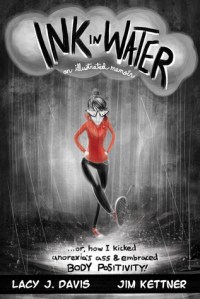
Ink in Water: An Illustrated Memoir (Or, How I Kicked Anorexia’s Ass and Embraced Body Positivity) – Lacy J. Davis

Illustrations – Jim Kettner

Lacy J. Davis has nailed it in this graphic novel memoir of her battle with an eating disorder in Ink in Water. She bravely takes the reader on a journey with her from its inception with thoughts of not being good enough to the beginnings of food restriction and anorexia, to compulsively exercising and finally bulimia. We watch on as her world shrinks along with her body, as she shuts out friends while her obsession with her body takes hold. We’re taken inside her mind as she battles the thoughts telling her she’s too fat and we silently cheer her on from the sidelines as we watch her courageously fight to become healthy again and triumph over her demons.

While everyone fighting an eating disorder is on their own journey, Lacy takes us on an unflinching ride through hers. Not sugarcoating (yeah, I know, weird word to use in a review for a book about eating disorders) her struggles, yet ultimately giving us hope, this book will speak to everyone who has had, has or knows anyone with an eating disorder. People who can’t understand why they just don’t eat more or why they don’t just stop exercising so much will gain much needed insight into what life with an eating disorder looks and feels like.

There are as many stories behind why eating disorders begin as there are people struggling with them and what works for one person may not work for another as they work towards recovery. I applaud Lacy for showing us that recovery from eating disorders isn’t a success only path but that ultimately there is hope.

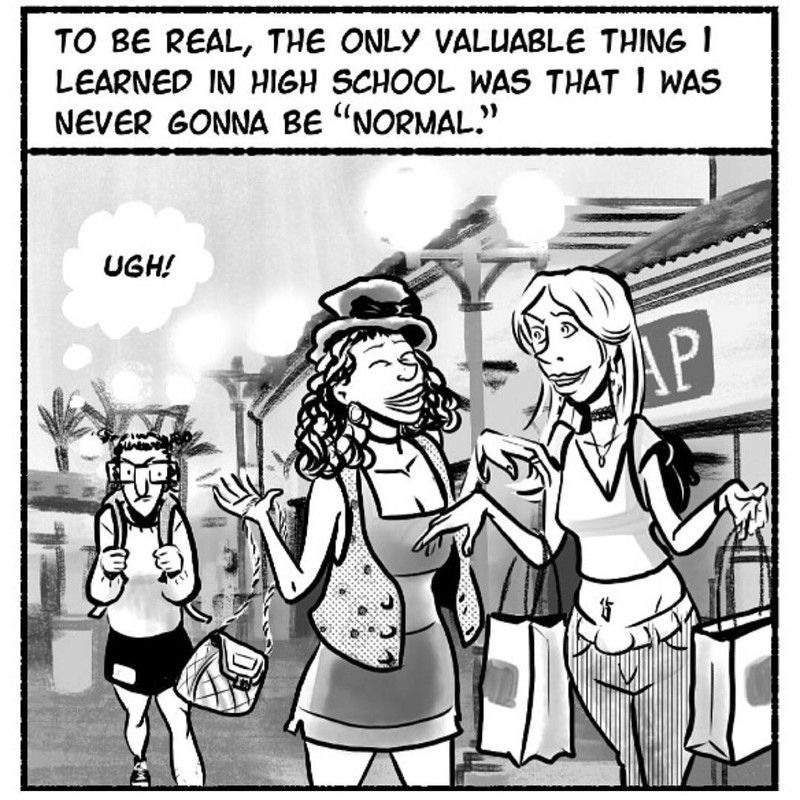
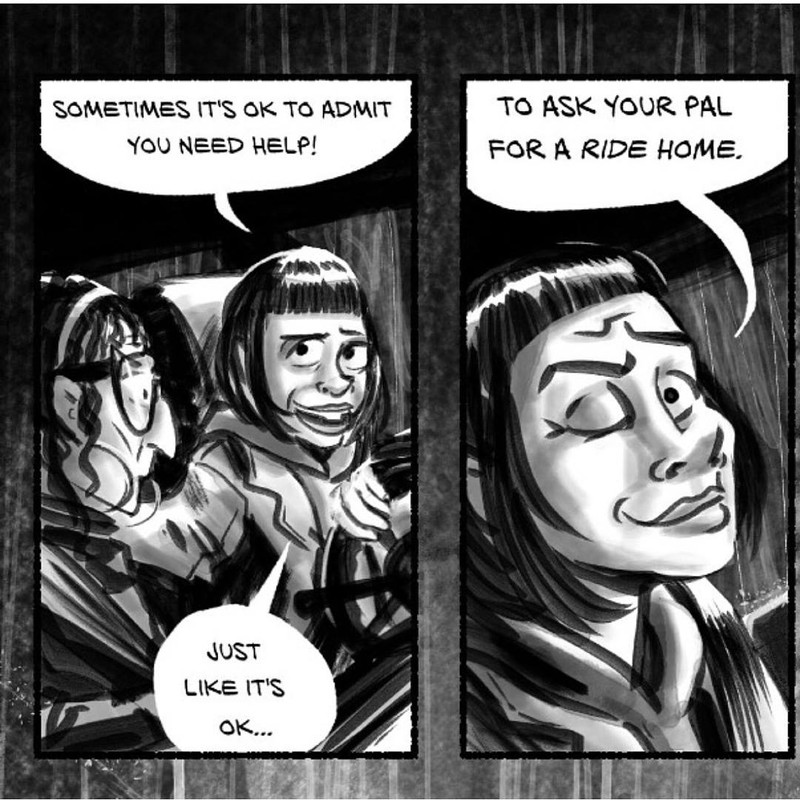
Jim Kettner’s illustrations are gritty and take us deeper into Lacy’s journey than we could have gone with words alone. We become a part of Lacy’s struggles and her grief, we’re inside her head listening to the voices telling her she’s not enough and we feel the hope that shines through despite her struggle.

Thank you so much to NetGalley and New Harbinger Publications, Inc. for the opportunity to read this graphic novel. If you have an eating disorder I encourage you to keep fighting, don’t stop searching until you find treatment that works for you and hold onto hope. Recovery is possible. Yes, even for you!

Rating: 5 out of 5.

Once Upon a Blurb

At once punk rock and poignant, Ink in Water is the visceral and groundbreaking graphic memoir of a young woman’s devastating struggle with negative body image and eating disorders, and how she rose above her own destructive behaviours and feelings of inadequacy to live a life of strength and empowerment.

As a young artist living in Portland, Lacy Davis’ eating disorder began with the germ of an idea: a seed of a thought that told her she just wasn’t good enough. And like ink in water, that idea spread until it reached every corner of her being. This is the true story of Lacy’s journey into the self-destructive world of multiple eating disorders. It starts with a young and positive Lacy, trying to grapple with our culture’s body-image obsession and stay true to her riot grrrl roots. And while she initially succeeds in overcoming a nagging rumination about her body, a break up with a recovering addict starts her on a collision course with anorexia, health food obsession, and compulsive exercise addiction. At the request of her last real friend, she starts going to a twelve-step Overeaters Anonymous course, only to find that it conflicts with her punk feminist ideology.

Blending bold humor, a healthy dose of self-deprecation, vulnerability, literary storytelling, and dynamic and provocative artwork by illustrator Jim Kettner, Ink in Water is an unflinching, brutally honest look into the author’s mind: how she learned to take control of her damaging thoughts, redirect her perfectionism from self-destructive behaviours into writing and art, and how she committed herself to a life of health, strength, and nourishment.

Epic Fail – Cristy Watson

Spoilers Ahead!

Jared, Bree and Kenzie have been friends for a long time, until the events that took place at a party two years ago. Jared knew his brother planned this party with his Year 12 friends with the sole purpose of having sex with as many Year 9 girls as possible. Apparently these get togethers are a common occurrence. Jared fails to warn his friends and Kenzie is raped at the party. Jared’s guilt comes to a head when a photo of Kenzie from the night she was raped is posted on social media.

Before reading this book I’d never heard of a Hi-Lo book. For those as in the dark as I was, Hi-Lo are high-interest, low-readability books; basically books with more mature themes for reluctant readers if my understanding is correct. I love the concept. Anything that helps non-readers become readers is something to be applauded in my world.

I felt this book had potential as it addressed rape culture. It saddens and horrifies me that rape is so prevalent in society that it has its own culture. I’m not sure you can ever say that you enjoy a book where the central theme is sexual assault but in the context of a Hi-Lo book, I think the author did a good job.

I liked that this story is told from the point of view of a 16 year old boy. The majority of books I’ve read about sexual assault are told primarily from a female perspective. I like that at the end of the book the author listed some website resources. I didn’t really find a connection with any of the characters, although that may be in part because this was a quick read and as such there wasn’t the opportunity to get to know the characters as well as you do in longer novels.

I can understand Jared questioning why Kenzie never reported what happened to her. Until you’ve been there you don’t know what you’d do in that situation and there is no right or wrong answer. Some people report. Others don’t. I can understand both sides.

I appreciated the growth shown in Jared’s character throughout the book and how he kept trying to reach out to Kenzie. Jared talks about how useful the mediation training sessions he’s been attending have been but I would have liked to hear more about what he learned so readers could take something else away from the book.

I felt as though some of language attributed to the teens in the book didn’t work for the target audience or as examples of how young people speak. I’m not sure 15 and 16 year olds would be using terms like ‘young man’ used to describe a teenager in a video, or ‘compromising photos’ used to describe nude selfies or revenge porn. Also, some of the conversations read like they belonged in a pamphlet found in a counsellor’s office, not coming out of the mouths of teens.

It really frustrated me that while the author mentioned Kenzie was getting slut shamed on social media, the photograph in question constituted child pornography and no one did anything about it. While the focus is on Kenzie’s rape, there’s all of this blame from the characters towards Bree. Yes, Bree made really bad decisions, but… Maybe there are different laws where the author lives but where I come from a 14 year old girl is not old enough to legally be able to give consent so even if she was all for it, it’s still statutory rape.

I would have liked to have seen at least one person other than the victims experience consequences. Cam gets away with raping Kenzie. Seth gets away with physically abusing Jared, the statutory rape of Bree, and the production and distribution of child pornography. Who knows how many unnamed Year 12 boys raped how many unnamed Year 9 girls at their parties. Countless people in social media land do nothing when they see child pornography being distributed except shame the victim. Bree distributed child pornography and deserves to go down in history as being one of the worst friends ever. Jared’s father gets away with the blatant neglect of his son. No one at the school appears to even acknowledge the fact that Kenzie barely attends. I could probably go on, but that’s enough frustration at the lack of accountability.

Thank you very much to NetGalley and Lorimer Children & Teens for the opportunity to read this book. I’d recommend watching Audrie & Daisy to anyone interested in a great documentary that complements the themes of this book quite well.

Rating: 2 out of 5.

Once Upon a Blurb

Epic Fail tells the story of Kenzie, a 16-year-old half Native American girl, and her two best friends, who have grown up in a multiracial, mixed-income suburb. Two years after a party where Kenzie was raped, she is still dealing with the trauma. When photos of the incident appear on social media there are serious consequences for everyone involved.

This book tells a tough but realistic story about teen relationships and sexual assault and how social media plays a role in magnifying its impact.

All Things New – Lauren Miller

If Parallel and Free to Fall were 5 out of 5 books for me, then All Things New has to be a 6. While Lauren Miller’s first two novels were exceptional, I found extra depth in All Things New. Anxiety, written well, by someone who understands it! Now, this is a combination you don’t see very often. Thank you so much for writing this book, Lauren!

Because Lauren gets it, Jessa’s internal voice is authentic. As someone who is all too familiar with this dragon and coincidentally has also experienced long term effects from a car accident, I went on this journey with Jessa. I empathised with Jessa recounting how it felt when her friends ditched her after her panic attacks started. I cheered internally when Jessa’s courage to let her walls down was rewarded instead of punished. I felt anxious for her when she was anxious for her friends.

I loved how real the supporting characters felt to me and cared about what happened to them. I admired Jessa’s father for how hard he worked to build a relationship with his daughter. I appreciated that Hannah wasn’t a cliché, that she got snippy when she was frustrated by something or herself. Mr I. … what can I say except I wanted to curl up on a comfy couch somewhere, probably next to a roaring fire, and listen to him explain philosophy to me all day. (By the way, I get so excited when a book I love includes references to other books. Oscar Wilde and Descartes are definitely getting added to my scarily high TBR pile.)

And frustratingly optimistic Marshall. I adored him despite myself and would like to put an order in for a Marshall please (albeit an age appropriate one for me). Maybe he’s got an older cousin? The banter between Jessa and Marshall was so much fun! Because I read a snippet of a review that compared this book to John Green’s The Fault in our Stars, I spent most of this book anxiously muttering, ‘Please don’t let Marshall die! Please don’t let Marshall die!’

I was fascinated by the concept of the internal world that we often hide from others, sometimes more so from those closest to us, being made visible to Jessa. I loved Jessa’s interactions with the other characters and watching some relationships growing stronger as others faded into the background. While life isn’t a fairytale in the end, Jessa has, through her experience, learned to see and be compassionate to the internal struggles of others and her own.

We spend so much time hiding our true selves from the people around us that sometimes I wonder how much we ever really know anyone. There are entire worlds playing out inside our heads and if only we shared those with each other I’m positive we’d find out how alike we all are. Sure, everyone has their own pain and their own struggles but when it comes down to it, pain is pain. We get so afraid of rejection that we hide behind our walls, thinking we’re protecting ourselves when really we’re preventing ourselves from bring able to give and receive the support and validation that comes with knowing you’re not alone in your experience.

I found a Hallmark card about a decade ago and bought every one I could find at the time, dispensing them in the years since to those I felt would benefit from or appreciate its message like I did. This book reminded me of the writing on that card – “Daylight will peek through a very small hole. That’s how hope gets through, too.” No matter what we’re going through, there is hope, even if the hope is that things won’t always be this way. OK, stepping off my soapbox now!

This was one of those books that made me sad that you only get to read it for the first time once. However, I’m sure there’ll be a second time coming fairly soon. If I did have the chance to read it for the first time again I think I’d highlight the passages that don’t resonate with me instead of the ones that do. As it stands, because I did the opposite, my highlighter would have run dry before I got to the halfway mark if I’d been reading a paperback. Instead I wore out my index finger constantly highlighting passages on my Kindle.

Thank you so much to NetGalley and Three Saints Press for the opportunity to read this book. I’d recommend this to young adults and adults alike, to anyone who has experienced anxiety or anyone who wants to gain a better understanding of those who do, or to those who simply want to read a great book. I don’t care what you write about in the future, Lauren, but please keep writing. I’ll be reading anything you publish!

Rating: 5 out of 5.

Once Upon a Blurb

Jessa has always felt broken inside, but she’s gotten very good at hiding it. No one at school knows about the panic attacks, the therapy that didn’t help, the meds that haven’t worked. But when a severe accident leaves her with a brain injury and visible scars, Jessa’s efforts to convince the world that she’s okay finally crumble — now she looks as shattered as she feels. 

Fleeing from her old life in Los Angeles, Jessa moves to Colorado to live with her dad, where she meets Marshall, a boy whose kindness and generous heart slowly draw Jessa out of her walled-off shell and into the broken, beautiful, real world — a place where souls get hurt just as badly as bodies, and we all need each other to heal.

All Things New is a love story about perception and truth, physical and emotional pain, and the messy, complicated people we are behind the masks we put on for the world, perfect for fans of All the Bright Places and The Fault in Our Stars.