Eggshell Skull – Bri Lee

The term ‘eggshell skull’ refers to the legal principle that a victim must be accepted for who they are individually, regardless of where their strengths and weaknesses place them on a spectrum of human normality. If you strike a person whose skull happens to be as thin as an eggshell, and they break their head open and die, you can’t claim that they were not a ‘regular’ person. Full criminal liability – and responsibility – cannot be avoided because a victim is ‘weak’.

This was a really drawn out read for me – almost three months have passed since I read the first chapter. Part of this snail’s pace can be put down to bad timing; I’d finished reading Louise Milligan’s Witness less than two weeks before I started this book and it had already solidified my feelings about the way the Australian legal system chews up and spits out sexual assault survivors.

‘But what if the legal system is unfair?’

Reading about the cases that came across Bri’s desk while she was working as a judge’s associate became overwhelming at times. Some of the details were vividly described so if sexual assault is a particularly difficult topic for you, please take good care of yourself if you choose to read this book.

Bri’s experience working in the legal system offers her a different perspective than most survivors. Yet even she is not able to prepare herself for the emotional toll that her own case of historic sexual assault will have on her.

Bri is unlike so many survivors for a number of reasons.

She has the full support of her loved ones throughout the process. Many survivors do not have that luxury, having to go it alone.

She is confident that the people she tells about the sexual assault she experienced will believe her. So many survivors have not been believed when they’ve had the courage to speak out.

She reports the sexual assault to the police. “Less than one in three Australian women who are sexually assaulted ever go to the police.”

The police charge the perpetrator in Bri’s case, while “fewer than one in five sex offences reported to the police result in charges being laid and criminal proceedings being instigated.”

While I wished for less details at times when Bri was explaining the cases she worked on as a judge’s associate, I found myself wanting more details about her own court case. With such a build up throughout the book, I felt like I only managed a quick glance around the courtroom for much of the trial.

Rating: 4 out of 5.

Once Upon a Blurb

EGGSHELL SKULL: A well-established legal doctrine that a defendant must ‘take their victim as they find them’. If a single punch kills someone because of their thin skull, that victim’s weakness cannot mitigate the seriousness of the crime. 

But what if it also works the other way? What if a defendant on trial for sexual crimes has to accept his ‘victim’ as she comes: a strong, determined accuser who knows the legal system, who will not back down until justice is done?

Bri Lee began her first day of work at the Queensland District Court as a bright-eyed judge’s associate. Two years later she was back as the complainant in her own case. 

This is the story of Bri’s journey through the Australian legal system; first as the daughter of a policeman, then as a law student, and finally as a judge’s associate in both metropolitan and regional Queensland – where justice can look very different, especially for women. The injustice Bri witnessed, mourned and raged over every day finally forced her to confront her own personal history, one she’d vowed never to tell. And this is how, after years of struggle, she found herself on the other side of the courtroom, telling her story.

Bri Lee has written a fierce and eloquent memoir that addresses both her own reckoning with the past as well as with the stories around her, to speak the truth with wit, empathy and unflinching courage. Eggshell Skull is a haunting appraisal of modern Australia from a new and essential voice.

Consent – Vanessa Springora

Translator – Natasha Lehrer

Every so often I read a blurb and just know a book’s contents are going to make my blood boil. This is one of those books.

In her memoir, Vanessa (V.) tells us about G.

G. is Gabriel Matzneff, a French author who, in his books, never attempts to hide his sexual assaults (he calls it love) of underage girls and his trips to the Philippines to sexually assault even younger boys. G. is someone who has won awards for detailing his crimes.

After they met at a party, G. quickly turned his attention to Vanessa.

I had just turned fourteen. He was almost fifty.

The fury for me came in waves, each time someone who could have (and should have) protected Vanessa failed to do so.

Her father is physically and emotionally absent; he doesn’t act on the outrage he feels when he learns of Vanessa’s ‘relationship’ with G.

Her mother allows it, even casually having dinner with her daughter and her rapist. Sure, her mother “consulted” her friends about him but none of them were “particularly disturbed”. This is the woman who made a deal with the devil:

Whatever the reason, her only intervention was to make a pact with G. He had to swear that he would never make me suffer.

The police are notified on a number of occasions but their efforts can hardly be accused of being an investigation.

Then there’s Emil Cioran, a philosopher and friend of G., who came up with this gem:

“It is an immense honor to have been chosen by him. Your role is to accompany him on the path of creation, and to bow to his impulses.”

I’m so glad that Vanessa has used writing to tell her truth, the very medium that her abuser used to distort her experiences with him.

This was a quick but difficult read. I spent a significant amount of time wanting to throw the book against a wall, mostly because the people who were infuriating me weren’t conveniently standing in front of me.

The fact that so many people essentially gave this man their blessing to continue being a serial predator astounds me. Because books are such an integral part of my life I feel justified in being personally offended that G. was encouraged to continue writing about his sickening behaviour, both by the French publishers who continued to print them and the people who actually paid to read them.

G. was not like other men. He boasted of only having had sexual relations with girls who were virgins or boys who had barely reached puberty, then recounted these stories in his books. This was precisely what he was doing when he took possession of my youth for his sexual and literary ends.

This is a well written book. Just make sure you have a punching bag handy when you read it.

P.S. This NY Times article has given me a glimmer or hope that G. may get to see the inside of a jail cell. Maybe all of his published books will be good for something after all: evidence.

Rating: 4 out of 5.

Once Upon a Blurb

Already an international literary sensation, an intimate and powerful memoir of a young French teenage girl’s relationship with a famous, much older male writer – a universal #MeToo story of power, manipulation, trauma, recovery, and resiliency that exposes the hypocrisy of a culture that has allowed the sexual abuse of minors to occur unchecked.

Sometimes, all it takes is a single voice to shatter the silence of complicity. 

Thirty years ago, Vanessa Springora was the teenage muse of one of the country’s most celebrated writers, a footnote in the narrative of a very influential man in the French literary world.

At the end of 2019, as women around the world began to speak out, Vanessa, now in her forties and the director of one of France’s leading publishing houses, decided to reclaim her own story, offering her perspective of those events sharply known.

Consent is the story of one precocious young girl’s stolen adolescence. Devastating in its honesty, Vanessa’s painstakingly memoir lays bare the cultural attitudes and circumstances that made it possible for a thirteen-year-old girl to become involved with a fifty-year-old man who happened to be a notable writer. As she recalls the events of her childhood and her seduction by one of her country’s most notable writers, Vanessa reflects on the ways in which this disturbing relationship changed and affected her as she grew older. 

Drawing parallels between children’s fairy tales and French history and her personal life, Vanessa offers an intimate and absorbing look at the meaning of love and consent and the toll of trauma and the power of healing in women’s lives. Ultimately, she offers a forceful indictment of a chauvinistic literary world that has for too long accepted and helped perpetuate gender inequality and the exploitation and sexual abuse of children.

Women of a Certain Rage – Liz Byrski (editor)

There’s so much for women to be angry about … Discrimination because of your sexuality, race, ability, gender. The treatment of asylum seekers. Climate change. The inaction of politicians on any number of issues. People refusing to hear you or take you seriously because you’re a woman.

Yet, as women, it’s likely we grew up internalising our anger, swallowing it down, because to be visibly angry is not considered feminine. When we did speak up, our voices were silenced, our experiences minimised, our reality dismissed. Is it any wonder we’re angry?

Even though I’ve been an adult for longer than I was a child, I’ve yet to become comfortable with anger. Anger, when I was growing up, equalled violence and that’s not the manifestation I’m looking for. I want anger to spur me on to action, to propel me to right wrongs, not cause destruction.

In this collection, twenty women write about rage. Among them are writers, teachers, activists and medical professionals, and they range in age from 20’s to 80’s. They have diverse backgrounds but they’re all Australian.

Like other anthologies, some contributions spoke to me more than others. Reneé Pettitt-Schipp’s description of a young asylum seeker’s hope brought tears to my eyes. Goldie Goldbloom’s recollections of Max made me wish I knew him personally. Carly Findlay’s words hurt, as I imagined each scenario she described, but they also left me with hope because there are women like Carly who speak truth into the lives of others.

Rather than tell you what I thought of each contribution I’m going to instead share quotes with you.

Introduction by Liz Byrski

Let us go forth with fear and courage and rage to save the world. – Grace Paley

A Door, Opening by Victoria Midwinter Pitt

Anger is a state of opposition.

It is not merely intellectual, or philosophical. It’s personal.

It is the direct, visceral, spiritual experience of being at odds with something.

Quarantine by Reneé Pettitt-Schipp

Time and time again, it has been proven to me that we either honour the depth of each human emotion, maintaining the fullness of our capacity to feel, or we cut ourselves off and, in walking away from anger and heartbreak, turn our backs on the possibility of our most expansive expression of being a human in this world.

Waiting on the Saviour by Nadine Browne

I wouldn’t be the person I am, nor would I have had the resilience I have, without these women. But nothing we thought or did was ever any good unless it was certified by a man. The path to God itself was through a man. I’m still shocked by how these women can negate their own power, simply by the fact of their gender.

My Father’s Daughter by Jay Martin

I’m still sad, though, that the world that shaped my dad – and still shapes so many men – to believe that their value is in being providers, teachers, knowers of things. It meant I never got to know all of the vulnerabilities, dreams, passions and fears he must have harboured that made him who he was.

Regardless of Decorum: A Response to Seneca’s ‘Of Anger’ by Julienne van Loon

One of the things that makes me angry about Seneca’s ‘Of Anger’ is how bloody reasonable he is throughout.

The Girl Who Never Smiled by Anne Aly

Rage creeps up on you. It’s stealthy like that. Rage has to beat you down first and then, when you’re exhausted and you think you can’t possibly rage any more, it lingers beneath the surface, ready to pounce again. You can see it simmering behind the eyes of the downtrodden, the oppressed and the frustrated – but only if you look hard enough. Rage shadows you.

The Club by Sarah Drummond

The white road markers are plastic and so, instead of a row of smashed wooden posts where he ploughed them down, they flipped back into upright position after the accident like nothing had happened. For some reason, I found this inanimate insouciance disturbing. How dare those posts stand up again. Didn’t they know what had happened here?

Stuck in the Middle by Carrie Cox

Mark Twain, a man who apparently spent his whole life tossing pithy sayings at a sea of scribes, has been credited with comparing anger to an acid, one that can do far more harm to the vessel in which it is stored than to anything on which it is poured. This is how I feel about anger today.

To Scream or Not to Scream by Olivia Muscat

What makes me most upset is that I know where most people’s ignorance is coming from. It’s fear.

Fear of the unknown.

Fear that they may end up like me.

To the Max by Goldie Goldbloom

Goldie remembers how Max would introduce her to them as ‘the love of my life’. Whenever she sold a story, he would grip her forearms and say, ‘The cream always rises to the top.’

The Thief by Nandi Chinna

I found it impossible to articulate the magnitude and intensity of my inner experience and carried it around in my body like a ball of barbed wire that scratched and tore at my insides.

Write-ful Fury by Claire G. Coleman

Fury. It can flow hot and fast like fire dancing along a trail of petrol; it can flow cold, slow and relentless like a glacier; or as cold and breathtakingly fast as an avalanche, leaving me breathless and dying. Either way, when fury passes it’s hard to imagine anything in its path surviving.

Love More by Jane Underwood

Rage sits, like a bulky body part, ready to detonate, able to cause maximum damage. It’s not like the white-hot adrenal flash we call fury, that’s here and gone: you can relieve fury with an upraised middle finger. It’s not like anger – curl up the corner of anger – only sadness and fear there. If you can shift the bulk of a rage – find some squashed high-grade injustice there.

#AustraliaBurns: Rage, a Climate for Change by Margo Kingston

Rage begets action.

The Body Remembers: The Architecture of Pain by Rafeif Ismail

We cannot negotiate with our oppressors without relinquishing part of our own existence.

Everything is Awesome! by Mihaela Nicolescu

The notion of a ‘fair go’ disguises the reality of an unfair system and places the blame on the individual when that system fails them. A genuine ‘mate’ does not judge you for going through a hard time. And an evolved society places more value on the rights of all citizens to have their basic needs met than on the rights of a few citizens to accumulate ridiculous wealth (while one in six children live in poverty).

Uluru Statement from the Heart by Fiona Stanley

I think that in today’s world of corporate, political, bureaucratic and individual corruption and lack of care, we need to convert our anger to action more than ever.

Vicarious trauma: I Was You and You Will Be Me by Carly Findlay

Ableism starts with you.

And it can stop with you, too.

Seen and Not Heard by Meg McKinlay

And what is buried, of course, doesn’t always remain so; when conditions are right – or wrong? – it will vent, even erupt.

Women of a Certain Rage? by Eva Cox

Angry. Cranky. Mad. Can you think of any context when applying these words to a woman would be positive?

Rating: 4 out of 5.

Once Upon a Blurb

This book is the result of what happened when Liz Byrski asked twenty Australian women from widely different backgrounds, races, beliefs and identities to take up the challenge of writing about rage.

The honesty, passion, courage and humour of their very personal stories is engergising and inspiring. If you have ever felt the full force of anger and wondered at its power, then this book is for you. 

The Nesting – C.J. Cooke

‘Nature always protects itself by whatever means possible.’

Sophie has a new job as a nanny, caring for two adorable girls, Gaia and Coco. Their father, Tom, is an architect who’s currently working hard on an innovative new project in Norway. Sophie is also working hard, trying to make sure no one figures out that she’s not really Sophie, but Lexi, and that she’s not actually a nanny.

Although it appears to be the ideal escape from her real life, this new job isn’t as straightforward as Lexi had hoped. Tom’s wife died recently, supposedly by suicide, although Lexi suspects there’s more to the story. She’s also been told that the locked basement is off limits.

Even if you hear something down there, please stay out.

Hear something?

What the hell was in that basement?

Then there’s the Sad Lady, who Gaia keeps mentioning, who has holes where her eyes should be.

I’d only planned on reading a couple of pages to get a feel for the book but before I knew it I’d binged the entire thing. I enjoyed it much more than I expected I would but I am left with some question marks.

I adored the children but didn’t connect with any of the adults. The mental health components of Lexi and Aurelia’s stories intrigued me but I’m not a huge fan of unreliable narrators so I found myself questioning their realities more than I would have liked.

After such a build up, the ending felt rushed to me and some of the ways the story came together seemed a bit too convenient. Lexi’s backstory answered some questions I’d had but read more like an info dump, glossing over some pretty monumental events in her life.

With trees and a fjord, minimal sunlight and the tantalising possibility of spotting an aurora, the setting felt like its own character and made this an atmospheric read. This was helped along by the environmental message and the Norse folklore. The folklore included in this story were written by the author.

I’m interested in reading more books by this author and devouring some Norse folklore.

Rating: 4 out of 5.

Once Upon a Blurb

It was like something out of a fairytale …
The grieving widower.
The motherless daughters.
A beautiful house in the woods.

Deep in a remote Norwegian forest, Lexi has found a new home with architect Tom and his two young daughters. With snow underfoot and the sound of the nearby fjord in her ears, it’s as if Lexi has stepped into a fairy tale

But this family has a history – and this place has a past. Something was destroyed to build their beautiful new house. And those ancient, whispering woods have a long memory.

Lexi begins to hear things, see things that don’t make sense. She used to think this place heavenly, but in the dark, dark woods, a menacing presence lurks.

With darkness creeping in from the outside, Lexi knows she needs to protect the children in her care.

But protect them from what?

Lonely Castle in the Mirror – Mizuki Tsujimura

Translator – Philip Gabriel

‘If you’re told it’ll definitely come true,’ Masamune said, ‘then everyone will have a wish or two.’

Kokoro, a 7th grader who no longer attends school because of “the incident”, has the house to herself during the day while her parents are at work. She spends her time watching TV, hiding from the world outside her home.

One day a light appears from inside her mirror. Before she’s even barely begun investigating this strange occurrence, Kokoro finds herself on the other side of the mirror. There, in a castle that looks like it belongs in a fairytale, she meets others whose mirrors have learned the same new trick:

  • Aki is in the 9th grade and appears to have her act together
  • Fuka wears glasses, has a high pitched voice and is in the 8th grade
  • Masamune is in the 8th grade and is likely to be playing a video game whenever you see him
  • Subaru is in the 9th grade and is described as looking like Ron from Harry Potter
  • Ureshino is already in love with being in love and he’s only in the 7th grade
  • Rion is a handsome 7th grader who plays football.

The seven strangers are met by the Wolf Queen, who tells them the rules of the castle.

‘From now until next March, you will need to search for the key that will unlock the Wishing Room. The person who finds it will have the right to enter and their wish will be granted.’

Over the course of many months, the group slowly get to know one another and discover what they have in common. Despite the fairytale elements and some magical realism, the core of this book addresses some difficult topics, albeit in a sensitive way. I loved the focus on mental health, particularly anxiety, and how it impacts other areas of our functioning, including physical health and social interactions.

I liked the characters, although some were given more detailed backstories than others. I was most intrigued by Aki and wanted to spend more time behind what I saw as her protective wall. I would have loved to have learned what happened to all of the seven after the events of the story. I definitely wanted more page time with the mysterious Wolf Queen, hoarder of the best lines:

‘Can’t you simply be satisfied that you’ve been chosen as heroes in a story?’

Anyone who knows me knows I love portal stories and I found myself bingeing this one. There weren’t as many fantasy elements as I’ve experienced in other portal stories I’ve read. I also got to know the characters and the rules of the castle at a more leisurely pace than I’d expected. Neither were a problem for me, though. The payoff at the end ticked all the boxes for me, confirming some suspicions and answering most of the questions I had. This is definitely a book I want to reread.

How could a portal into a different world not be appealing?

Thank you so much to NetGalley and Doubleday, an imprint of Transworld Publishers, Penguin Random House UK, for the opportunity to read this book.

Rating: 4.5 out of 5.

Once Upon a Blurb

How can you save your friend’s life if she doesn’t want to be rescued?

In a tranquil neighbourhood of Tokyo, seven teenagers wake to find their bedroom mirrors are shining.

At a single touch, they are pulled from their lonely lives into a wondrous castle filled with winding stairways, watchful portraits and twinkling chandeliers. In this new sanctuary, they are confronted with a set of clues leading to a hidden room where one of them will be granted a wish. But there’s a catch: if they don’t leave by five o’clock, they will die.

As time passes, a devastating truth emerges: only those brave enough to share their stories will be saved.

Tender, playful, gripping, Lonely Castle in the Mirror is a mesmerising tale about the importance of reaching out, confronting anxiety and embracing human connection.

Committed – Adam Stern

“Patients are people. We are people. Be a person with your patients, and you are already halfway there.”

Committed provides an overview of what it’s like to be a resident psychiatrist, from imposter syndrome to applying textbook knowledge to patients’ lives. Dr Stern was one of 15 residents in “The Golden Class” at Harvard Medical School, the “highest ranked class in the history of the program”. In this book, he explores the highs and lows of these four years in three Parts (years three and four are combined).

There was a greater focus on the other members of the class than I had expected. I loved Feelings class, where the residents were able to bond, process the emotions they experienced as interns and learn to “never worry alone”. I also hadn’t anticipated the amount of time dedicated to Dr Stern’s dating experiences during his internship. It was probably because of her name but it started to feel like I was in an episode of Friends when Dr Stern was figuring out if he should ever kiss Rachel. I did eventually get sucked into the ‘will they or won’t they?’ though.

“Always find out about the people behind your diagnoses. That’s the most important part of this whole deal.”

I enjoyed Dr Stern’s writing style and would be interested in reading about patients he treated after his time as an intern. I felt I got to know Jane reasonably well and loved her, although I’m not sure if it was because of or despite her constantly challenging Dr Stern.

When I read Lori Gottlieb’s Maybe You Should Talk to Someone I couldn’t help becoming emotionally invested in the lives of her patients. While I was interested in Dr Stern’s other patients’ stories, I didn’t become invested in most of them. Much of this could be put down to the transitory nature of residency; oftentimes Dr Stern would be introduced to a patient, start to treat them and then move on to a new rotation, not knowing how the patient fared over the long term himself.

Thank you so much to NetGalley and Houghton Mifflin Harcourt for the opportunity to read this book.

Rating: 4 out of 5.

Once Upon a Blurb

Grey’s Anatomy meets One L in this psychiatrist’s charming and poignant memoir about his residency at Harvard.

Adam Stern was a student at a state medical school before being selected to train as a psychiatry resident at one of the most prestigious programs in the country. His new and initially intimidating classmates were high achievers from the Ivy League and other elite universities around the nation. Faculty raved about the group as though the residency program had won the lottery, nicknaming them “The Golden Class,” but would Stern ever prove that he belonged?

In his memoir, Stern pulls back the curtain on the intense and emotionally challenging lessons he and his fellow doctors learned while studying the human condition, and ultimately, the value of connection. The narrative focuses on these residents, their growth as doctors, and the life choices they make as they try to survive their grueling four-year residency. Rich with drama, insight, and emotion, Stern shares engrossing stories of life on the psychiatric wards, as well as the group’s experiences as they grapple with impostor syndrome and learn about love and loss. Most importantly, as they study how to help distressed patients in search of a better life, they discover the meaning of failure and the preciousness of success. 

Stern’s growth as a doctor, and as a man, have readers rooting for him and his patients, and ultimately find their own hearts fuller for having taken this journey with him. 

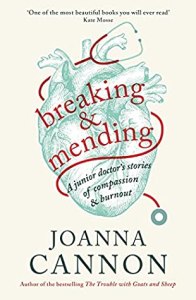
Breaking & Mending – Joanna Cannon

I learned that returning a life to someone very often has nothing to do with restoring a heartbeat.

In this memoir, Joanna Cannon invites readers to experience key moments of her time in medical school and as a junior doctor. This quick read has short chapters but they provide insights on her highs and lows, as well as the patients that have stayed with her. I found her writing style engaging and I could easily picture what Joanna was describing.

Burnout is an unlikely phrase, because it implies that the effects are loud and obvious, raging like a fire for everyone to see.

Most burnout, however, is quiet and remains unseen. It exists behind a still and mirrored surface, deep, out of reach, unnoticed by everyone – even, sometimes, by the one who is burning.

While some of the factors that contributed to her ‘breaking’ are fairly clear in my mind, the details of the ‘mending’ remain fairly vague to me. Sure, I know that being able to work in psychiatry, which was the reason Joanna was in medical school in the first place, was integral to her recovery. However, unlike the lead up to her burnout, the recovery process didn’t really come alive on the page for me.

I was impressed by Joanna’s ability to hold on to her compassion, even as her work as a junior doctor was taking a physical and psychological toll on her. What I will take away from this read, though, is the kindness and courage of so many of her patients, despite their circumstances.

Rating: 4 out of 5.

Once Upon a Blurb

“A few years ago, I found myself in A&E. 

I had never felt so ill. I was mentally and physically broken. So fractured, I hadn’t eaten properly or slept well, or even changed my expression for months. I sat in a cubicle, behind paper-thin curtains and I shook with the effort of not crying. I was an inch away from defeat … but I knew I had to carry on. 

Because I wasn’t the patient. I was the doctor.”

In this powerful memoir, Joanna Cannon tells her story as a junior doctor in visceral, heart-rending snapshots. 

We walk with her through the wards, facing extraordinary and daunting moments: from attending her first post-mortem, sitting with a patient through their final moments, to learning the power of a well or badly chosen word. These moments, and the small sustaining acts of kindness and connection that punctuate hospital life, teach her that emotional care and mental health can be just as critical as restoring a heartbeat.

In a profession where weakness remains a taboo, this moving, beautifully written book brings to life the vivid, human stories of doctors and patients – and shows us why we need to take better care of those who care for us.

The Minders – John Marrs

Click here to start your life again.

The most important thing I need to tell you about The Minders is that it is set in the same world as The One and The Passengers.

While you could technically read this book as a standalone, ginormous spoilers are included in this book about characters and events from the other books. Make sure you read them in publication order if you’re ever going to read more than one or you risk ruining your reading experience.

Now that we’ve seen firsthand the complications that can come from meeting your one true love and been chauffeured around by driverless cars, it’s time to turn out attention to classified information. Conspiracy theorists could only dream of gaining unrestricted access to everything their government has been hiding from them.

Due to very credible threats to national security, technology has been developed to hide these cover ups, secrets and misdirections in a brand new way – implanted into the heads of a select group of people.

We need to protect ourselves and make sure we are future proof. Our freedom depends upon it.

We follow the stories of five Minders:

Flick is really struggling as a result of the events that unfolded in The One and her connection with two of its characters.

Charlie has anxiety and is into conspiracy theories. This should be right up his alley.

Sinéad’s husband is a domestic abuser. If you happen to imagine a piano falling on his head while you’re reading, I won’t judge you.

Emilia only knows her name.

Like Flick, Bruno is also one of John Marrs’ secondary victims. He was personally impacted by the big action scene in The Passengers.

This was my fifth John Marrs read and the first one I could actually put down. I’m not entirely sure what the problem was but I didn’t connect with any of this book’s Marrs victims and wasn’t invested in the calamities they faced.

Maybe I wasn’t in the right headspace this week? Maybe it was because I didn’t get to spend a great deal of time seeing the characters living their lives before they became Minders? I don’t know, but because I’ve loved all of the others I’m going to classify this book as an anomaly and look forward to my next John Marrs read.

Thank you so much to NetGalley and Del Rey, an imprint of Random House UK, Cornerstone, for the opportunity to read this book.

Rating: 3.5 out of 5.

Once Upon a Blurb

Five strangers guard our secrets. Only four can be trusted …

In the 21st century, information is king. But computers can be hacked and files can be broken into – so a unique government initiative has been born. Five ordinary people have been selected to become Minders – the latest weapon in thwarting cyberterrorism. Transformed by a revolutionary medical procedure, the country’s most classified information has been taken offline and turned into genetic code implanted inside their heads. 

Together, the five know every secret – the truth behind every government lie, conspiracy theory and cover up. In return, they’re given the chance to leave their problems behind and a blank slate to start their lives anew.

But not everyone should be trusted, especially when they each have secrets of their own they’ll do anything to protect …

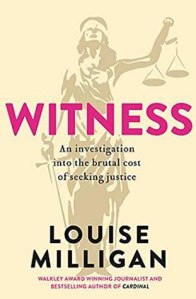
Witness – Louise Milligan

An analysis by The Age and The Sydney Morning Herald newspapers of sexual assault statistics published in September 2019 found that of the 52,396 sexual assaults reported to NSW Police between 2009 and 2018, charges were only laid in 12,894 cases.

Of the 12,894, 7629 went to court. Of those, 2308 were dropped at trial, 1494 found not guilty. The remaining 3827, or roughly 50 per cent of the total that went to court, were found guilty. That’s just 7 per cent of the cases that originally went to police.

I’m one of the 39,502 whose report to the police resulted in no charges being laid. Because there were no witnesses. Because the detective who took my statement didn’t even know how to classify the crime that was committed. [I checked. Section 61I of the Crimes Act 1900 No 40 says it has a name. It’s called sexual assault.] Because the second detective I spoke to didn’t believe me. Because the entire police investigation consisted of the second detective asking my psychologist if I had a mental illness that would cause me to make something like this up.

After reading this book I’m grateful that my retraumatisation was only at the hands of the police, that I never had to experience cross-examination in court, where

complainants and witnesses are treated like they are the villains, in order to defend the accused.

This book was an eye-opener in the most brutal way. I already knew the court system in Australia didn’t do any favours for people who have experienced violent crimes. I didn’t realise it was this bad.

I learned about the culture within the legal community, ensuring barristers are seen as not having been affected by the horrific offences they are defending. Without being able to acknowledge their own vicarious trauma or get help for it, barristers disregard the impact of trauma on victims they cross-examine in their courtrooms, making it easier to dehumanise them and rip holes in their testimony.

This is a system where teenagers are called ‘madam’ to make it sound as though they are older than they are. Where children are not allowed to take teddy bears with them when they testify because their presence would remind the jury that the victim is a child. Where the accused has a lawyer protecting their rights in court but the victim doesn’t. Where barristers behave towards victims in ways that would get you fired in pretty much any other job, but it’s mostly allowed because in court it’s all about establishing reasonable doubt.

And that’s where we come to that oft-repeated phrase from victims – that the cross-examination was as bad, if not worse, than the original abuse.

Psychologist Michelle Epstein says her patients who go through the court process generally say they would recommend others not to do it.

My take-away from this book?

If you’re sexually assaulted in Australia and your case is one of the few that actually makes it to court, you’re likely to wish it hadn’t. There you can expect to be traumatised at a level on par, if not more so, than the abuse you experienced to get you there in the first place.

This is a real indictment on the legal system (I almost said justice system but it appears justice is but a pipe dream for most survivors). Until real change occurs (and this is a system that moves imperceptibly slow, so don’t hold your breath), I predict that fewer survivors will feel safe enough to report what happened to them and perpetrators are going to keep on perpetrating, knowing, statistically, they’re very unlikely to be punished for their crimes.

‘It’s like you are alive, and you’re having an autopsy done on you.’

Julie Stewart

People who actually have the power to make a difference need to read this book immediately! Well written as it is, it made me feel so sad and angry, and utterly powerless. Now that I’m suitably dejected and disillusioned, I’m going to take a much needed mental health break. If you’d care to join me, I’ll be floating on a cloud made of cotton candy and hanging out with some unicorns.

Rating: 4 out of 5.

Once Upon a Blurb

From the best-selling author of Cardinal comes a searing examination of the power imbalance in our legal system – where exposing the truth is never guaranteed and, for victims, justice is often elusive. 

A masterful and deeply troubling expose, Witness is the culmination of almost five years’ work for award-winning investigative journalist Louise Milligan. Charting the experiences of those who have the courage to come forward and face their abusers in high-profile child abuse and sexual assault cases, Milligan was profoundly shocked by what she found. 

During this time, the #MeToo movement changed the zeitgeist, but time and again during her investigations Milligan watched how witnesses were treated in the courtroom and listened to them afterwards as they relived the associated trauma. Then she was a witness herself in the trial of the decade, R v George Pell.

She interviews high-profile members of the legal profession, including judges and prosecutors. And she speaks to the defence lawyers who have worked in these cases, discovering what they really think about victims and the process, and the impact that this has on their own lives. Milligan also reveals never-before-published court transcripts, laying bare the flaws that are ignored, and a court system that can be sexist, unfeeling and weighted towards the rich and powerful. 

Witness is a call for change. Milligan exposes the devastating reality of the Australian legal system where truth is never guaranteed and, for victims, justice is often elusive. And even when they get justice, the process is so bruising, they wish they had never tried. 

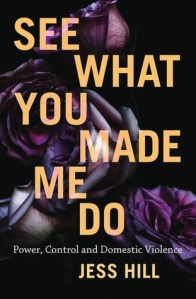
See What You Made Me Do – Jess Hill

We talk a lot about the danger of dark alleys, but the truth is that in every country around the world the home is the most dangerous place for a woman.

If you only ever read one book about domestic abuse, please make it this one. While I’d like everyone to read it, I think it should be mandatory for so many professions, including anyone involved in the judicial system, medicine, politics, teaching and counselling.

Domestic abuse is not just violence. It’s worse. It is a unique phenomenon, in which the perpetrator takes advantage of their partner’s love and trust and uses that person’s most intimate details – their deepest desires, shames and secrets – as a blueprint for their abuse.

I thought I knew a lot about domestic abuse already. I’ve experienced it firsthand. I’ve read plenty of fiction and non-fiction books that talk about it. I have a psychology degree. I worked in a women’s refuge for a short time. Yet I learned so much from this book.

What should surprise us about domestic abuse is not that a woman can take a long time to leave, but that she has the mental fortitude to survive.

When the author introduced Biderman’s ‘Chart of Coercion’, saying there are parallels between the experiences of returned prisoners of war and domestic abuse survivors, I admit I was a tad wary. Even as someone well versed in the experience of domestic abuse, I wasn’t sure how the two would or could line up. The way the author outlined the techniques, step by step, sucked me in though. It all made perfect sense and it was horrifying, but I was learning something new and I needed to find out more.

Accompanying extensive research are stories of people who have perpetrated and been victimised by domestic abuse. Prepare to brace yourself as you read these accounts as they are invariably brutal and heartbreaking, but please don’t bypass them, even though that would be easier. (Or else you risk missing out on aha! moments, like when emotional abuse is explained as someone bashing someone with their emotions instead of their fists.)

If you’ve experienced domestic abuse yourself, you will easily recognise the truth of these accounts. If you are fortunate enough to have made it this far without being impacted by this type of trauma, know that these stories are representative of so many people’s lives. Friends, family, neighbours …

I can’t imagine reading these accounts without having a visceral reaction and if you’re struggling to ‘witness’ them on the page, please be sure to practice self care. I don’t know if what helped me will apply to other readers but each time I came across something that was too difficult, I told myself that my discomfort wasn’t even in the same ball park as the horror of actually experiencing that firsthand.

The people who have told their stories have courage beyond my comprehension and I feel we owe it to them to not shy away from their words. It’s too easy to maintain the status quo; maybe what we all need is a wake up call to spur us into action.

There’s so much we still need to do. A recent Australian survey, conducted by White Ribbon, found that

Four in ten young men do not consider punching and hitting to constitute domestic violence

Source: The Sydney Morning Herald 25/10/2020

In NSW, Australia, coercive control is not even a criminal offence. Yet. Hopefully this will change, if proposed coercive control laws aren’t squished by the powers that be. You can find Women’s Safety NSW’s proposal here.

I want people to stop asking ‘Why does she stay?’ and start asking ‘Why does he do that?’

SURVIVOR, QUEENSLAND

P.S. There’s going to be a three part TV series in 2021 hosted by Jess Hill.

Rating: 5 out of 5.

Once Upon a Blurb

At the office of Safe Steps, Victoria’s dedicated 24/7 family violence response call centre, phone counsellors receive a call every three minutes. Many women are repeat callers: on average, they will go back to an abusive partner eight times before leaving for good.

‘You must get so frustrated when you think a woman’s ready to leave and then she decides to go back,’ I say.

‘No,’ replies one phone counsellor, pointedly. ‘I’m frustrated that even though he promised to stop, he chose to abuse her again.’

Women are abused or killed by their partners at astonishing rates: in Australia, almost 17 per cent of women over the age of fifteen – one in six – have been abused by an intimate partner.

In this confronting and deeply researched account, journalist Jess Hill uncovers the ways in which abusers exert control in the darkest – and most intimate – ways imaginable. She asks: What do we know about perpetrators? Why is it so hard to leave? What does successful intervention look like?

What emerges is not only a searing investigation of the violence so many women experience, but a dissection of how that violence can be enabled and reinforced by the judicial system we trust to protect us.

Combining exhaustive research with riveting storytelling, See What You Made Me Do dismantles the flawed logic of victim-blaming and challenges everything you thought you knew about domestic and family violence.