Polyvagal Prompts – Deb Dana & Courtney Rolfe

Naming our experience begins the process of letting go of judgment and self-blame and making room for curiosity.

I first encountered Polyvagal Theory about a year ago but initially had trouble getting past the sciencey bits so hadn’t made it to the understanding part. That changed when I read Our Polyvagal World by Stephen Porges and Seth Porges. So many lightbulbs went off in my head I may as well have had the sun in there.

Suddenly I made sense to me. Not only that, other people also made sense. My optimism was tempered by a history of thinking something’s a great idea, knowing it would be better for me if I incorporated it into my life and momentum fading as life invariably happens.

This stuck, though, so much so that I now think in terms of colours. Thanks to the bazillion times I watched Twister in the late 90’s, I began to think of the ventral vagal state as ‘greenage’.
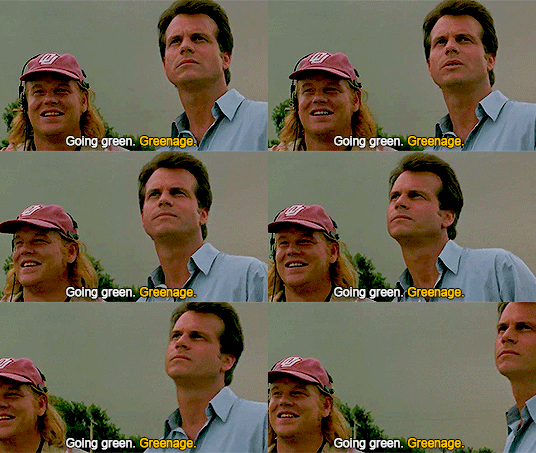
Twister greenage meme

Thanks, Dusty!

And you know what? It also stuck and I’m delighted to report that apparently it’s contagious. The fun of hearing people who usually speak quite formally casually mentioning greenage makes my green that much brighter.

Needless to say, I couldn’t wait to read more about Polyvagal Theory. I started at the end of this book because of course I did. Actually, it is suggested as an option in the Introduction so this wasn’t me going rogue.

There you’ll find A Beginner’s Guide to Polyvagal Theory and a glossary. The Beginner’s Guide can act as either an introduction or a refresher. I found it helpful to revisit what I’d previously learnt.

The guided prompts are presented in a logical progression, although you can work through them in any order. I’d be interested to discover how my answers change over time.

I absolutely loved the haiku examples to describe each state. I’ve gotten so used to understanding what state I’m experiencing in terms of colour, I tend to get confused when I read dorsal, sympathetic and ventral. These helped a lot.

Dorsal:

How long have I sat

No voice, no movement, slow breath

Far away from you

Sympathetic:

Look around, danger

Who is safe and who is not?

Get me out of here

Ventral:

A bright heart beaming

Wrapping all with love and warmth

Holding space for you

Overall, I was encouraged, knowing that I’m still implementing what I learned from reading Our Polyvagal World. I also appreciated being reminded of some things I’ve unintentionally let go of along the way. I plan to pay closer attention so I notice glimmers throughout my day and will be on the lookout for awe inspiring moments.

I’m keen to read more about Polyvagal Theory so don’t be surprised if you hear more about it from me in the near future.

Thank you so much to NetGalley and W. W. Norton & Company for the opportunity to read this book.

Rating: 5 out of 5.

Once Upon a Blurb

Discover the remarkable ways your nervous system works in service of your safety and wellbeing.

Polyvagal Theory, developed by researcher and scientist Dr. Stephen Porges and popularised by therapist Deb Dana, has impacted countless lives. It has changed the way therapists work with their clients and provided a pathway toward healing for those who have experienced hardship or trauma. 

In Polyvagal Prompts, Deb Dana and Courtney Rolfe invite readers to explore their nervous systems through Polyvagal Theory with engaging questions and exercises, which readers can respond to directly in the pages of the book. Readers are guided in noticing their systems, listening with curiosity, and reflecting on what they learn. The prompts can be used as a daily practice or to explore specific topics at the reader’s own pace, and are also ideal for helping clients track and reflect upon their polyvagal-informed therapies. 

No matter how readers decide to explore, Polyvagal Prompts offers an invaluable opportunity to begin the life changing journey of befriending one’s nervous system.
Our Polyvagal World – Stephen W. Porges & Seth Porges

I was tempted to post a glowing review as soon as I finished reading this book but held off. I wanted to see if time did anything to dull the glow. It’s been three weeks now and my feelings about this book are as shiny as ever.

Oftentimes when I find a book I expect to be life changing, I come away disappointed. When I do connect with a concept, I always plan on applying what I’ve learned to my life but then I move on to the next thing and my good intentions remain just that.

This book, though. It felt like entire chunks were written specifically with me in mind and the follow through? It actually happened!

I’ve been interested in learning about Polyvagal Theory but until now I’d never made it past the science speak. This is the first book I’ve found that doesn’t talk at you like a textbook but invites you to understand, using examples that are relatable. Examples like dogs and the Hulk.

So, what’s Polyvagal Theory all about?

How safe we feel is crucial to our physical and mental health and happiness.

Sounds obvious, right? How safe we feel can be different to how safe we are, though, and that’s a crucial distinction here.

By the end of this book, you’ll be well versed in the vagus nerve and why it matters. You’ll gain a better understanding of trauma: why we respond the way we do when traumatic events happen and why the impacts of such events make so much more sense than you’ve probably ever realised.

The impact of trauma is not isolated to our brains, but stretches through our nervous system to virtually every part of our body, changing how our senses sense, how our organs operate, and just about every aspect of our physical and mental health.

The first part of the book explains Polyvagal Theory in a way that made sense to me. I understood the sciencey bits and the examples that explained the sciencey bits, and I was able to apply it to specific parts of my life. I make more sense to me now! And the bonus is, so do other people!

To give you just one example, life experiences have made me particularly wary of breathing exercises. Many well meaning individuals have tried and failed to teach them to me over the years. It wasn’t until I learned from this book the best way to do them (because science) and how doing them helps (also science), that I was able to attempt them without my body panicking. I’m now someone who can use breathing exercises (the scientific way for scientifically proven benefits) to regulate myself. And it helps!

Along the way, I discovered why I’m hypersensitive to sound, particularly background noise. I’m currently also working on my own theory (which I haven’t found research on – yet) about whether the proximity of the trigeminal nerve to the vagus nerve may explain why I experience the pain pattern associated with trigeminal neuralgia after I spend a considerable amount of time in the red zone.

The second part of the book takes what you’ve learned and applies it to “circumstances and settings such as the pandemic, the workplace, schools, and prison.” While each of these chapters are helpful in their own right, by seeing how Polyvagal Theory applies to these, you are essentially given a road map to allow you to apply it elsewhere.

Then there’s the glossary, which amps up the science. If you don’t have a scientific background, you may not want to spend too much time here. I found I started to lose some confidence in what I had learned when I tried to decipher all of the science. Then I let it go. I didn’t need to be able to quote all of the right terminology to start making changes to my life.

This is a book I know I’ll keep coming back to. I expect I’ll need a refresher from time to time and as the circumstances of my life change, so will the parts of the book that speak to me.

I’ve already recommended this book to a bunch of people who work in the trauma field and I don’t think I’m going to be shutting up about it anytime soon.

Thank you so much to Edelweiss and Norton Professional Books, an imprint of W. W. Norton & Company, for the opportunity to read this book.

Rating: 5 out of 5.

Once Upon a Blurb

The creator of the Polyvagal Theory explains the principles in simple terms that are accessible to all.

Since Stephen Porges first proposed the Polyvagal Theory in 1994, its basic idea — that the level of safety we feel impacts our health and happiness — has radically shifted how researchers and clinicians approach trauma interventions and therapeutic interactions. Yet despite its wide acceptance, most of the writing on the topic has been obscured behind clinical texts and scientific jargon.

Our Polyvagal World definitively presents how Polyvagal Theory can be understandable to all and demonstrates how its practical principles are applicable to anyone looking to live their safest, best, healthiest, and happiest life. What emerges is a worldview filled with optimism and hope, and an understanding as to why our bodies sometimes act in ways our brains wish they didn’t.

Filled with actionable advice and real-world examples, this book will change the way you think about your brain, body, and ability to stay calm in a world that feels increasingly overwhelming and stressful.

The Upside-Down Book of Sloths – Elizabeth Shreeve

Illustrations – Isabella Grott

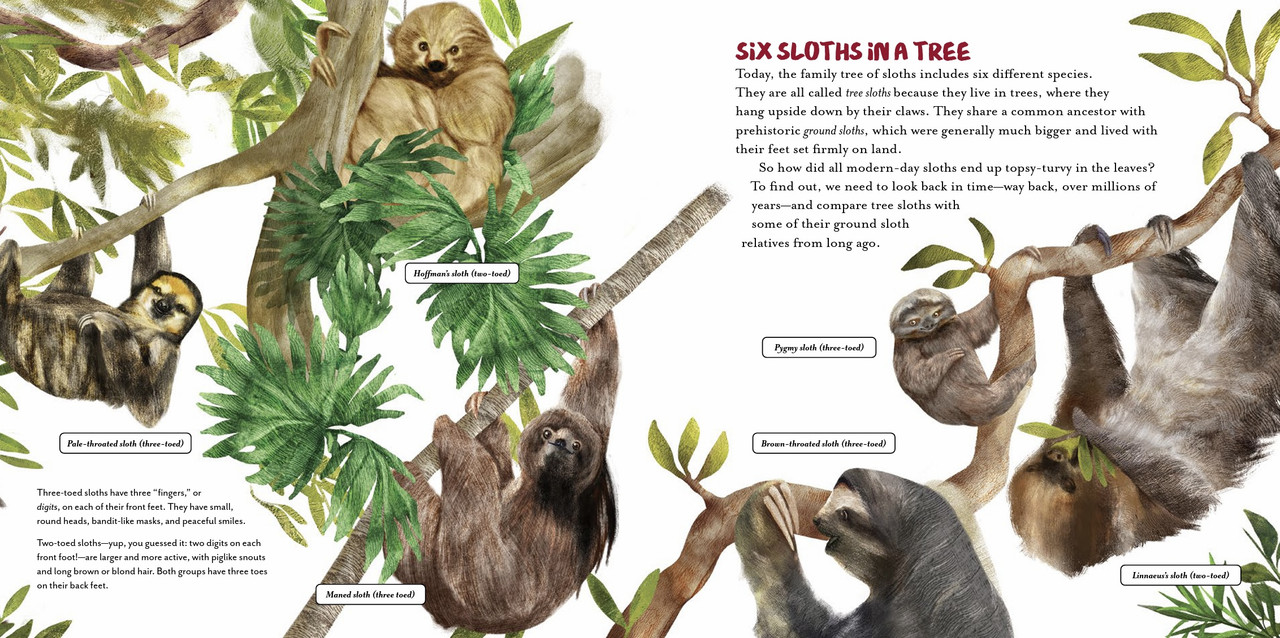
This book is a lovely introduction to the six types of sloths that live in Central and South America as well as some of the dozens that used to walk the earth (and in one case swam the sea) millions of years ago. Comparing the three-toed sloths with their “bandit-like masks” and the larger two-toed sloths to those we have learned about through their fossils, we discover how they live, sleep, raise their young and poop.

While I’ve yet to meet a sloth, I’ve read about them, fallen in love with some cuties I’ve seen in documentaries and have bought my mother, who adores them even more than I do, all manner of sloth merchandise. Did you know you can buy sloth bandaids?

This was a quick, enjoyable read that taught me some new fun facts. My top three are:

🦥 The largest tree sloths grow to 32 inches (81cm) and weigh up to 24 pounds (10.9kg). That’s tiny when you compare it to the Megatherium, a giant ground sloth, that lived 10 million years ago. It grew to 18 feet (almost 5.5m) and weighed around 8,000 pounds (3,628kg)!

🦥 Sloths move about 13 feet per minute through trees and about one foot a minute on the ground. They’re good swimmers, moving three times as fast in the water than they do on land.

🦥 It takes more than a month for a sloth to digest a meal.

Isabella Grott’s illustrations are gorgeous, showcasing species both past and present.

description

Kid me definitely would have borrowed this book from the library for a school project.

Thank you so much to NetGalley and Norton Young Readers, an imprint of W. W. Norton & Company, for the opportunity to read this book.

Rating: 4 out of 5.

Once Upon a Blurb

Slow, sleepy — and adorable. This playful and informative picture book follows the fascinating history of one of the world’s most beloved animals.

Many find sloths cute, while some find them just plain bizarre. In The Upside-Down Book of Sloths, Elizabeth Shreeve uncovers their less-well-known evolutionary history and how they became the beloved — and unique — creatures of today. She pairs and compares the six extant modern species, like the pygmy sloth, the brown-throated sloth, and the ai, with their prehistoric counterparts, such as Thalassocnus, the tough seafaring sloth; Paramylodon, which had armor-like skin and walked on the sides of its feet; and Megatherium, which could weigh up to 8,000 pounds. She even reveals how modern sloths have adapted to hang upside down, how they learned to swim, and even how they poop!

As entertaining as it is educational, The Upside-Down Book of Sloths offers a brilliant deep dive into sloths, their evolution, and their connections to our planet’s natural history — and future.

Letter to a Young Female Physician – Suzanne Koven

Your training and sense of purpose will serve you well. Your humanity will serve your patients even better.

Although each essay in this book can be read separately, together they paint a picture of Suzanne Koven’s life, from her childhood recollections of her father’s orthopedic practice and always choosing to be the doctor during childhood games of Careers to her own residency and eventually her work as a doctor. Throughout, the reader witnesses Suzanne struggling to maintain a work-life balance, parenting her children, caring for her ageing parents and figuring out how to be the best doctor she can be for her patients.

I find my patients much more interesting than their diseases.

Although I was introduced to a number of the author’s patients, albeit de-identified and with some details changed, there were times I was holding out for a resolution that failed to come. I wanted to know what became of these people whose stories I was just becoming invested in.

For some reason I also became invested in the story of the white pine trees, where the infection of one may result in the infection of its neighbours. My biggest frustration with this book was not learning whether the two pine trees survived or not. Why do I care so much about this? Perhaps it was because of what those trees symbolised to the author. Regardless, I felt cheated by not knowing their fate.

My favourite parts of this book involved the author’s relationship with her mother and how it changed throughout her life.

The reflections on what it is that makes a good doctor would be particularly valuable for newly trained doctors, who are finding their feet in a world where having empathy for their patients can prove just as important as knowledge of their medical conditions.

Students worry about knowing enough. Patients worry about them caring enough.

Thank you so much to NetGalley and W. W. Norton & Company for granting my wish to read this book.

Rating: 3.5 out of 5.

Once Upon a Blurb

In 2017, Dr. Suzanne Koven published an essay describing the challenges faced by female physicians, including her own personal struggle with “imposter syndrome” – a long-held secret belief that she was not smart enough or good enough to be a “real” doctor. Accessed by thousands of readers around the world, Koven’s “Letter to a Young Female Physician” has evolved into a deeply felt reflection on her career in medicine.

Koven tells candid and illuminating stories about her pregnancy during a grueling residency in the AIDS era; the illnesses of her child and ageing parents during which her roles as a doctor, mother, and daughter converged, and sometimes collided; the sexism, pay inequity, and harassment that women in medicine encounter; and the twilight of her career during the COVID-19 pandemic. As she traces the arc of her life, Koven finds inspiration in literature and faces the near-universal challenges of burnout, body image, and balancing work with marriage and parenthood.

Shining with warmth, clarity, and wisdom, Letter to a Young Female Physician reveals a woman forging her authentic identity in a modern landscape that is as overwhelming and confusing as it is exhilarating in its possibilities. Koven offers an indelible account, by turns humorous and profound, from a doctor, mother, wife, daughter, teacher, and writer who sheds light on our desire to find meaning, and on a way to be our own imperfect selves in the world.

Will My Cat Eat My Eyeballs? – Caitlin Doughty

Illustrations – Dianné Ruz

We can’t make death fun, but we can make learning about death fun.

A book written by a funeral director, answering questions asked by kids, about death? This future corpse had to read this book! I now know the answers to over thirty death related questions, some I’ve always been curious about and others I didn’t know that I needed to know until I came across them here.

Can I keep my parents’ skulls after they die?

Will I poop when I die?

What would happen if you swallowed a bag of popcorn before you died and were cremated?

What if they make a mistake and bury me when I’m just in a coma?

Caitlin Doughty not only answers the question that’s asked but sometimes also adds an ‘if you were asking because of [insert interesting reason here], allow me to suggest an even cooler idea’ or offers solutions to multiple hypothetical tangents.

What’s left behind in the cremated remains is a thrilling combo of calcium phosphates, carbonates, and minerals and salts.

Bacteria farts, the rainbow of livor mortis and putrefaction, leakage and corpse onesies (unionalls) are all explained. I also learned some fun death question adjacent facts, such as the scientifically determined ideal temperature for popping popcorn – “356 degrees Fahrenheit”, if you’re interested.

Written in a conversational way, with some much needed humour given the topic, Caitlin combines her experiences with those of her colleagues and adds some science, cultural differences and some good ol’ myth busting. A couple of times small pieces of information would be repeated in later chapters; they were relevant each time they were mentioned and the repetition was often pointed out in the text. It was more noticeable to me because I inhaled the book.

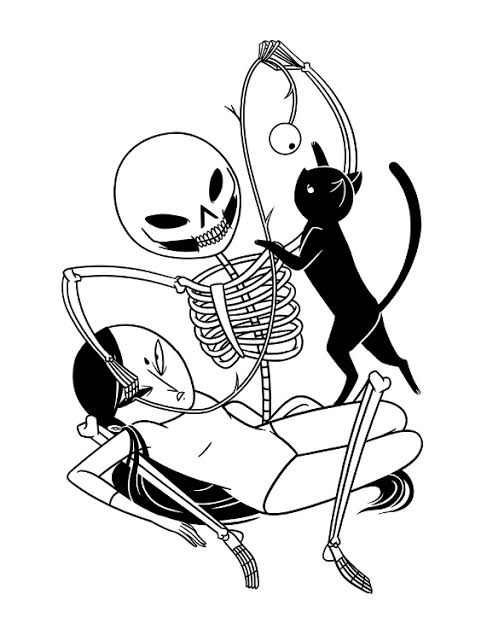
Accompanying the text are some wonderful illustrations by Dianné Ruz. They’re quirky and add to the humour.

I enjoyed this read even more than I expected to and only wish I could have passed it along to my Nan, who I’m certain would have appreciated it even more than I did. Well, except for the chapter that debunks Viking funeral myths. See, my Nan was the coolest person I’ve ever met and her dream funeral consisted of being transported via a carriage pulled by a team of Clydesdales in the middle of the main street to the ocean, where she would be sent off Viking funeral style.

I approximated the Viking part by buying a wooden boat shaped candle holder, loading it up with some of her ashes, setting it alight and drenching myself trying to get it far enough into the ocean so it wouldn’t surf its ways back in.

I’m fairly certain Nan would have also been willing to donate her awesome manicured nails in aid of Ragnarök, should they be required.

Rating: 4 out of 5.

Once Upon a Blurb

Every day, funeral director Caitlin Doughty receives dozens of questions about death. What would happen to an astronaut’s body if it were pushed out of a space shuttle? Do people poop when they die? Can Grandma have a Viking funeral?

In Will My Cat Eat My Eyeballs?, Doughty blends her mortician’s knowledge of the body and the intriguing history behind common misconceptions about corpses to offer factual, hilarious, and candid answers to thirty-five distinctive questions posed by her youngest fans. In her inimitable voice, Doughty details lore and science of what happens to, and inside, our bodies after we die. Why do corpses groan? What causes bodies to turn colors during decomposition? And why do hair and nails appear longer after death? Readers will learn the best soil for mummifying your body, whether you can preserve your best friend’s skull as a keepsake, and what happens when you die on a plane. Beautifully illustrated by Dianné Ruz, Will My Cat Eat My Eyeballs? shows us that death is science and art, and only by asking questions can we begin to embrace it.