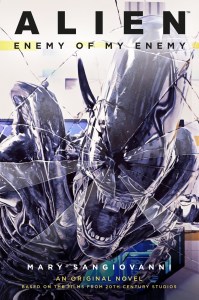
Alien: Enemy of My Enemy – Mary SanGiovanni

“Are there monsters on this moon?”

A novel based on one of my favourite movie franchises written by one of my favourite authors. What’s not to love?!

There has been a lot of face hugging in my life recently. I gave myself some homework before allowing myself to enjoy this read, binge every Alien movie I own…

“You … BITCH!”

”Get away from her, you bitch!”

”You’ve been in my life so long, I can’t remember anything else.”

”So, like, what did you do?” “I died.”

”Big things have small beginnings.”

”When one note is off, it eventually destroys the whole symphony, David.”

”What did you say this room was called?” “Sacrificial chamber.”

”See? No monster.”

All eight of them. It was a really entertaining couple of weeks. So, onto the book.

It was so much fun! You’ll meet scientists, researchers and volunteers. The moon they currently call home is on a crash course with a dead planet, but that’s the least of their problems. Some bright spark decided to enhance the traits that make these “remarkable creatures” so deadly, because that’s obviously a great idea.

Once you make it through the bloodbath otherwise known as Chapter One, you’ll begin to wonder if there’s any point trying to remember anyone’s name because it’s fairly certain they’re all doomed.

Blood paints walls, floors and bystanders. The death to page ratio is satisfyingly high. I started a tally of all of the deaths but quickly gave up.

“Now, that’s really not a good sign – for anybody.”

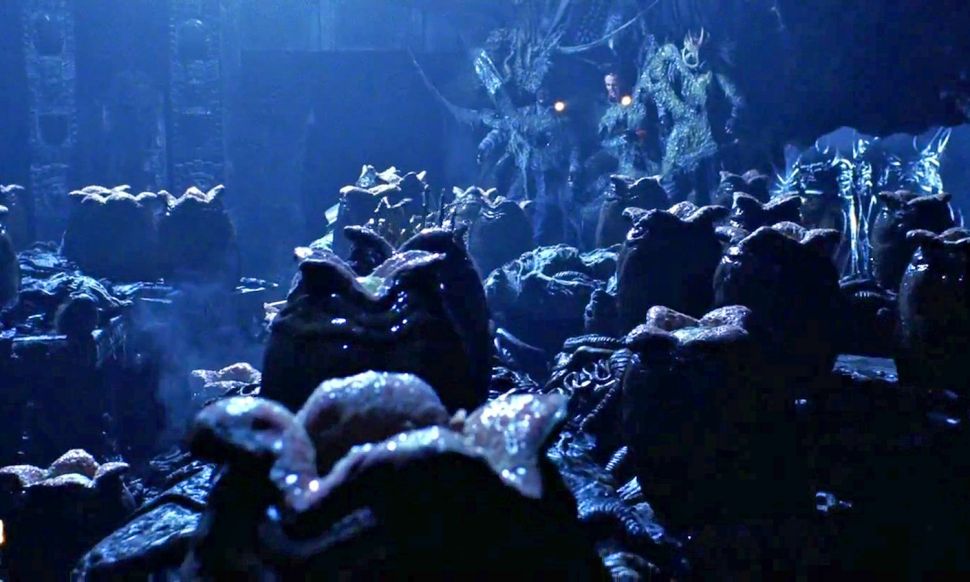
You can look forward to catching up with some of your favourite friends from the Alien movies, including Ovomorphs,
description

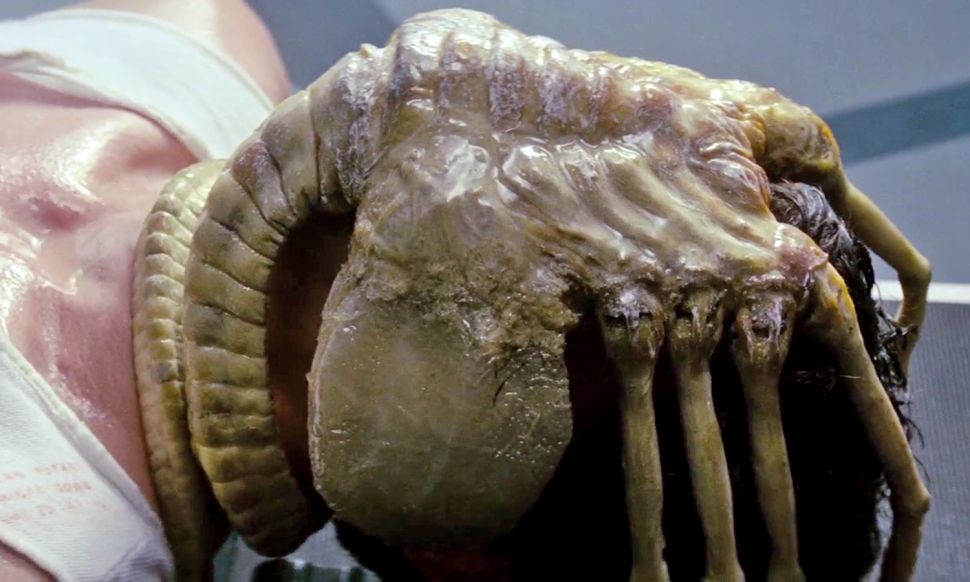
facehuggers,

description

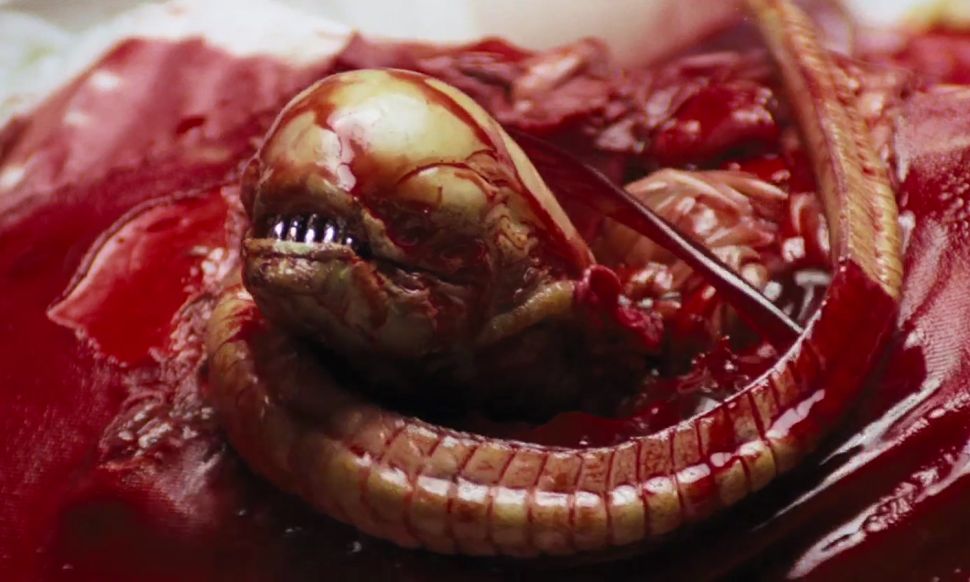
chestbursters

description

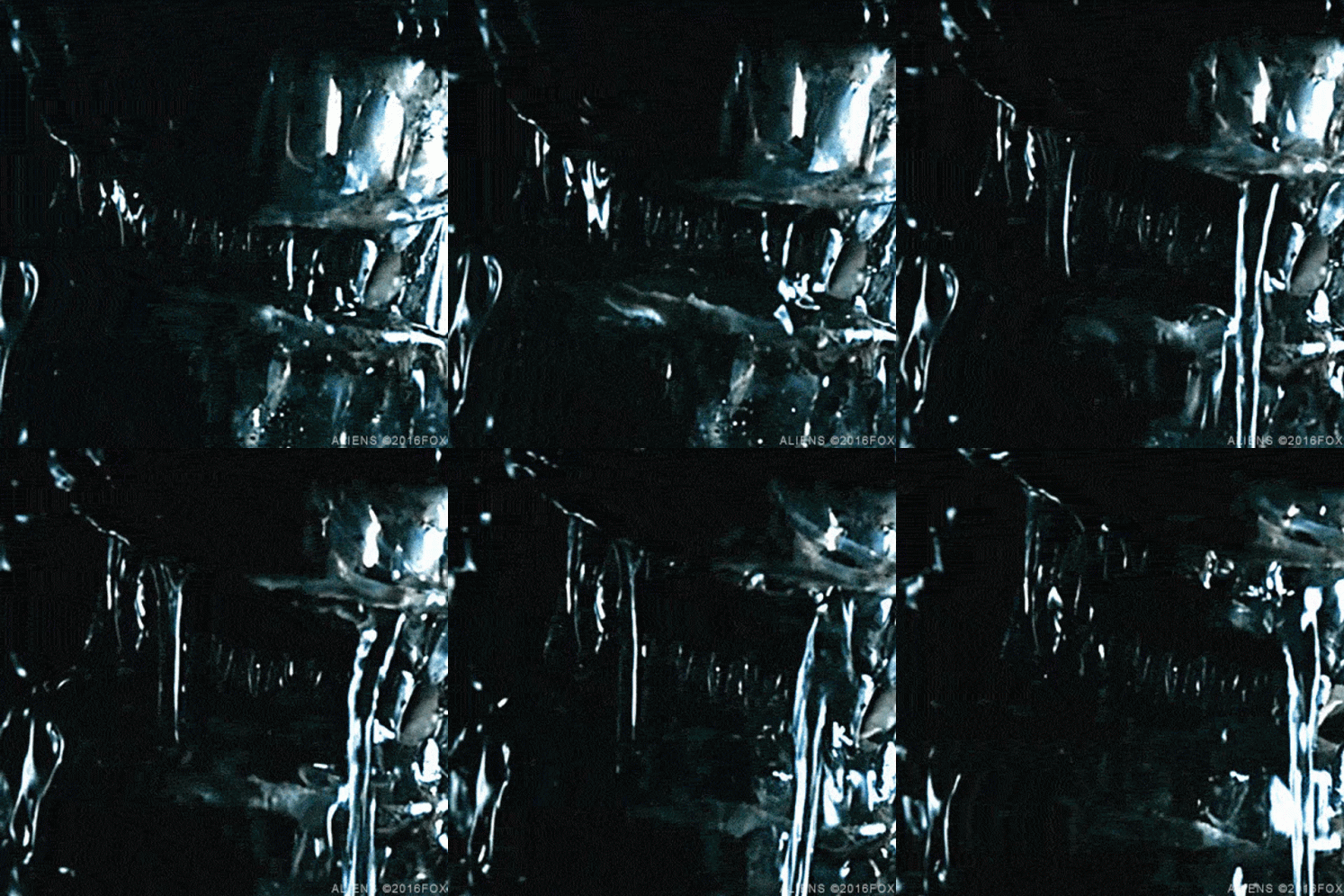
and Xenomorphs.

description

“Did you know, Sergeant, that the Xenomorphs have mouths inside their mouths?”

There are characters you’ll barely meet before their insides become their outsides. Others you’ll get to spend some time with before they inevitably cease breathing.

Kira, whose favourite stuffed animal is a dog called Mr. Bones, was adorable. Even though I’d just finished my Alien movie binge, I initially had high hopes for Kira’s survival. Then I remembered Newt. This franchise doesn’t shy away from killing its young. Regardless, she’s the character I most wanted to survive.

Then there was Dr Martin Fowler. To know him is to eagerly anticipate his demise.

If you like your Xenomorph’s saliva to be glistening and dripping, and you want your humans to be torn apart from the outside in and the inside out, this is your book. If you’ve never been on board the Nostromo, you might want to spend some time with Ripley first.

Favourite no context quote:

Her eyes grew wide with horror as she watched her arm dangling from the claws of the creature above her.

Thank you so much to Edelweiss and Titan Books for the opportunity to read this book.

Rating: 5 out of 5.

Once Upon a Blurb

HYGIEIA – AN OUTER RIM COLONY – IS DOOMED

The moon on which it was built hurtles toward an inevitable collision with the dead planet Hephaestus. The clock is ticking, yet when a distress signal arrives from a Weyland-Yutani biowarfare outpost, a desperate plan is launched to evacuate the trapped scientists. Meanwhile, across the galaxy a mysterious black substance rains down on Earth settlements, creating hideous monsters from indigenous creatures … and from human beings. Terran governments point the accusing finger at one another. Thus on LV-846 – a United Americas colony – high-level talks convene to address the galaxy-wide hostilities, but there’s a plot brewing among the participants. One which could plunge the colonies into all-out war. The only hope for peace may lie with the deadliest ally imaginable…

BONUS FEATURE: An exclusive new role playing game scenario based on the massively popular, award-winning Alien RPG from Free League Publishing!
Ghosts of the Orphanage – Christine Kenneally

For more than a hundred years, the people of Vermont had, knowingly or unknowingly, sent their children in reverent offering to the huge house on the hill outside of town. The obedient servants of the Catholic God took the children in, and in return, behind the locked doors of St. Joseph’s Orphanage, out of their own pain and misery, and with all their immense entitlement, they devoured them.

Some books stay with me because they were so well written. Others linger because they invited me into a world that I previously knew very little of, or their content haunts me. Then there are those that introduce me to people I’ll never forget.

This book was all of the above. I expect it to be one of my favourite non-fiction reads of the year.

Investigating some of the worst abuses of power I’ve ever read about, abuse that took place over the course of decades and throughout continents by seemingly countless perpetrators, this is not an easy read. Important, absolutely. Easy, not even close.

However, despite detailing abuses that run the gamut – verbal, emotional, physical, sexual, medical, neglect, torture, even murder – the descriptions are not as graphic as I had expected them to be. That’s not to say that there’s any doubt about the level of brutality these children survived (or didn’t, in some cases). The content is potentially triggering but it’s delivered as sensitively as possible.

The research that preceded this book was extensive, consisting of hundreds of interviews as well as … take a deep breath …

thousands of pages of transcripts from the St. Joseph’s litigation in the 1990s and files from Vermont Catholic Charities, which included contemporaneous logs from social workers at the orphanage, medical records, historic photographs, and letters written by priests and other workers in child welfare at the time, as well as handwritten diaries, police records, autopsy reports, transcripts from secret church tribunals, priest rehabilitation reports, orphanage settlement letters, historic newspaper articles, death and birth certificates, and government files and reports from many jurisdictions.

While the bulk of the book focuses on the atrocities that took place at St. Joseph’s Orphanage in Vermont, you’ll also learn about other orphanages in America, Canada, Australia, Ireland and Scotland.

“I thought I was the reason all that stuff happened,” he told me. “All that time, I thought it was only happening to me, but it was happening all over the place.”

Geoff Meyer

Sally Dale is integral to this book but hers is not the only story that will stay with you. I’m in awe of the courage, resilience and determination of the children I was introduced to, those who lived to become adults as well as those who didn’t.

As adults, many have fought for justice against one of the oldest institutions in the world. The pain of hearing their stories was well and truly offset by the privilege of getting to know these remarkable survivors.

I can’t recommend this book highly enough, but my recommendation comes with a word of warning: please take good care of yourself while you’re reading it. And make sure you have tissues on hand.

Now I know that some people have always moved freely between the reality that is plain to see and its hinterlands: the institutions, the orphanages, the places where things happen behind closed doors and stay hidden.

Thank you so much to Hachette Australia for the opportunity to read this book.

Rating: 5 out of 5.

Once Upon a Blurb

A shocking expose of the dark, secret history of Catholic orphanages – the violence, abuse, and even murder that took place within their walls – and a call to hold the powerful to account.

Ghosts of the Orphanage is the result of ten years of investigation by award-winning journalist Christine Kenneally. What she has uncovered is shocking, yet it was all hiding in plain sight.

Terrible things, abuse, both physical and psychological, and even deaths have happened in orphanages all over the world for many years. The survivors have been telling what happened to them for a long time, but no one has been listening. Authorities have too often been unwilling to accept their stories. And a victim’s options for recourse have been limited by the years it has taken many survivors to process their trauma, tell their stories, and pursue legal action.

Centering on St. Joseph’s, a Catholic orphanage in Vermont, Kenneally investigates and shares the stories of survivors. She has fought to expose the truth and hold the powerful – many of them Catholic priests and nuns – to account. And it is working. As these stories have come to light, the laws in Vermont have been forced to change, including the statute of limitations on prosecuting them.

Told with human compassion, novelistic detail and a powerful sense of purpose, Ghosts of the Orphanage is not only a gripping story but a reckoning. It is proof that real evil lurks at the edges of our society, and that, if we have the courage, we can bring it into the light and defeat it.

Crookhaven: The School for Thieves – J.J. Arcanjo

Illustrations – Euan Cook

‘Alone you can become exceptional; together you can become unstoppable.’

The only thing Gabriel Avery’s parents left when they abandoned him was a 2p coin. Gabe lives with his Grandma, using his pickpocketing skills to put sandwiches on the table (bacon for Gabe and charred sausage for Grandma). Although he’s done well to stay under the radar, his thieving abilities have recently been noticed.

‘As I live and thieve!’

Rather than spending some time behind bars, Gabe has been offered a place at a most “disreputable establishment”, Crookhaven, a boarding school for “wrongdoers, swindlers and thieves”. There he will study subjects that will mould him into a criminal all-rounder: forgery, crimnastics, picking locks, hacking and deception.

The three principles students learn at Crookhaven are:

Lie. But never lie to yourself.

Cheat. But never cheat your friends.

Steal. But never steal from those in need.

Each student comes to Crookhaven with their own set of skills and there is some division between those who gain entry as Merits and the Legacies, but the students all have something in common. They’re “the outcasts, the misunderstood, the reviled”. I’m a sucker for stories featuring outcasts.

Besides the comfort of knowing he doesn’t have to scheme and steal to put food in his belly, Crookhaven offers Gabe another first, the opportunity to make friends. The found family aspect of this book was one of my favourite takeaways.

There’s Penelope, who can’t abide rule breaking. She speaks five languages fluently and understands another two. I adored her spikiness and attitude.

Ade and Ede are twin white hats, known in the hacking community as the Brothers Crim. The only time they’re in sync is when they’re hacking, so part of their role is comic relief.

Then there’s the Blur, Amira. Other than Penelope, she’s the one I most want to spend more time with.

The first in a series, this book introduces you to Gabe’s world, as well as the beloved and new people in his life. You’ll crave bacon sandwiches as you scheme along with Gabe as he navigates his new surroundings.

So I don’t forget by the time I read the sequel, I made a list of the various Crookhaven teachers:

  • Caspian Crook teaches Tech-nique
  • Friedrich teaches Crimnastics
  • Miss Jericho teaches History of Crookery
  • Mr Khan teaches Deception
  • Ms Locket teaches Infiltration
  • Palombo teaches Forgery
  • Mr Sisman teaches Cultivating a Crook
  • Mr Velasquez teaches Tricks of the Trade
  • Whisper teaches Hacking.

Crookhaven’s co-Headmasters are Caspian Crook and Whisper.

This book hooked me. I love the characters. I love the setting. I love the fact that it takes outcasts and gives them somewhere to belong, all the while playing to their strengths.

You’d think a book about crooks would be chock full of nefarious characters fighting dirty to be the biggest Big Bad. The focus, though, is learning skills to do good in the world.

‘Crookhaven: we do wrong to put the world right.’

That’s not to say that there aren’t any morally grey characters or baddies being dastardly.

This book is an entertaining mix of action, mystery, drama and humour. Adult me loved it. Kid me would have loved it. I can’t imagine geriatric me feeling any differently. It’s a winner.

While their role is explored in this book, I’m hoping to get to know some of the Gardeners in future books.

Favourite no context quote:

‘Because it is the outsiders, the forgotten, the ones who’ve always felt like they don’t belong, who end up changing the world.’

Thank you so much to Hachette Australia for the opportunity to read this book. I can’t wait for the sequel!

Rating: 5 out of 5.

Once Upon a Blurb

“So this is really a school for criminals.” It was meant as a question, though it came out more as an accusation.

“We are so much more than that,” Caspian said, sitting in a plush leather chair and gesturing for Gabriel to sit in a similar one across the table. “We are a home for the forgotten, a sanctuary for the lost and … yes, a training ground for the greatest crooks of the future.”

13-year-old Gabriel is a brilliant pickpocket, a skill which he uses to keep his often empty belly not quite so empty. And then one day, he’s caught.

But instead of being arrested, he is invited by the mysterious Caspian Crook to attend Crookhaven – a school for thieves. At Crookhaven, students are trained in lock-picking, forgery and ‘crim-nastics’, all with the intention of doing good out in the world, by conning the bad and giving back to the innocent.

But … can you ever really trust a thief?

With a school wide competition to be crowned Top Crook and many mysteries to uncover, Gabriel’s first year at Crookhaven will be one to remember…

Churn the Soil – Steve Stred

‘Twas the month before Christmas, when Saska’s blood spilled

The cops were called in to see how she was killed;

The Border was safe from evil unspoken,

Now they’re all fucked ’cause the pact has been broken.

One hundred feet of clearing is all that separates The Border from the woods. The residents of the settlement know not to cross the boundary after dark.

Graham Brown spent part of his childhood living in the settlement. Now he’s a Basco police officer. He and Reynolds, his partner, are investigating Saska’s death. They probably should have called in sick.

Those woods. They looked so ominous, as though once you entered you never came back.

I love horror that knocks us off the top of the food chain. I especially love horror when you’re not even really sure for the longest time what it is that’s going to cause your insides to become your outsides.

It’s cold, so very cold, and the snow is currently undergoing a reddening. You really should stay out of the woods if you want to be breathing this time tomorrow. Although … if you play it safe you won’t get to meet Bruiser, the best cop ever.

Under an icy snowfall…

Under a clear, blue moon…

Get your eviscerations here!

Rating: 4 out of 5.

Once Upon a Blurb

Two hundred miles north of the town of Basco sits The Border. It’s a quiet, off-the-grid settlement, where the residents have developed a tentative agreement with those that live on the other side of the clearing.

But things are about to change forever. 

As night falls, a teenage girl is brutally murdered as she flees across the clearing. Now, it’s up to Basco PD officers Brown and Reynolds to find her killer. 

But the truth is far worse than they could possibly imagine, and the more the officers uncover, the bolder the things beyond the clearing grow. 

‘Under an icy snowfall…’
‘Under a clear, blue moon…’

The Madman’s Gallery – Edward Brooke-Hitching

‘If I could say it in words,’ explained the twentieth-century American artist Edward Hopper, ‘there would be no reason to paint.’

I’m absolutely obsessed with everything bookish but my art literacy leaves a lot to be desired. I love a lot of art. As someone whose stick figures don’t exactly resemble stick figures, I’m in awe of artists. Despite this, I don’t tend to really ‘get’ art.

This book focuses on “the oddities, the forgotten, the freakish, all with stories that offer glimpses of the lives of their creators and their eras.” It includes fertility art, doom paintings, revenge art and some artists sneaking portraits of themselves in paintings. There’s a lot of religious inspired art.

Two fun facts and a word of warning…

One of the funniest finds was an Italian fresco created in 1265. It’s called lbero della Fecondità. It’s otherwise known as the penis tree. The restorers swear they didn’t erase any testicles.

Restorations of Leonardo da Vinci’s The Last Supper have been undertaken since 1726. Currently only 42.5% is Leonardo’s work, 17.5% has been lost and 40% is the work of restorers.

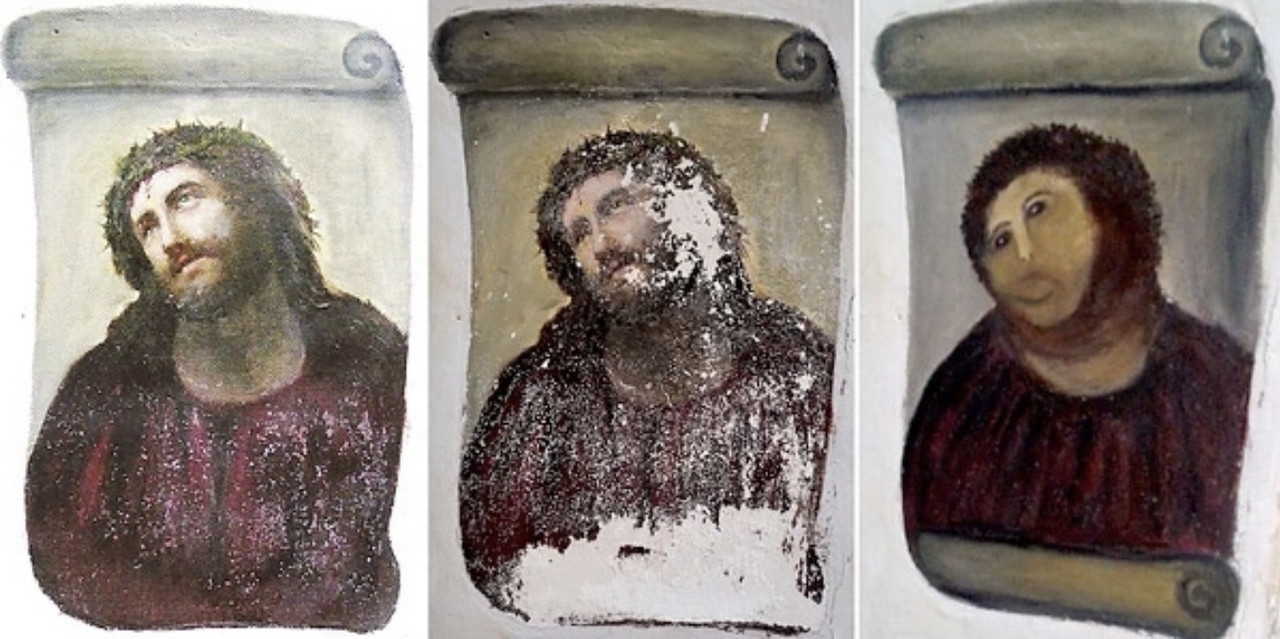
It’s important to use a trusted restorer, unless you’re looking for results like Ecce Homo.

description

I didn’t get a lot of the art in this book but there were some I particularly liked, including:

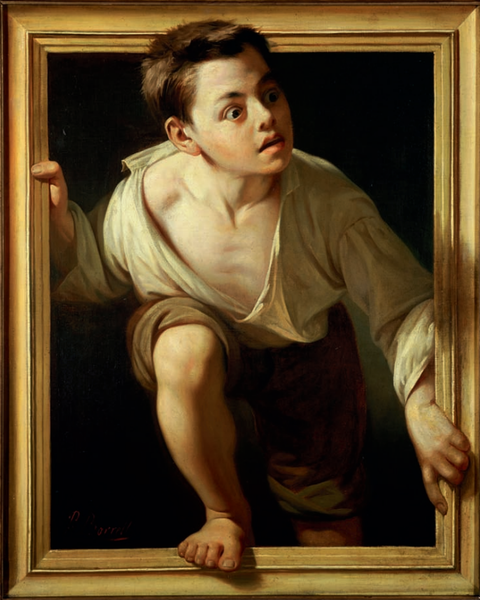
🎨 Pere Borrell del Caso’s Escaping Criticism

description

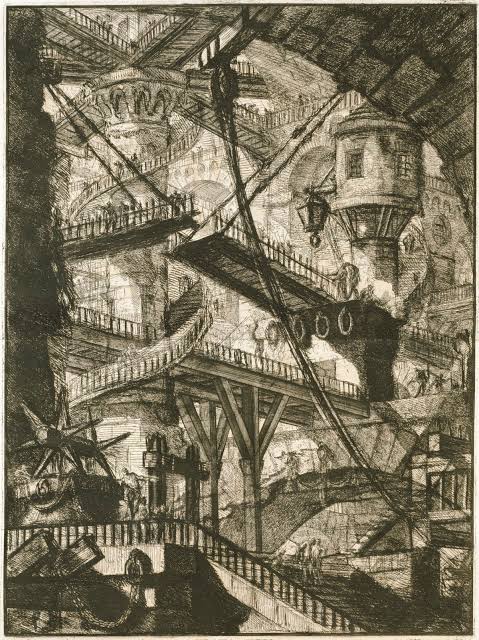
🎨 Giovanni Battista Piranesi’s The Drawbridge

description

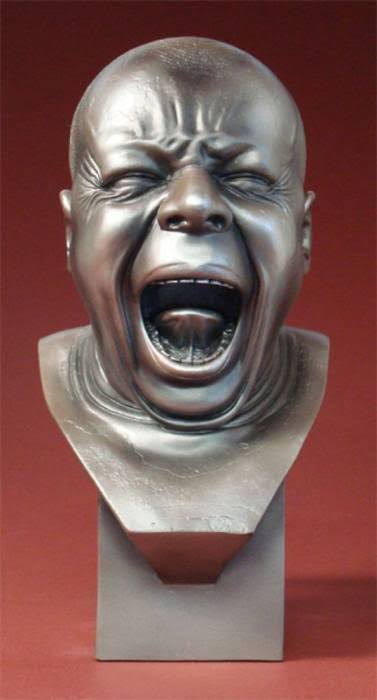
🎨 All of Franz Xaver Messerschmid’s Character Heads. This is The Yawn.

description

This book confirmed that my weird threshold is pretty high. I expected the artwork to be weirder. I really enjoyed the first half of this book but it didn’t keep my interest as much when it made it to more contemporary art.

I may not be obsessed about this book like I was with The Madman’s Library but I’m glad I read it. It’s piqued my interest enough to order more of the author’s books from the library.

Rating: 3.5 out of 5.

Once Upon a Blurb

Enter The Madman’s Gallery – the perfect gift book for any art lover. Discover an eccentric exploration through the curious history of art, to find the strangest paintings, sculptures, drawings and other artistic oddities ever made.

Obscure and forgotten treasures sit alongside famous masterpieces with secret stories to tell. Here are Doom paintings, screaming sculptures, magical manuscripts, impossible architecture, dog-headed saints, angel musketeers and the first portrait of a cannibal. Stolen art, outsider art, ghost art, revenge art, and art painted at the bottom of the sea take their place alongside scandalous art, forgeries and hoaxes, art of dreams and nightmares, and cryptic paintings yet to be decoded. Discover the remarkable Elizabethan portraits of men in flames, the mystery of the nude Mona Lisa, the gruesome ingredients of lost pigments, the werewolf legion of the Roman army, and the Italian monk who levitated so often he’s recognised as the patron saint of aeroplane passengers.

From prehistoric cave art to portraits painted by artificial intelligence, The Madman’s Gallery draws on a remarkable depth of research and variety of images to form a book that surprises at every turn, and ultimately serves to celebrate the endless power and creativity of human imagination.

Reclaim – Dr Ahona Guha

I’ve read books about complex trauma before. Most focus exclusively on those who have experienced trauma, classifying them as victims or survivors. They tend to talk about what happened to people and then discuss the various short and long term impacts, and offer suggestions for managing them.

I’ve also read books about perpetrators before, although these reads generally focus on serial killers, a result of my interest in criminal profiling. More often than not, a perpetrator is painted as only that. If mention is made of any victimisation that they have experienced, it’s in a reductive manner. This happened to this person as a child. Therefore, this person acted in this way as an adult.

This book is designed to be a guide to evidence-based psychological frameworks that can aid in understanding the nature of complex traumas, the tasks of recovery, the nature of those who perpetrate abuse, and broader issues involved in service provision and trauma management.

What drew me to this book was the fact that its author works as both a clinical and forensic psychologist. As someone with a trauma history, I’m always looking for new, better ways to manage its impacts. As someone with a psychology degree (the most expensive piece of paper I own), I am interested in the why behind the what when people act in ways that victimise others.

I love that this book delves into something that most people conveniently ignore: sometimes a person is both victim and perpetrator.

We have neat binaries in our minds: victims and perpetrators. Some people are both, and we struggle to know where to place these people and how to respond to them.

One of my favourite parts of this book was its exploration of the way the media highlights the stories of survivors of trauma whose impacts are socially acceptable; these are usually young, attractive, educated, heterosexual, white women. What’s lost in the narrative is everyone else, including those who are incarcerated, homeless, struggle with addiction or virtually any other impact that makes it easier for us to focus on someone’s behaviour at the risk of ignoring their underlying trauma.

When we think about complex trauma it is essential to hold all survivors in mind – not just those we judge to be worthy of healing (typically those we see as being most like us).

I also appreciated the acknowledgment that many perpetrators are very skilled at hiding their true colours from the people they’re not victimising. So many times when I’m reading news articles about a horrific crime, I see quotes from people who know the alleged perpetrator, who talk about what a nice, wonderful, community minded person they are. They can’t believe that their friend, coworker, family member or acquaintance would be capable of such violence.

People who engage in abusive acts often demonstrate situation and context-dependent behaviours, so that people who are not being victimised by them will often see very different behaviours.

A blend of theory and case studies (composites so as not to breach confidentiality), this book would be of interest to both trauma survivors and those who work in helping professions. I anticipate that readers who work with trauma survivors will find the information relating to managing vicarious trauma particularly helpful.

Thank you so much to Scribe Publications for the opportunity to read this book.

Rating: 4.5 out of 5.

Once Upon a Blurb

A groundbreaking book that will broaden and expand your thinking, whether you are a trauma survivor, a clinician, someone who loves a survivor, or someone seeking to understand abuse.

The relationship between trauma and mental health is becoming better recognised, but survivors and professionals alike remain confused about how best to understand and treat it. In Reclaim, through a series of case studies and expert analysis, Dr Ahona Guha explores complex traumas, how survivors can recover and heal, and the nature of those who abuse. She shines a light on the ‘difficult’ trauma victims that society often ignores, and tackles vital questions such as, ‘Why are psychological abuse and coercive control so difficult to spot?’, ‘What kinds of behaviours should we see as red flags?’, and ‘Why do some people harm others, and how do we protect ourselves from them?’

As a clinical and forensic psychologist, Dr Guha has had extensive experience in working with those who perpetrate harm – including stalkers, sex offenders, violent offenders, and those who threaten, bully and harass – and she has a deep understanding of the psychological and social factors that cause people to abuse others. In turn, her clinical work in the trauma treatment field has led her to recognise the enormous impacts of complex trauma, and the failures of systems when working with those who have been victimised.

By emphasising compassion above all, Dr Guha calls for us to become better informed about perpetrators and the needs of victims, so we might reclaim a safer, healthier society for everyone.

The Unit – Ninni Holmqvist

Translator – Marlaine Delargy

Dorrit is dispensable. Society says she’s not needed because she unmarried, childless and doesn’t work in one of the specified professions that would give her an exemption for failing to fulfil her duties as a woman. Having just turned fifty, Dorrit has earned herself a one way trip to the Second Reserve Bank Unit for biological material.

From now on it was important that I was kept in good condition and good health in every way. That was the whole point, after all.

It’s almost like an all expenses paid resort, where your food, entertainment, medical expenses and even shopping are on the house. All it costs is your life.

A dystopia for the childless, this book introduces readers to a democratic society that’s come to the conclusion that every body is a commodity. Those who have been designated dispensable – fifty year old women and sixty year old men who don’t have children – have all of their needs met as they participate in drug trials and experiments, and ‘donate’ their organs to the indispensable.

The best dystopias are the ones you can imagine happening. The worst dystopias are the ones you can imagine happening. This is a best-worst dystopia.

I liked Dorrit and, despite the circumstances, enjoyed seeing her belong for the first time in her life. I loved the camaraderie between her and the friends she made at the Unit. I had such hope for her when she found love.

Then I remembered this was a dystopia and all of the things I loved about this book became things that could be taken away from Dorrit and, by extension, myself as I became more and more invested in her story.

Interestingly, while I liked most of the characters, I didn’t become emotionally attached to any of them. When I learned about various characters having made their final donation I was interested but didn’t need a single tissue.

Considering how much money was being invested in keeping dispensables as healthy as possible for as long as possible (alcohol isn’t even allowed), I wondered how management would feel about the potential drug trials had to destroy previously viable organs.

Thank you so much to NetGalley and Oneworld Publications for the opportunity to read this book.

Rating: 4 out of 5.

Once Upon a Blurb

In paradise, nobody can hear you scream.

Ninni Holmqvist’s eerie dystopian novel envisions a society in the not-so-distant future where men and women deemed economically worthless are sent to a retirement community called the Unit. With lavish apartments set amongst beautiful gardens and state-of-the-art facilities, elaborate gourmet meals, and wonderful music and art, they are free of financial worries and want for nothing. It’s an idyllic place, but there’s a catch: the residents – known as dispensables – must donate their organs, one by one, until the final donation. When Dorrit Weger arrives at the Unit, she resigns herself to this fate, seeking only peace in her final days. But she soon falls in love, and this unexpected, improbable happiness throws the future into doubt.  

Clinical and haunting, The Unit is a modern-day classic and a spine-chilling cautionary tale about the value of human life.

Our House – Louise Candlish

Fi comes home one day to find a moving truck in front of her house, unloading the belongings of strangers. Only Fi didn’t sell her house…

Something horrific is taking place, she thinks. Knows. Knows in her bones.

This is not the type of book I’d usually read but the blurb sucked me in. I wanted to know Fi and Bram’s backstory, to figure out how and why this had happened.

Beginning with Fi’s discovery that her house is no longer her house, this story then takes you back to the beginning of where it all went wrong. Fi’s story is told via a podcast that she and her friends all used to listen to before her life became an episode. Bram wrote his own version of events.

I don’t usually finish books when I don’t like any of the main characters. I’m all for loving characters or loving to hate them, but don’t tend to want to get to know fictional characters I wouldn’t want to sit down and have a conversation with. I made an exception for Fi and Bram, neither of whom I’d meet for coffee.

After hooking me in the beginning, the story dragged in the middle. I decided to stick with it and am glad I did because it picked up towards the end. I saw some of the twists coming. The ones I didn’t see coming didn’t surprise me when they arrived; my response was more that how the plot was unfolding made sense rather than there being any jaw dropping.

I can see why people enjoy books like this one. There’s dysfunctional family dynamics, betrayal and people pushed beyond their limits. I still don’t think it’s really my type of book (if the characters had made the decisions I probably would have, there wouldn’t have been a book in the first place), but I like wandering outside of my reading comfort zone every so often to see what I’m missing. I probably need to do it more often.

Thank you so much to NetGalley and Simon & Schuster for the opportunity to read this book.

Rating: 3.5 out of 5.

Once Upon a Blurb

FOR BETTER, FOR WORSE.
When Fi Lawson arrives home to find strangers moving into her house, she is plunged into terror and confusion. She and her husband Bram have owned their home on Trinity Avenue for years and have no intention of selling. How can this other family possibly think the house is theirs? And why has Bram disappeared when she needs him most?

FOR RICHER, FOR POORER.
Bram has made a catastrophic mistake and now he is paying. Unable to see his wife, his children or his home, he has nothing left but to settle scores. As the nightmare takes grip, both Bram and Fi try to make sense of the events that led to a devastating crime. What has he hidden from her – and what has 
she hidden from him? And will either survive the chilling truth – that there are far worse things you can lose than your house? 

TILL DEATH US DO PART.

The Baby-Sitters Club Graphic Novels #10: Kristy and the Snobs – Chan Chau

Text – Ann M. Martin

Colour – Braden Lamb

There’s a part of me that will never forgive Ann M. Martin for making me love a senior dog. If I know a dog isn’t going to survive a book, I refuse to read it and I blame Louie for that.

I ugly cried through the novel this week and now it’s the graphic novel’s turn. I don’t know whether it’s worse to imagine Louie’s final days or see them laid out before you panel after panel.

This is my first Chan Chau BSC graphic novel and they’ve done a really good job of adapting this story but, with all due respect, I don’t think I will ever read Louie’s story again.

Rather than getting the tissues out, here are the main differences I noticed between the book and graphic novel.

Book: Kristy’s alarm goes off at 6:45am.
Graphic novel: Kristy’s alarm goes off at 6:30am.

Book: Kristy says “Poor old Louie” twice, when she feels his cold paws and when David Michael asks her to call Louie to her.
Graphic novel: Kristy only says “Poor old Louie” when David Michael asks her to call Louie to her.

Book: Shannon Kilbourne has thick, curly blonde hair.
Graphic novel: Shannon Kilbourne has straight, dark brown hair.

Book: After saying the neighbourhood kids look like snob clones, Kristy board the school bus. She calls out, “Good-bye, snobs”, to which Shannon replies, “‘Bye, jerk-face”. Kristy pokes her tongue out at Shannon.
Graphic novel: After saying the neighbourhood kids look like snob clones, Kristy board the school bus. Kristy pokes her tongue out at Shannon. Shannon responds in kind.

Book: Kristy talks to Mimi downstairs in the kitchen. Because of Mimi’s stroke, her speech isn’t perfect.
Graphic novel: Kristy calls down the Mimi, who is sitting downstairs having tea (probably special tea), as she goes upstairs to the BSC meeting. Mimi’s speech appears unaffected by her stroke.

Book: Charlie, Kristy and David Michael take Louie to his first vet appointment.
Graphic novel: The three kids and their mother take Louie to his first vet appointment.

Book: Priscilla, the purebred cat, cost $400.
Graphic novel: Priscilla, the purebred cat, cost $4000.

Book: Mary Anne babysits Myriah and Gabbie Perkins. Jamie Newton storms off and goes back home after upsetting Gabbie.
Graphic novel: Logan is at the Perkins’ home as well. Jamie Newton stays for the tea party.

Book: All of the furniture in the Delaney’s family room is white.
Graphic novel: Only the fireplace is white.

Book: Dawn babysits her younger brother, Jeff. It doesn’t go well. She cries about the situation during the next BSC meeting.
Graphic novel: Jeff isn’t mentioned at all.

Book: The fish fountain cost $2000.
Graphic novel: The fish fountain cost $20000. Basically, we’re adding a 0 to every price.

Book: Mallory helps Claudia babysit her siblings.
Graphic novel: Jessi is there, too.

Book: Karen and Andrew are there when Louie gets sicker.
Graphic novel: Karen and Andrew (and Boo-Boo) nap with David Michael and Louie. This is really sweet and doesn’t involve the trauma of seeing Louie get much worse. Louie also doesn’t end up going down the basement stairs.

Book: Watson stays in the car during Louie’s final vet appointment.
Graphic novel: Watson stays in the reception area with Kristy and David Michael during Louie’s final vet appointment.

Book: Brother Louie is played on a tape deck.
Graphic novel: There’s a CD of Brother Louie.

Book: A cross marks the place where Louie’s belongings are buried.
Graphic novel: A gravestone marks the place where Louie’s belongings are buried.

Book: Mary Anne makes the exorcise joke about Ben Brewer.
Graphic novel: Jessi makes the exorcise joke about Ben Brewer.

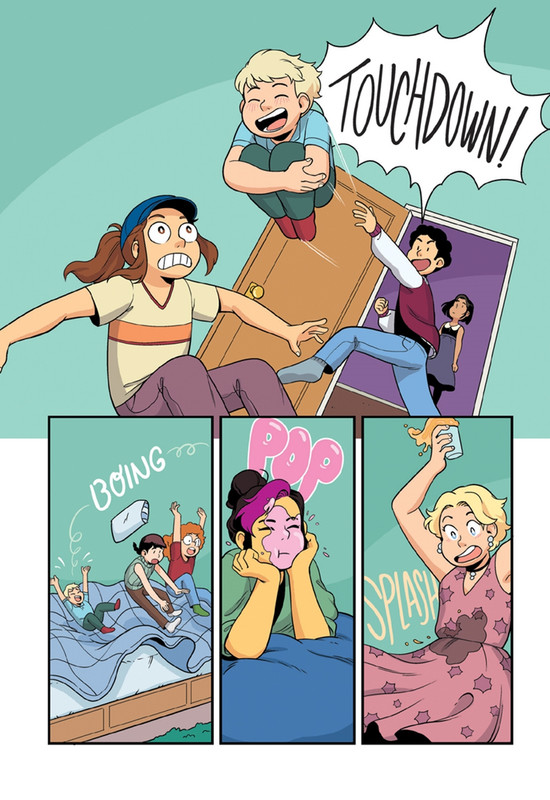
There’s a lot of sad in this story, so I need to leave you with a smile. Andrew is such a good football in this adaptation.

description

Rating: 4 out of 5.

Once Upon a Blurb

Kristy’s mum got remarried and their family moved to the ritzy neighbourhood across town. The other members of the Baby-sitters Club think it’s a good opportunity to get some new business, but the kids who live nearby aren’t very friendly. They criticise Kristy’s clothes and make fun of the BSC. And, worst of all, they laugh at Louie, Kristy’s pet collie, who’s getting old and not feeling well. These kids are total snobs! But if anyone can put them in their place, it’s the Baby-sitters Club!

The Baby-Sitters Club #11: Kristy and the Snobs – Ann M. Martin

Kristy, in her third BSC book, is here to break my heart. Although, to be fair, I should be blaming Ann M. Martin for ruining my illusion that my childhood dog would live forever.

We babysit Jackie, Archie and Shea Rodowsky, Linnie, Hannie and Sadi Papadakis (with Myrtle the turtle and Noodle the poodle), Myriah and Gabbie Perkins, and Amanda and Max Delaney (snobs: kid edition).

Dawn babysits her younger brother, Jeff, who is having problems, one of which may be the fact that their mother is still dating a man named Trip.

Claudia babysits the Pike kids with some help from Mallory, five of whom have chicken pox. Nicky and Vanessa get bent out of shape over the Bizzer sign. They also have cream cheese and jelly sandwiches, which sounds like a somewhat disturbing combination.

Stacey gets Amanda and Max Delaney to clean up their room in a very non Mary Poppins way.

Claudia fails a spelling test. No surprises there.

Tigger has worms. Poor Tigger.

Stacey has an upcoming doctor’s appointment.

“Boy, what a lousy, stinky, rotten day”

Stacey references The Taming of the Shrew. The Tenth Good Thing About Barney was also mentioned when I was pretending I wasn’t ugly crying about a fictional dog.

Kristy has to miss a BSC meeting but I can’t even poke fun at her about it because it was about Louie.

Karen talks about Morbidda Destiny and Ben Brewer.

Andrew is a football.

Shannon goes from being one of the neighbourhood snobs to the BSC’s second associate member.

This book gets sadder every time I read it.

Stoneybrook Central Time: Kristy, her mother and brothers moved in to Watson’s mansion several months ago. Dawn’s brother, Jeff, is now ten years old.

Up next: Claudia makes a new friend, which seems to morph the Baby-Sitters Club into the Baby-Sitters Cult.

Rating: 4 out of 5.

Once Upon a Blurb

Kristy’s mum got married again last summer and now Kristy and her family in a new neighbourhood. The kids aren’t very friendly. In fact, they’re… well, snobs. They criticise Kristy’s clothes. They make fun of the Baby-sitters Club. And worst of all, they laugh at Louie, Kristy’s pet collie, who’s going blind. Nobody does that and gets away with it!

Kristy’s fighting mad – and she’s not going to put up with it much longer. If anybody can beat a Snob Attack, it’s the Baby-sitters Club. And that’s just what they’re going to do.