Hocus & Pocus #1: The Legend of Grimm’s Woods – Manuro

Illustrations – Gorobei
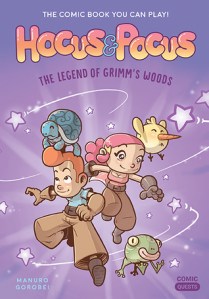
I loved Choose Your Own Adventure books as a kid and I’ve loved graphic novels since then so a combination of these in game form seemed like a trifecta that couldn’t fail. In Hocus & Pocus you have the choice of character and which magical creature you will take on your adventure. Aimed at kids in middle school this interactive graphic novel includes “choices, puzzles, mysteries, and powerups”. For this adventure you will need a die, pencil and eraser.

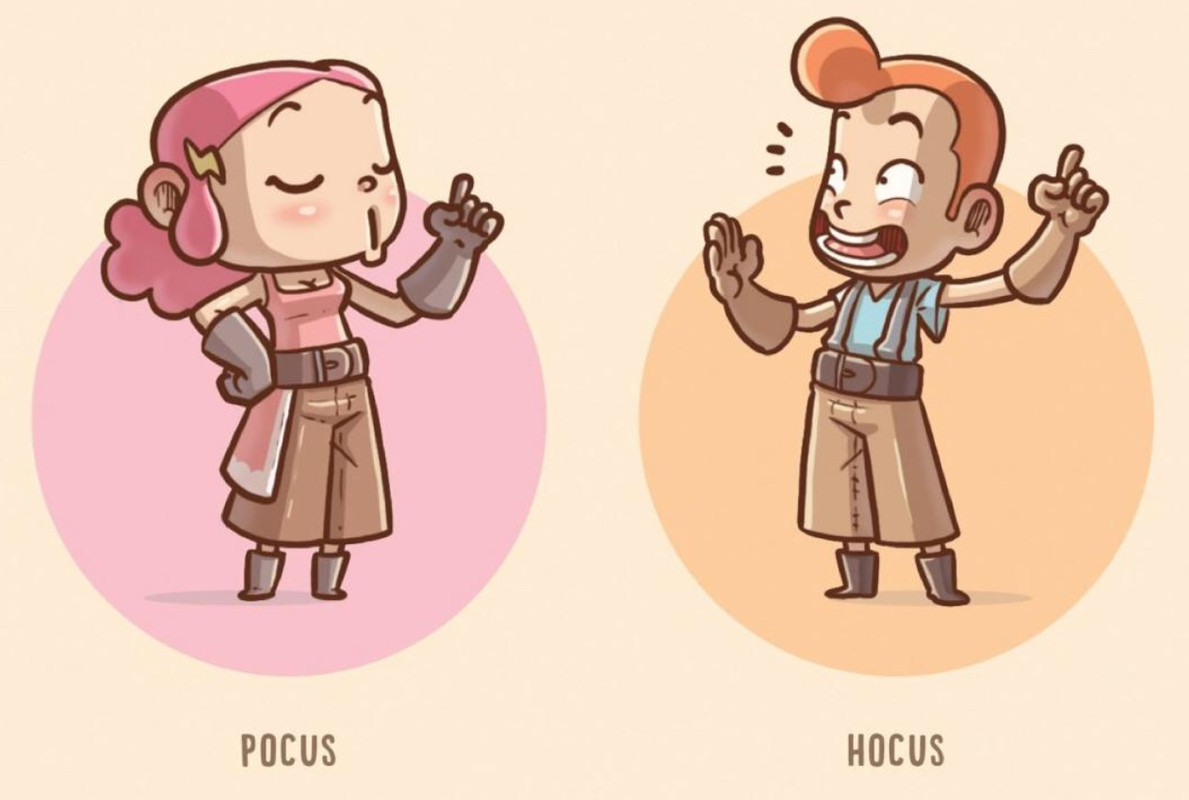
Pocus has pink hair so naturally she was who I wanted to be for my first adventure.
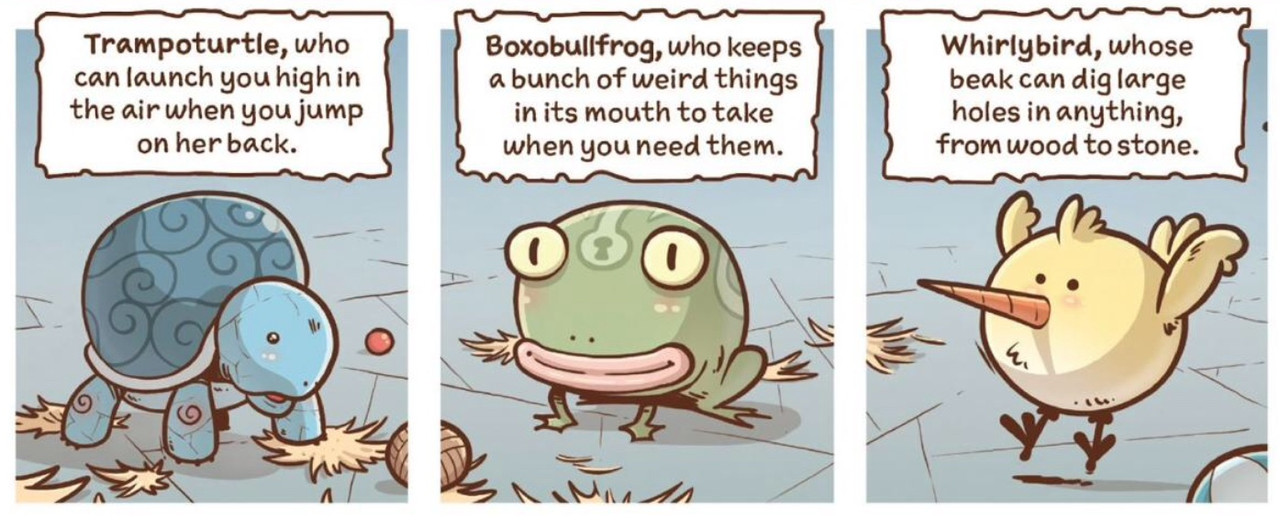
My choice of magical creature was also easy; the Boxobullfrog, “who keeps a bunch of weird things in its mouth to take when you need them”. I barely looked at the other options. Why wouldn’t I want a creature that produces handy weirdness when required?!
So with my character and creature chosen I took off on my adventure and fairly soon I was lost. I ended up on the exact same path in the forest several times and I thought for a while that I was going to be lost forever. There were times where I wandered around paths with no story. I went from a panel where all I needed to do was choose a number, flipped to the number and found another panel where all I needed to do was choose a number.

On my second adventure I decided to be Hocus with his hair sprayed pompadour. I kept my Boxobullfrog because “weird things in its mouth”! There was no other option for me although this little critter wasn’t as useful to me this time around. While I didn’t get lost on a path this time I had to return to the map of the castle so many times I felt the urge to scream in frustration. If I wound up at the Groundhog Day map again in a future adventure I’d write down each number I followed from it so I didn’t accidentally wind up at the same place so many times more than once.

There are rules to follow regarding whether your magical creature is awake or asleep which involve searching for its food in the drawings and marking boxes on your Adventure Tracker. I probably would have loved this part when I was in the age group the book is intended for but now that I’m old it felt too much like homework to me and so I may have cheated, deciding that my magical creature was always going to be awake when the story gave me the option of obtaining their help. I expect a lot of kids will enjoy making notes each time they find some food for their creature or a star.

Because my brain has a habit of connecting pieces of information that have no relevance to one another (thanks, brain!) this book reminded me of an article I read last week where someone was discussing the differences between Pass the Parcel from the good ol’ days and now. Back when I was a child sometimes the music stopped on you during a game and sometimes it didn’t. When the next layer was opened there’d be a cheap plastic toy or a lolly or nothing. Apparently every layer now has a toy (that’s not some cheap plastic thing) and everyone has to win something or they’ll feel left out. Hold on; my brain is about to try to connect the dots for you.

In this story it felt as though no matter what I chose everything would end up fine in the end and that it was more an illusion of choice than the real deal. There was always the possibility in the Choose Your Own Adventures of my childhood that the wrong choice could be dangerous for the character and potentially lead to their demise but when I read this graphic novel straight through I didn’t uncover anything dastardly, which was disappointing. I was encouraged by the amount of panels I came across when I read from cover to cover that I hadn’t already seen so you could potentially read this a number of times and discover different parts of the story, albeit with the same ending.
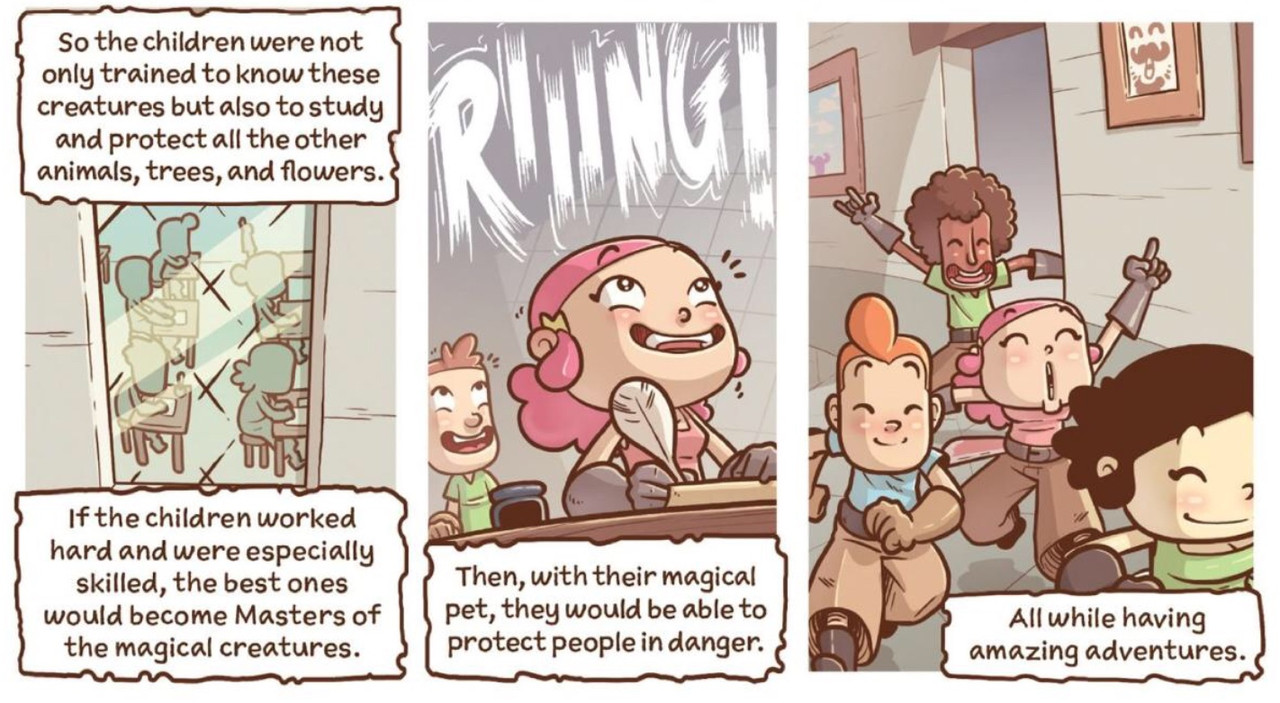
The illustrations were cute. I particularly liked the tree at the crossroads in the Woods of the Treemen that looked like it was shrugging, not knowing which path to choose either.

Thank you to NetGalley and Quirk Books for granting my wish and giving me the opportunity to read this book.

Rating: 3.5 out of 5.

Once Upon a Blurb

Introducing a new series of interactive graphic novels – first published in France, and translated/transported to English language readers by Quirk Books.

Enter a world inspired by all of your favorite fairy tales – complete with gingerbread houses, a girl dressed in red, and seven children lost in the woods. Hocus & Pocus offers a new kind of reading experience – part game book, part graphic novel, and part Choose Your Own Adventure story. Readers can play as Hocus (a girl) or Pocus (a boy), choose a magic animal companion, and enter a colourful fairy tale forest of riddles, magical objects, and unusual characters. Succeed or fail, it’s all up to you! 
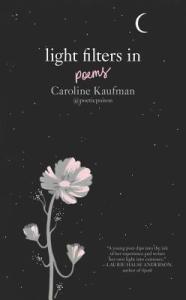
Light Filters In: Poems – Caroline Kaufman

Illustrations – Yelena Bryksenkova

Caroline Kaufman is probably better known (so far) by her Instagram profile @poeticpoison. Published while still a teenager, this book is a mixture of dark and light, heartache and hope. Poetry can be very hit and miss for me and I found that to be the case with this collection as well. I connected with some of her words so deeply that I could have written them myself when I was Caroline’s age.

I’ve spent so much time trying to become who I should be that I lost myself along the way.

Others I struggled with but that’s probably more indicative of my stony cold heart than Caroline’s writing ability. When I read about relationships and heartache it’s akin to a vampire feeling the warmth of sunlight on their skin.

This book is divided into four sections: the darkness falls, the night persists, the dawn breaks, and the sun rises. What I loved above all else is the honesty of these poems.

sometimes I imagine my younger self and I worry she wouldn’t recognize me.

Once upon a nitpick: One of my pet peeves is sentences that don’t begin with a capital letter. It bugs me whenever I see it and for some reason that baffles me it seems to be a cool thing to do these days. Some poems in this book include my beloved capital letters; others don’t.

This collection reminded me of the tumultuous experience of adolescence, a place I don’t like to visit. There’s a rawness to the writing that I really appreciated although overall I don’t feel as though I’m the target audience. I probably would have been when I was a teenager but a lot of the writing felt very young (and rightly so as the author is only 18). I hope that Caroline continues to write from her heart as the authenticity of her voice has the potential to impact a lot of young lives.

Rating: 3.5 out of 5.

Once Upon a Blurb

In Light Filters In, Caroline Kaufman – known as @poeticpoison – does what she does best: reflects our own experiences back at us and makes us feel less alone, one exquisite and insightful piece at a time. She writes about giving up too much of yourself to someone else, not fitting in, endlessly Googling “how to be happy,” and ultimately figuring out who you are.

This hardcover collection features completely new material plus some fan favourites from Caroline’s account. Filled with haunting, spare pieces of original art, Light Filters In will thrill existing fans and newcomers alike.

it’s okay if some things

are always out of reach.

if you could carry all the stars

in the palm of your hand,

they wouldn’t be

half as breathtaking

From the Heart of Africa: A Book of Wisdom – Eric Walters (compiler)

From the Heart of Africa: A Book of Wisdom comprises of aphorisms (sayings), where they originated and their meaning, every saying accompanied by an illustration. Each illustration is the work of an individual artist, all of which have brief bios at the end of the book.

The compiler of these sayings, Eric Walters, co-founded an organisation focused on the Mbooni District in Kenya called Creation of Hope. This organisation supports orphans and a portion of the proceeds of this book will be donated to assist with the childrens’ education.

My Compassion daughter lives in Kenya so I have a soft spot for the people of this country. What I particularly like about what I’ve learned about Creation of Hope is that while its co-founder is a Canadian man, it’s a Kenyan program run by Kenyan people.

I enjoyed the sayings in this book but wanted there to be so many more. There were only 15 sayings included, most I’d heard some variation of before but also a couple that were new to me. The meanings were fairly basic and easily understood.

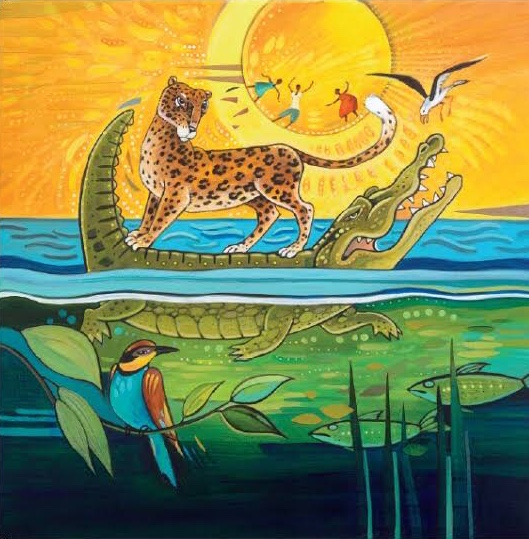
For me this book was all about the illustrations, the majority of which were vibrant and absolutely stunning. My personal favourite illustration was by Eugenie Fernandes and depicts the saying,

“When in the middle of a river, do not insult the crocodile.”

I adored the detail of the animals and the gorgeous colours. I’m no art critic but I want a copy of this illustration and I definitely need to seek out more of this artist’s work.

My two favourite sayings in the book were

“Rain does not fall on one roof alone.”

and

“I pointed out to you the stars, but all you saw was the tip of my finger.”

Suitable for children and adults alike, this would make a beautiful addition to school and public libraries, and as a gift or coffee table book.

Thank you so much to NetGalley and Tundra Books, an imprint of Penguin Random House Canada, for the opportunity to read this book.

Rating: 3.5 out of 5.

Once Upon a Blurb

A collection of African wisdom gorgeously illustrated by artists from Ghana, South Africa, Zimbabwe, Canada, the United States and more.

Aphorisms are universal. They give guidance, context and instruction for life’s issues, and they help us understand each other and the world around us. We use them every day, yet never think about where they came from or why they exist. 

In this beautifully illustrated collection, Eric Walters brings us classic sayings from the places where this shared wisdom began. Ashanti, Sukuma, Akan and Kikuyu: all of these cultures use the portable and easily shared knowledge contained in aphorisms, and from these cultures and more this communal knowledge spread. 

This book is a celebration of art, of community and of our common history.

Hopeless Heroes #1: Here Comes Hercules! – Stella Tarakson

Illustrations – Nick Roberts

Here Comes Hercules! is a fun start to a new children’s series called Hopeless Heroes. Including plenty of illustrations by Nick Roberts, we’re introduced to Tim Baker who lives with his mother. Tim is often needed to help out with the housework as his mother is busily working two jobs trying to keep her small family afloat, while actively working on her dream of becoming an author.

One day while dusting an ancient Greek vase he accidentally drops it and it shatters. Unbeknownst to Tim, by breaking the vase he’s also accidentally set Hercules free after he was trapped inside by wicked Hera, the wife of Hercules’ father Zeus. Hercules winds up ‘helping’ Tim with his household chores as only a Hopeless Hero can.

Hercules’ funny attempts to help inevitably end in disaster and Tim’s poor mother thinks Tim is acting out because he’s sick of cleaning. Tim discovers he’s the only person who can see Hercules, which complicates his relationship with his mother, his friendship with Ajay and even with Leo, the bully at school. Hercules is desperate to return to his wife and daughter and Tim is determined to help him, if only they can figure out how.

This chapter book is suitable for younger children who will enjoy Hercules’ bumbling attempts to be helpful. There are some good giggles and great illustrations, along with some accidental education about ancient Greek mythology. Bullying is addressed and I expect this theme will continue in future books. There are also indications the bully is facing family problems.

Tim and his mother are likeable characters who both have room for growth in future books. Tim, while not a fan of housework, wants to help out his mother and is supportive of her dream of becoming an author. Tim’s mother only wants the best for her son and is working hard to support him. I will be interested in reading the next book in the series.

Thank you so much to NetGalley and Sweet Cherry Publishing for the opportunity to read this book.

Rating: 3.5 out of 5.

Once Upon a Blurb

When Tim Baker breaks his mum’s favourite vase, it’s the least of his problems. The Greek hero he’s released is in danger of doing far worse. To the flowers, the rug – Oh, no! Not the kitchen!

Hercules is only trying to be helpful but he’s just hopeless. It’s time to send this dim demigod home before Tim becomes ancient history.

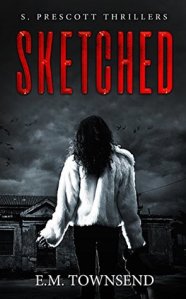
Sketched – E.M. Townsend

I loved the concept of Sketched. You’ve got a police sketch artist who has an ooky spooky second sight connection that allows her to go into trancelike states where she’s able to draw photograph quality portraits of people who (with the exception of her mother) she’s never seen before – while she’s blacked out.

After a face and location are revealed to her via her supernatural connection, Piper winds up face to face with Dixon’s very own serial killer, the Dixon Demon, and survives (barely). She then goes into hiding eight hours away from her hometown.

Fast forward five years and Piper’s ability is stronger than ever. The Dixon Demon is back in the business of making townsfolk disappear and Piper is drawn back to her hometown to face her own demons as well as the elusive Demon.

I found the story intriguing and entertaining. I really enjoyed the atmosphere the author created. There’s a dark, creepy foreboding that follows you through the book. I wanted to continue reading to learn more about the killer’s motivation and how the various threads were going to be tied together. However, I had some problems with the characters in this book, mostly due to my lack of connection to any of them.

When someone dies during the book, my response was, ‘oh, okay’ and that wasn’t okay with me. Usually I’d be outraged or ecstatic or would at least have some sort of feeling about it, especially when they were an important person in another character’s life, but I didn’t.

The serial killer was unusual in that their victimology changed during the course of the book. While their motivation remains fairly consistent their crime scenes reflected a mix of organised and disorganised elements. I enjoyed learning their backstory and connecting the dots to discover how this person became so freaking messed up.

They are a huge fan of the baddie monologue and take mother issues to a whole new level. Take my word for it: this mother could probably teach Norma Bates a thing or two. I really liked that there were three characters with various mother issues in this book, all responding with their own versions of lashing out and engaging in self-destructive behaviour.

I never really understood the role of Piper’s psychiatrist. While he’s still advising Piper (mostly to actually eat a meal and not drown herself), his role appears to be more Boy Friday than anything else. He’s the chef, the executive assistant, the friend, the babysitter.

I wondered why one alcoholic got the DT’s at a certain point when the alcoholic that was with them at the time didn’t. It’s also noted that a body is too decomposed to be identified using dental records. My forensic knowledge is amateur at best but I thought teeth were one of the best identifiers when a body is decomposed.

I found some of the sentence structure awkward. One portion of a sentence, as an example, read, “their flashlights the only light source of light.” (76%) Although to be fair I read an advanced copy so it’s likely that sentences like this were remedied prior to the book’s release.

Favourite sentence:

“What if she finally surfaced only to find herself still submerged?”

Had I connected to the characters this book would have been a solid ⭐️⭐️⭐️⭐️. I’m interested in reading more books by this author.

Thank you so much to NetGalley, S. Prescott Thrillers and BookBuzz.net for the opportunity to read this book.

Rating: 3.5 out of 5.

Once Upon a Blurb

Fledgling police sketch artist Piper Cooke has always been different. 

Gifted with second sight, but cursed with a life of tragedy, she has survived the feral streets of Dixon and has triumphed over her troubled upbringing. Piper faces her biggest challenge yet, however, when her visions compel her to disobey police orders and send her right into the wicked grasp of a madman. 

Her life should’ve ended back in the blood soaked suburban basement, but it didn’t. Instead, the brutal trauma that should’ve been the end of her only makes her unique abilities stronger. 

Years after her escape, a series of hideous visions force Piper out of hiding and back into the city that almost destroyed her years ago. Plagued by premonitions of doom, she finds herself compelled to track down Dixon’s most twisted serial killer yet. 

Follow Piper through a horrifically unsettling labyrinth of family secrets, corruption and the sickening workings of humanity’s darkest minds. 

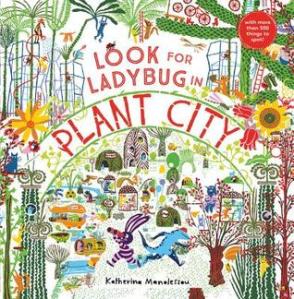
Look for Ladybug in Plant City – Katherina Manolessou

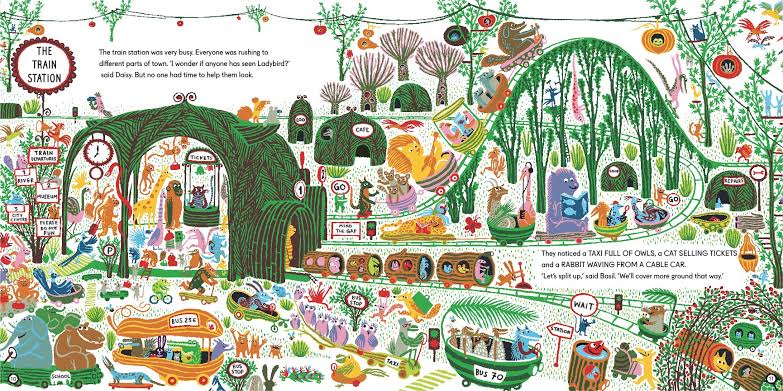
Daisy’s pet Ladybird has decided to play a game of hide-and-seek. Daisy enlists the help of the best detective in Plant City, Basil, to help find him. They search the school, train station, museum, fun fair, restaurant, garden centre, a concert, hospital, riverbank and market. Along the way they find many other animals doing fun activities including a skateboarding crocodile and items such as a picture of a pineapple.

The illustrations were colourful and jam packed with activity. Kids will enjoy spending time searching the pages for animals doing cute and funny things. This book is the first in a planned series and it definitely has potential but I think it could have been more interactive.

I had expected the book to ask the reader/seeker to find more things. As the front cover boasts that there are over 500 things to find I was surprised that each scene only required on average three things to be found. Perhaps additional items to find could have been listed at the back of the book, along the lines of, “Well done! You’ve found Ladybird and some of the residents of Plant City. Can you also find …” and then maybe list some more things to find in each scene.

I know kids can find their own items in the scenes and adults can ask a kid if they can see something but most of the fun of this sort of book is having a big list of items to find and then having the satisfaction of knowing where everything is in each scene.

While I liked the style of the illustrations there were a few animals I couldn’t identify. I’d be able to work around this with a child by asking them to find an animal of a certain colour doing a particular activity. I also would have liked a final page where Daisy and Basil actually find Ladybird. As it stands, Daisy wants to cry because she misses her pet so she and Basil try silly hats on to cheer themselves up so the story itself finishes on a bit of a downer.

Helpful Hint: Just because Daisy and Basil can’t find Ladybird in each scene doesn’t mean you won’t be able to find him.

Thank you so much to NetGalley and Quarto Publishing Group – Frances Lincoln Children’s Books for the opportunity to read this book.

Rating: 3.5 out of 5.

Once Upon a Blurb

Daisy’s pet ladybug goes missing, so she visits super-sleuth Basil, the best detective in Plant City. Can he help her find Ladybug? Follow Daisy and Basil as they look for Ladybug all over Plant City.

Is he in the museum, the carnival, the train station, the school, the concert or the restaurant? Witty, colorful, illustrations packed with visual jokes and plenty of wild things to spot in the background will delight children of all ages.

Overcoming Anxiety in Children & Teens – Jed Baker

In Overcoming Anxiety in Children & Teens, Jed Baker both outlines theory and provides practical advice for parents with anxious kids. The aim of treatment is realistic in that it doesn’t promise to eradicate anxiety completely as we all experience anxiety at times. The goal is to help the child/teen no longer be controlled by it.

Baker differentiates between true alarms and false alarms. True alarms are when someone is actually in danger. When someone experiences false alarms, reacting with anxiety over events that present no actual danger, gradual exposure therapy can reduce their anxiety. Cognitive behavioural therapy (CBT) aims to assist the individual to manage their fears by challenging their thoughts rather than allowing thoughts and emotions to rule their behaviour.

Touching on medications that may assist in the management of anxiety as well as their side effects but recommending they be used after trying other tools first, the author also outlines non-pharmacological alternatives such as exercise, meditation, mindfulness and neurofeedback. I’m not sure how I’d react as a parent being told in a book about anxiety that one of the possible side effects of medication use for my child is problems with their sexual performance. 😂

Baker describes his approach to making therapy less threatening to young people by initially focusing on their strengths while also addressing challenges (things that can prevent someone from reaching their goals) and the importance of taking into account other areas of a person’s life that may be contributing to their anxiety levels. Information is also given about how fear ladders can work to assist a child to gradually face their fears from least to greatest.

Intrinsic and extrinsic rewards for climbing the fear ladder steps were outlined. Personally I have some issues with a couple of the extrinsic rewards. Linking food rewards to preferred behaviour reminded me too much of Pavlov’s dogs and I wondered about the wisdom of rewarding children with junk food.

I can certainly see the benefit of rewarding them with time spent doing activities they enjoy but I baulked at the idea of paying kids for taking steps to overcome fear. Granted this is a different situation but it reminds me of a girl I played netball with whose father paid her $1 per goal she got each game. Naturally it made no difference to the girl if a teammate was in a better shooting position; she took every shot because she wanted her $1. We were kids in the 80’s and let me tell you that $1 was a lot of money to us at the time! Speaking of junk food, $1 could buy you 20 lollies of your choice in a white paper bag at the local shop.

I’m also not keen on 1 to 5 rating scales. This isn’t a specific problem with this book although it does use them but a pet peeve in general. My argument against these is twofold. People invariably will rate the same thing differently; what is an anxiety level of 2 out of 5 for one person, another may rate as 4 out of 5. Also, even an individual’s rating may not be consistent and could be affected by so many variables including whether or not they’ve had a good day, if they’re hungry or if they got enough sleep the night before.

Specific attention is given in this book to providing tools to manage fear for children who are less verbal, including those with autism. Chapters also provide case studies of the author’s work with children with specific anxieties – simple phobia, social anxiety, selective mutism, separation anxiety and school refusal, panic disorder, Obsessive Compulsive Disorder (OCD), somatic symptom disorder and/or illness anxiety disorder, Generalised Anxiety Disorder (GAD), perfectionism and other common fears that don’t fall into disorders outlined in the DSM-5, including fear of others’ aggression and fear of unexpected changed in schedule or routine.

The case studies, whilst fairly repetitive in parts, would be useful for parents who could read the first section of the book and then focus on the chapter that specifically covers their child’s experience with anxiety. I would anticipate that by reading an outline of a child facing a similar situation and what steps were taken to reduce their anxiety, this would provide much needed hope to a parent that their child will be able to replicate this success.

Having studied anxiety disorders fairly extensively, this book didn’t break any new ground for me but I found its concepts were explained in an approachable way, steering clear of the scientific mumbo jumbo that can put off people who just want answers.

Quoting from other people’s studies and theories (along with plugging their own books several times) the author doesn’t appear to be claiming they’re coming up with a new model for treating anxiety in children but instead explaining existing models and showing parents how they can be applied by using case study examples. While the majority of the references cited throughout the book are ten or more years old, additional tools were also provided in the form of potentially useful websites and apps.

Time is spent explaining how to get the child on board but fails to provide any information regarding what a parent is supposed to do if their child refuses to cooperate with the treatment plan.

I wasn’t a fan of the photographs used in this book. They silently scream, “Dodgy clichéd stock images!” Personally I’d prefer no images over ones that make me roll my eyes. However, this isn’t a photography book so the images have no bearing on my rating.

I particularly liked the scripts that parents and teachers can use to guide children through relaxation, breathing techniques and mindfulness. I’ve read ones similar to these before but have never come across ones written specifically for use with children and found the explanations of the techniques well done.

Thank you so much to NetGalley and Future Horizons for the opportunity to read this book.

Rating: 3.5 out of 5.

Once Upon a Blurb

The key to this book is that it outlines both the science and art of anxiety therapy. The science of overcoming anxiety is using the well researched approach called gradual exposure therapy which involves helping individuals gradually face their fears. The art of therapy is figuring out how to actually convince someone to face their fears. Jed describes motivational techniques, cognitive behavioral strategies, exercises, relaxation and mindfulness guides to lower anxiety to the point where individuals can begin to confront their fears. The book covers: simple phobias, social phobia, selective mutism, separation anxiety and school refusal, panic disorder, obsessive compulsive disorder, somatic symptom disorder and/or illness anxiety disorder, generalized anxiety disorder, perfectionism, and other common fears.