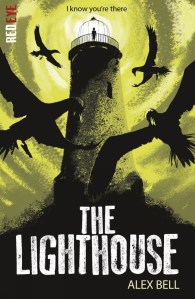
The Lighthouse – Alex Bell

Don’t go near the lighthouse.

There’s not much to do on Bird Rock. The island has no shops, locals or phone reception. What it does have are thousands of gannets, some stone bothies, a lighthouse and an abundance of guano.

Fifteen year old Jess Oliver is definitely not keen on spending two weeks of her summer vacation there. Rosie, her twelve year old sister, is more positive about the trip and hopes to take an award winning photo while she’s there.

Their father and his new wife, Kate, both ornithologists, are working on the island. The sisters will be meeting Charlie, their stepbrother, for the first time.

“The lighthouse is haunted. Cursed. It’s a dangerous place. Something will happen if you stay here. Something bad-”

Because this is an Alex Bell book, and a Red Eye one at that, it’s not long before strange things begin to happen. This was a compulsive read, with a centuries old mystery at its heart, some great creepy moments and a dose of sadness.

I enjoyed the gradual reveal of the history of the lighthouse and absolutely loved that I wasn’t able to figure out what was behind the mystery ahead of time.

Knowing what I now know, I want to return to Bird Rock and experience it all over again.

“I know you’re there.”

Thank you so much to NetGalley and Stripes Publishing, an imprint of Little Tiger Group, for the opportunity to read this book.

Rating: 4.5 out of 5.

Once Upon a Blurb

On Bird Rock, gannets circle and thick mist surrounds the lighthouse at its centre, hiding the secrets of a tragic past within …

From the second they set foot on the island to join their dad and his new family, Jess and Rosie feel that something’s wrong. Nightmares haunt their dreams and there seems to be someone, or something, else with them in the lighthouse – their home for the summer.

Counting down the days until they can leave, Jess and Rosie decide to investigate. But when Rosie disappears, the countdown takes on a new meaning. Especially when no one but Jess remembers Rosie at all…
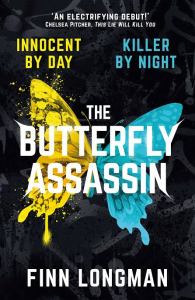
The Butterfly Assassin – Finn Longman

No mercy, no hesitation, no witnesses.

I finished reading this book two weeks ago and I’m still having trouble figuring out what to say about it. It’s not that I didn’t enjoy it. I did. I flew through it. It’s not that I didn’t love the characters. I did. So much! It’s that practically everything I want to say about this book wanders into spoiler territory and I don’t want to ruin it for you.

Isabel Ryan is trying her best to reinvent herself as Bella Nicholls. Isabel was trained as a contract killer by Comma, one of Espera’s two guilds. Bella is an ordinary high school student, a civilian.

She’s seventeen, she’s safe, and she got out.

One day maybe that will feel true.

Isabel is one of the best badass characters I’ve ever survived. She’s resilient, surprisingly vulnerable and all kinds of lethal when the situation calls for it.

‘It’s my trauma. You don’t get to tell me how to deal with it.’

Emma is one of the best friends you could ever hope to meet.

She smiles like it’s nothing. Show her how she can help, give her the knowledge to do it, and there it is: joy.

Grace is a librarian, which made her one of my favourite characters even before I knew anything else about her.

‘All I can offer is books and friendly advice, I’m afraid.’

This is a book about surviving against the odds. It’s about extricating yourself from the past when it’s holding on for dear life. It’s about control: being controlled, losing control and taking it back.

Isabel’s past is essentially layers of trauma and her present isn’t any easier. Not only is she trying to cope with the physical and emotional fallout from her life in the guild, she’s doing her best to create a new life for herself in hopes of having a future. Although not specifically identified as such, the portrayal of PTSD was authentic.

I loved that the chapter titles were in Esperanto as well as English. I loved the worldbuilding. I hated being constantly worried about the safety of my favourite characters but loved that, despite the darkness of this book, there was enough light to find them in the first place.

Favourite no context quote:

‘A candle can’t do much against a black hole.’

‘So light another candle.’

Thank you so much to NetGalley and Simon & Schuster Children’s UK for the opportunity to read this book. I need the sequel immediately!

Rating: 5 out of 5.

Once Upon a Blurb

Trained and traumatised by a secret assassin programme for minors, Isabel Ryans wants nothing more than to be a normal civilian. After running away from home, she has a new name, a new life and a new friend, Emma, and for the first time in Isabel’s life, things are looking up.

But old habits die hard, and it’s not long until she blows her cover, drawing the attention of the guilds – the two rival organisations who control the city of Espera. An unaffiliated killer like Isabel is either a potential asset … or a threat to be eliminated.

Will the blood on her hands cost her everything?

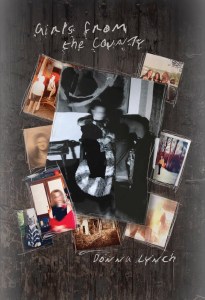
Girls From the County – Donna Lynch

If ghosts exist, perhaps this is how it happens. The marks of things that happen in a place never really go away, nor do the pieces of us we leave there.

Girls From the County explores dark truths: personal stories and those of young women the author grew up with, as well as rural legends and folklore. It’s about trauma and the illusion of safety. Given the subject matter, this was at times a difficult read.

I had a number of favourite poems but my top five were Drag, Plot, Girls From the County, Education, and Thirty-two Years (Eighteen Years Reprise).

The one that’s probably going to stay with me the longest, though, is Grave. While it’s the shortest poem in the collection, it certainly packs a punch.

She grew up and became a mortician

so that when he finally died

she could make sure.

Thank you so much to Raw Dog Screaming Press for the opportunity to read this book.

Rating: 4 out of 5.

Once Upon a Blurb

This book is merely a record of dark events, the kind that you can sometimes move on from, yet can’t help but see in every old house, high school, or crumbling bridge.

In the county, eerie stillness can be mistaken for stagnation. In the county, rumination on pain and guilt can be confused with omens and curses. In the county, feelings of claustrophobia stem from understanding what the encroaching darkness brings with it.

You’ve heard of country girls, and city girls, but what of the forgotten girls from the in-between space of the county? Confronting the things too wild for urban areas, and too methodically malevolent for the countryside, girls from the county are often dismissed by popular narratives, left to solve riddles of grief and rage for themselves.

Known for weaving folk horror with confessional poetry, unflinching true crime approaches with myth and fable, contemporary appetites with gothic literature, award-winning author Donna Lynch has composed a lyrical reconstruction for readers to navigate the lives – and deaths – of girls from the county.

Goth Girl, Queen of the Universe – Lindsay S. Zrull

Jess has moved from house to group home to house for the past nine years. Having entered the foster care system at seven, Jess doesn’t know what it’s like to have a safe place to call home.

Foster Care Pro-tip number eight: Never become emotionally involved with anyone. Ever.

Jess doesn’t expect this placement to be any different but Barbra, Jess’ new foster parent, is unlike any of the ones she’s had before.

Jess’ look is inspired by the “patron saint of goths”, Edgar Allan Poe. This has acted both as a protective layer and a way to express herself. She never expected her creativity to lead to cosplay but if that’s what she needs to do in order to make it to New York to see her biological mother, then that’s what she’s going to do.

Who knew dressing up in costume after the sixth grade could be so much fun?

Barbra was a foster kid’s dream come true. A big part of me tried to keep her at arm’s length, just like Jess did, because she seemed too perfect and I kept waiting for the other shoe to drop. Ultimately, though, I ended up loving her to bits and allowing myself to hope that she actually does represent reality for some foster kids.

Goofy, geeky Oscar was absolutely adorable and stole my heart early on. His enthusiasm and passion were infectious and I wanted to watch him as he created the foam weapons of my dreams.

This is a story of found family, of learning to be vulnerable and to trust, and letting people get to know the real you. The experience of being a foster kid was realistic and the discussions about mental health were refreshingly honest.

It’s suddenly hard to believe that I’ve lived this long without knowing another human being who understands what this is like.

The cover image, which I loved and was what drew me to this book in the first place, had me expecting a middle grade story. Imagine my surprise when Jess’ first day of school included a stranger mid psychotic break trying to get as many swear words in a sentence as possible and a reference shortly thereafter to a “kinky sex dungeon”. Spoiler: Not a kinky sex dungeon.

I did get irritated at times by Jess fairly consistently saying “thank the Goddess” and the way it all played out was predictable, but … the story was just so heartwarming, the pop culture references abounded and I loved watching Jess’ journey through the pages.

As I’ve come to expect, an email address that was mentioned during the story doesn’t currently exist. Every time I see one in a book I test it out, hoping that one time a publisher will figure out the marketing potential and set it up with an auto-reply. I keep hoping for something fun like a message from one of the characters, behind the scenes info from the author or a secret competition to win book swag. One day I’ll be pleasantly surprised. Until then I’m going to keep sending test emails into the void.

Thank you so much to NetGalley and Flux, an imprint of North Star Editions, for the opportunity to read this book.

Rating: 4.5 out of 5.

Once Upon a Blurb

Bounced between foster homes since the age of seven, Jessica knows better than to set down roots. Most of the kids at her new Michigan high school think she’s a witch anyway (because, you know, goth). The only one who gives her the time of day is geeky Oscar, who wants to recruit her fashion skills for his amateur cosplay group. But Jess is fine showing off her looks to her Insta fans – until a woman claiming to be her biological mother barges into her DMs.

Jess was claimed by the state when her bio mum’s mental illness made her unstable. While their relationship is far from traditional, blood ties are hard to break. There’s only one problem: Jess can’t reunite with her mum in New York City without a bunch of paperwork and she worries her social worker will never approve the trip. That’s when she remembers Oscar’s cosplay group, which is aiming for that big convention in New York …

So, Jess joins Oscar’s team – with every intention of using them to get to her mum. But her plan gets complicated when she discovers that, actually, cosplay is pretty great, and so is having friends. And Oscar, who Jess thought was just a shy nerd, can be as gallant and charming as the heroes he pretends to be. As the big convention draws near, Jess will have to decide whether or not chasing a dream of “family” is worth risking the family she’s built for herself.

Little Prisons – Ilona Bannister

There was a time before and there will be a time after. I cannot imagine it, Mother, but there will be a time after this one. 

Four women who seemingly have nothing in common all live in the new building on Bedford Road. 

Penny in 1B remembers a time when leaving her home didn’t feel impossible. Penny has agoraphobia.

In 1A, on the other side of Penny’s wall, Carla is doing her best to raise fourteen year old Mary Rose and twelve year old Daniel while experiencing coercive control.

Frequently knocking on both of their doors is the building’s resident Jehovah’s Witness, Mable from 3B. 

Then there’s Woman, who resides with the building’s owner and his family in 2A-2B. Woman hasn’t had an identity since she left Home Country. The promise of Better Life was a lie. Woman has been trafficked and is now a slave.

Told from the perspectives of the four central women and a few others whose lives intercept one or more of them, this story primarily takes place over the course of a year, beginning in January 2020. Written during lockdown, Little Prisons explores the lives of these four women both before and during lockdown, and how acts of kindness, some that don’t cost much and some that cost much more, change their lives.

Some really difficult life experiences are explored in this book and at times I really felt the weight of that. The perseverance and courage of the women gave me hope though and I quickly became invested in their lives. 

Initially I had trouble believing that the four women dealing with all of these monumental problems were all living in a building that only had space for nine residences. Then I stepped back and thought about it. I realised that you don’t know what you don’t know and that’s the point. 

We rarely know what’s happening behind the closed doors of people’s lives. People experiencing what the women in this book are are silenced, their traumas invisible.

I loved that these strangers, who just so happen to live in the same building, became important to one another. Sure, they don’t necessarily like one another initially and, let’s face it, have no reason to place their trust in anyone, but gradually they let themselves be seen. That’s so powerful.

There was a little ugly cry that took me unawares but my takeaway from this book is hope. I love found family stories and find strength in reading about people who have every reason to give up but keep getting out of bed every day and trying again. 

While I understood that this wasn’t their story, a part of me really wants to know more about the man in 1C, the young couple in 3A and the three girls in 3C. What were their stories and how much of what was happening in their building were they aware of?

Thank you so much to NetGalley and Two Roads, an imprint of John Murray Press, for the opportunity to read this book. 

Rating: 4.5 out of 5.

Once Upon a Blurb

When you can’t get out, let kindness in.

In a non-descript building in a gentrifying corner of London, Penny is doing daily battle with her mind. She is convinced that the world beyond her door is too dangerous for her, though her heart knows it isn’t. Penny’s neighbour, Carla, an American expat and single mother of two teens, has lived in a coercive relationship for many years, too worn down by her controlling husband to escape her situation. Mable, Penny’s upstairs neighbour, an elderly Jamaican pensioner and devout Jehovah’s Witness, has sacrificed everything for her faith, including her relationship with her family. And Woman, the housekeeper and nanny on the second floor, has been trafficked. When she is not cleaning and cooking, she works in the laundrette the landlord owns on the ground floor, a hidden slave in full view of the public.

Through grocery deliveries, glimpses through windows, and overheard conversations in the stairwell, the women come to know each other. Their small acts of compassion help them each find a way to mend the broken paths in their lives.

Not Waving, Drowning: Mental Illness and Vulnerability in Australia – Sarah Krasnostein

Quarterly Essay #85

Mental illness is so prevalent that it’s likely either you or someone you love will have lived experience. If it hasn’t impacted you personally, it probably means that it hasn’t yet, not that it won’t. 

Almost half of all Australian adults will experience mental ill-health during their lives, and almost one in five will meet the criteria in a given year. These numbers have likely risen during the pandemic. 

In this essay, Sarah Krasnostein traces the way mental illness has been managed (or perhaps it would be more accurate to say, poorly managed) over time in Australia. They outline the trauma experienced by convicts and the “increasingly lethal, state-sanctioned attempt to eradicate Aboriginal people” (a minimum of 270 massacres over 140 years, beginning in 1794!!) before exploring our asylum days, beginning with Tarban Creek Lunatic Asylum, Australia’s first purpose built psychiatric facility. 

Krasnostein evaluates our current system, where money buys you care if you’re cis, heterosexual and white, while pretty much everyone else has to fight for the scraps, if they can find any. 

What is known as “the mental health system,” for example, is really just billions of human interactions. And that is where the problems lie. 

We go down the rabbit hole of how people with mental illness are marginalised, looking at the failure of individuals, institutions and society at large. I grew weary hearing about the cascade of inquiries into the mental health system that consistently result in recommendation after recommendation that are not acted on.

We can memorise the stats and read the policies but what really stays with me are peoples’ lived experiences. You can intellectually know that people with mental illness disproportionately experience homelessness and that the ‘service gaps’ are really service chasms, but that doesn’t tell you the whole story. 

Being introduced to Rebecca, who despite being found not fit to stand trial and not guilty because of mental impairment, was imprisoned and kept in solitary confinement for up to 23 hours a day simply because there was nowhere else for her to go? Her story is going to stay with me. So is Daylia’s, a woman with a history of setting fires in order to try to gain control over her life.

The story of lived experience that stood above all others for me, though, was that of Eliza. A young woman who has survived extensive childhood trauma and is living with a diagnosis of borderline personality disorder, Eliza is now a peer worker, working to reform a system that in many ways has failed her. To say that I am impressed by her resilience and courage is an understatement. We need to be listening more to people like Eliza.

Quote I loved whose context I can’t remember but would be appropriate in so many situations

absence of evidence is not evidence of absence 

From the ‘I bet whoever approved this name didn’t give it a lot of thought’ files

The Australian Institute of Health and Welfare have spreadsheets collating cause of death called General Record of Incidence of Mortality (GRIM). 

Because there is no systems change without relational change – and no relational change without personal change – perhaps our best hope lies in a critical mass of those who are privileged by the current economic and social model following the lead of those people with lived experience and making the radical choice to normalise their own vulnerabilities – not just by refusing to participate in the stigmatisation of mental illness, but by calling out Othering in all its pernicious forms. 

There were a couple of quotes from the Correspondence section about Jess Hill’s The Reckoning that I wanted to make note of: 

Adrienne Rich wrote that when a woman tells the truth, she creates “the possibility for more truth around her.” 

Hannah Ryan & Gina Rushton

Silence and withdrawal by the many is what enables crimes by the few. 

Malcolm Knox

Rating: 4 out of 5.

Once Upon a Blurb

Mental illness is the great isolator – and the great unifier. Almost half of us will suffer from it at some point in our lives; it affects everybody in one way or another. Yet today Australia’s mental health system is under stress and not fit for purpose, and the pandemic is only making things worse. What is to be done?

In this brilliant mix of portraiture and analysis, Sarah Krasnostein tells the stories of three women and their treatment by the state while at their most unwell. What do their experiences tell us about the likelihood of institutional and cultural change? Krasnostein argues that we live in a society that often punishes vulnerability, but shows we have the resources to mend a broken system. But do we have the will to do so, or must the patterns of the past persist into the future?

“In our conception of government, and our willingness to fund it, we are closer to the Nordic countries than to America. However, we’re trending towards the latter with a new story of Australia. The moral of this new story is freedom over equality, and one freedom above all – the freedom to be unbothered by others’ needs. However, as we continue to saw ourselves off our perch, mental health might be the great unifier that climate change and the pandemic aren’t.” —Sarah Krasnostein, Not Waving, Drowning

The Greatest Thing – Sarah Winifred Searle

In this semi-autobiographical graphic novel, Sarah Winifred Searle introduces us to Win. Their two best friends have enrolled at a new school so Win is starting the tenth grade alone. Fortunately for Win, they have art and it’s through their independent study with Mrs Fransson that they meet April and Oscar.

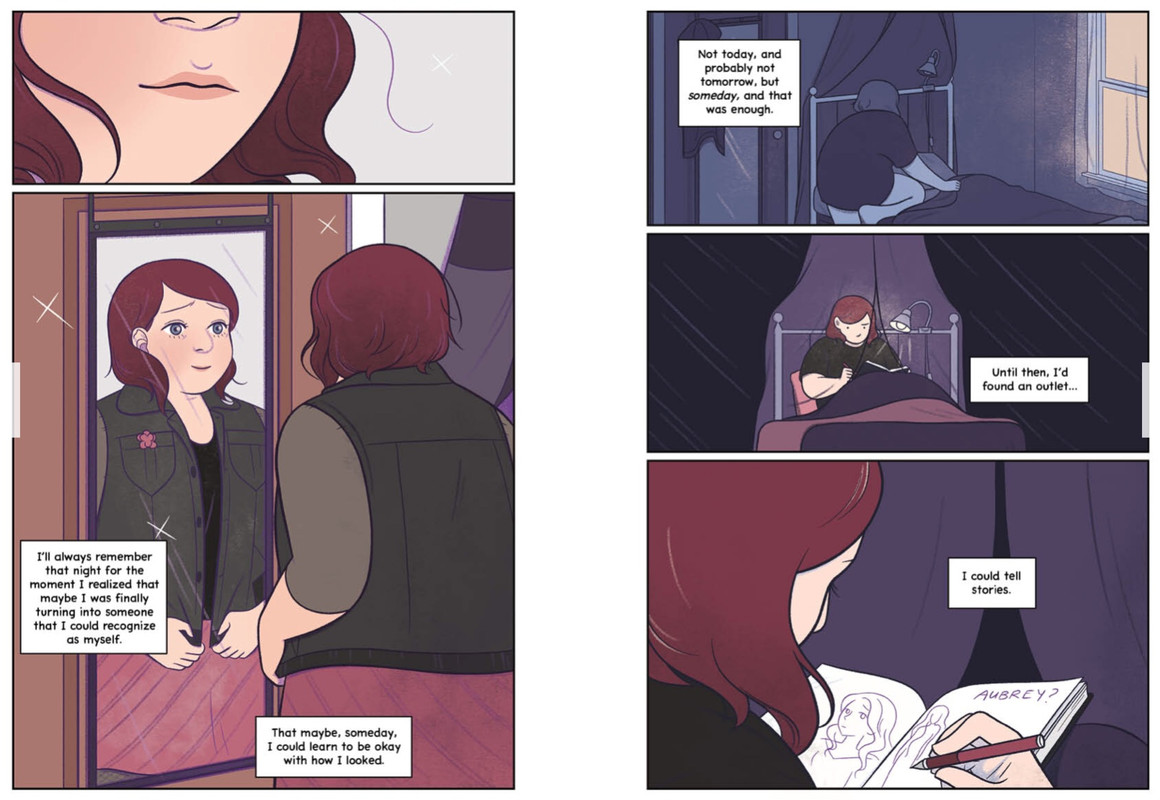
I found the struggles of all three characters relatable. This could have been quite a dark story and it does touch on some difficult topics, specifically those relating to sexuality, identity and body image.

description

There’s an exploration of mental health and the feelings of being alone and not fitting in. 

I mean, I don’t belong here. I feel like I work so hard to keep afloat but no one sees or hears me. 

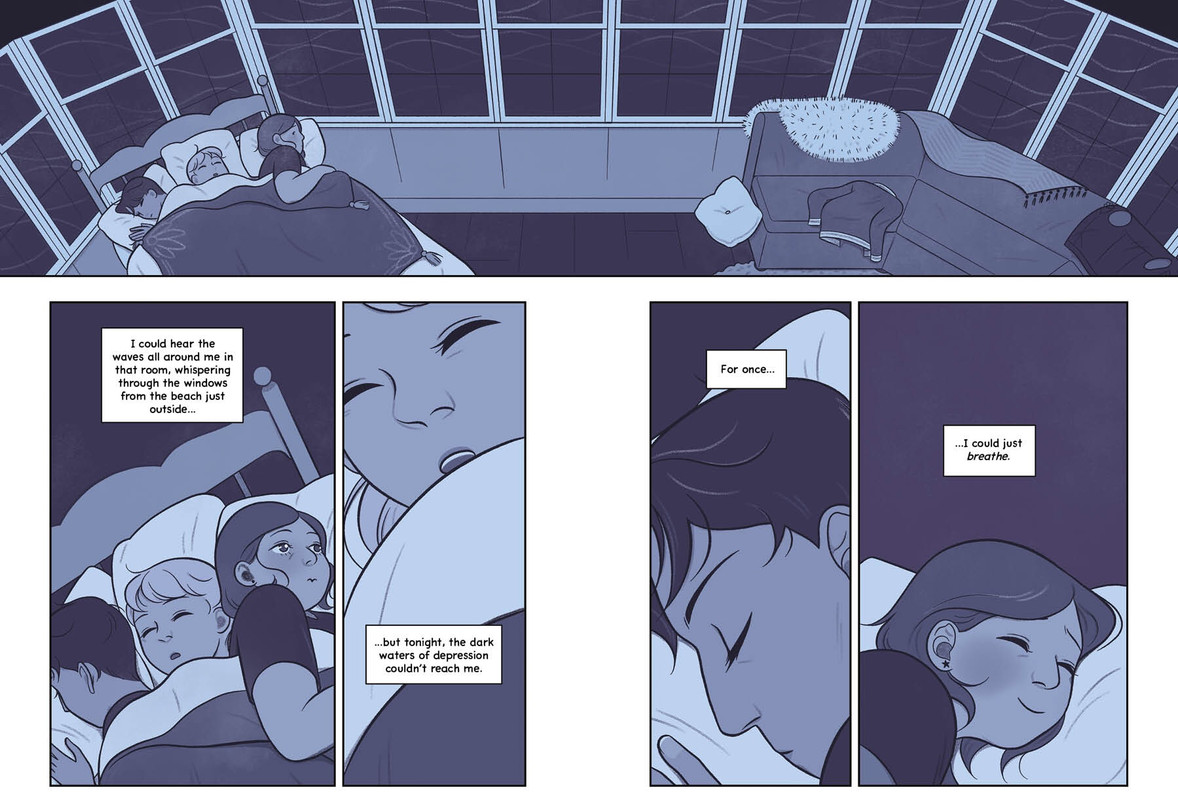
The friendship between Win, April and Oscar makes all the difference.

description

Their friendship isn’t always easy and things don’t always work out as planned but their connection gave this story the injection of hope that it needed. The zine they worked on together, which is included in its entirety, was heartbreaking and beautiful. 

While I connected with some of what Win and April were struggling with, it was Oscar who stole my heart. I absolutely adored him. 

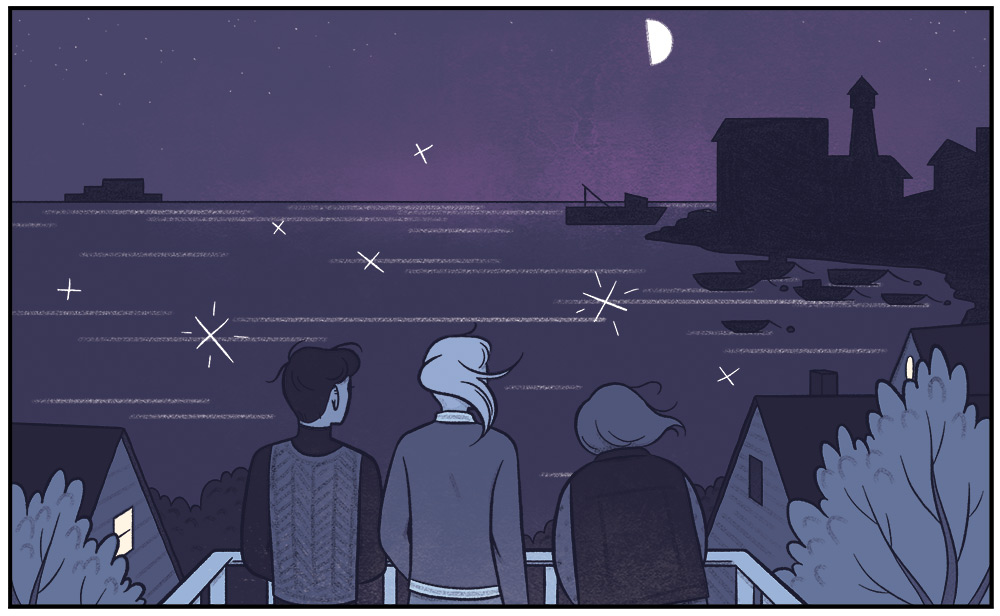
I wish I could hear the song Win and Oscar listen to. I loved the illustrations and the colour palette. 

Teenage me would have read this graphic novel so much that it would have disintegrated in my hands. Adult me is definitely keen for a reread.

description

To see myself through your eyes, as I look to someone who loves me … it has simply been the greatest thing. 

Thank you so much to Allen & Unwin for the opportunity to read this graphic novel.

Rating: 4.5 out of 5.

Once Upon a Blurb

It’s the first day of Grade Ten, and Winifred is going to reinvent herself. Now that her two best (and only) friends have transferred to a private school, Win must navigate high school on her own.

Luckily, she isn’t alone for long. In art class, she meets Oscar and April. They don’t look or act like the typical teenagers in her town: they’re creative, a little rebellious and seem comfortable in their own skin in a way that Win can only dream of. 

But even though Winifred is breaking out of her shell, there’s one secret she can’t bear to admit to April and Oscar, or even to herself – and this lie threatens everything.

Win needs to face her own truths, but she doesn’t need to do it alone. Through the healing power of clandestine sleepovers, op-shopping and zine publishing, Win finds and accepts what it means to be herself.

Trauma: The Invisible Epidemic – Paul Conti

In this book, Dr Conti explores what trauma is and how it works, the sociology of trauma, and how trauma impacts people physically and mentally.

I found the stories of people impacted by trauma interesting. They helped to illustrate points the author was making, although I often wished they were longer.

There were times I came across a topic I wanted to learn more about (like inflammation, the limbic system and epigenetics) but, because this book provides more of an overview than a deep dive, there’d only be a few paragraphs dedicated to it.

There were too many analogies for my liking and by the end of the book I wished I had counted the amount of times I’d read “compassion, community and humanity”.

If you’re looking for a book that offers an introduction to trauma, this may be the book for you. However, if you’re already well versed in trauma and its impacts, you may have already encountered much of the information covered here.

Thank you to NetGalley and Vermilion, an imprint of Ebury Publishing, Penguin Random House, for the opportunity to read this book.

Rating: 3 out of 5.

Once Upon a Blurb

Trauma is everywhere and so many of us are silently affected by it. Stressful, challenging and frightening events can happen to anyone, at any age, leaving us feeling overwhelmed, anxious and exhausted. Left unchecked, difficult experiences can have a lasting psychological effect on our wellbeing.

In Trauma: The Invisible Epidemic, leading psychiatrist Dr Paul Conti sets out a unique set of tools anyone can access to help recognise the signs of trauma, heal from past hurt and find the road to recovery.

Drawing on the most recent scientific research, Dr Conti breaks down the topic into clear sections, looking at why trauma happens, how it manifests in the body and what we can do to move past it. In the book, you’ll discover the three different types of trauma you might face, as well as practical exercises and solutions for getting to the root of the problem.

This is an important, life-affirming book, one that invites you to empower yourself against trauma, own your life experiences and learn to thrive, not just survive, in the wake of life’s difficulties.

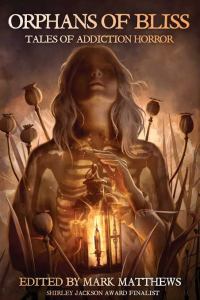
Orphans of Bliss – Mark Matthews (editor)

This is the third (and final) anthology of addiction horror edited by Mark Matthews, but my first. I want to say that I thoroughly enjoyed this read but that feels so inappropriate given the subject matter. Some stories were horrific; not the jump scare variety, but the type that gets under your skin. Many of the stories will be accompanying me for a while, whether I want them to or not.

You Wait For It, Like It Waits For You by Kealan Patrick Burke 

Reality isn’t easily distinguishable for Sean, as the days pass in the room with no door. 

“Do you know where you are?”
“Inside myself.” 

One Last Blast by S.A. Cosby

Sometimes not even death can stop you from needing a fix. 

“I … can … smell it.” 

What We Name Our Dead by Cassandra Khaw

Eleanor returns to her childhood home, a place of fear and pain. 

Hurt changes you. Hurt stays. Hurt gnaws a nest for itself in the heart and stays burrowed there until you die. 

Huddled Masses, Yearning to Breathe Free by John F.D. Taff 

Alan Denbrough is a collector. If you have trypophobia, you may want to skip this one. 

I don’t hoard so much as … collect. And yes, there’s a distinction.

Through the Looking Glass and Straight Into Hell by Christa Carmen

This rehab offers something different: virtual reality recovery simulation. 

“What do you wish it would show you?” 

Holding On by Gabino Iglesias

Guillermo needs to get Max and Alondra out of Section C before it’s too late. 

In Section C, nothing good ever happens at night.

Buyer’s Remorse by Samantha Kolesnik

Sometimes the punishment fits the crime. 

“Everything has a price” 

A Solid Black Lighthouse on a Pier in the Cryptic by Josh Malerman 

If you draw the attention of a witch in a bar, be prepared for the consequences. 

“Drink and you are drunk.” 

Singularity by Kathe Koja 

We’re in space, but I was fairly lost. I may need to reread this one. 

You know you’ve never been wanted the way the dark wants you now. 

My Soul’s Bliss by Mark Matthews 

We meet two addicts, whose lives had diverged, at a funeral. 

Because that’s what happens with certain moments. They imprint themselves on you and you can’t change them. They define you, become the hinge all your decisions swing upon. 

I wasn’t sure what to expect when I began this anthology but out of ten stories, I came away with five favourites, those by Cassandra Khaw, John F.D. Taff, Christa Carmen, Josh Malerman and Mark Matthews. 

Now I’m keen to read Garden of Fiends and Lullabies for Suffering.

Thank you so much to NetGalley and Wicked Run Press for the opportunity to read this anthology. 

Rating: 4.5 out of 5.

Once Upon a Blurb

“My soul’s bliss kills my body, but does not satisfy itself.” – Emily Bronte

Addiction is the perpetual epidemic, where swarms of human moths flutter to the flames of hell. Because that warm blanket of a heroin high, that joyful intoxication of a pint of vodka, that electric energy from a line of cocaine, over time leaves you with a cold loneliness and a bitter heart. Relationships destroyed, bodies deteriorate, loved ones lost, yet the craving continues for that which is killing us – living, as the title suggests, like an Orphan of Bliss.

Welcome to the third and final fix of addiction horror and the follow up to the Shirley Jackson Award Finalist, Lullabies for Suffering. A diverse table of contents brought together for an explosive grand finale – an unflinching look at the insidious nature of addiction, told with searing honesty but compassion for those who suffer.

Table of Contents includes: 

Kealan Patrick Burke
Cassandra Khaw
Josh Malerman 
S.A. Cosby
John FD Taff
Christa Carmen
Gabino Iglesias
Samantha Kolesnik
Mark Matthews
Kathe Koja

The three Addiction Horror anthologies, Garden of Fiends, Lullabies for Suffering, and Orphans of Bliss, do not have to be read in order and are not sequential.

Enough – Harriet Johnson

In her work as a barrister, Harriet Johnson has seen how the criminal justice system can work and also how it can fail women. In this book, Harriet outlines many of the ways violence is perpetrated against women, how the justice system responds to it and how it can be more adequately addressed as well as prevented.

An overview of the law, statistics and case studies are presented about various ways that women experience violence: homicide, sexual violence, domestic abuse, female genital mutilation, stalking, street harassment and online harassment. 

The author clearly points out that even though a dark picture can already be painted using the statistics that are available, there are entire groups of women whose experience is not even captured in them.

If you’re not from the UK, you’ll find that the definitions of offences, the laws that relate to them and the maximum applicable if someone is convicted won’t line up with the laws of your country. The statistics are also UK specific, although most didn’t seem dissimilar to what I know of stats from other countries.

None of the suggested strategies for ending violence against women surprised me. They focus on prevention, as well as making improvements to the systems that are currently in place. It’s about having enough resources and training. It’s taking a long, hard look at the way police and the courts respond to violence. It’s including marginalised women in the statistics because if we don’t have a clear picture of what’s happening, then how can we ever expect things to change.

Favourite quote: “the culture you get is the behaviour you tolerate.”

Thank you so much to NetGalley and William Collins, an imprint of HarperCollins, for the opportunity to read this book. 

Rating: 3.5 out of 5.

Once Upon a Blurb

This is a book that calls time on the endless tide of violence against women and the failures of our criminal justice system to respond.

From barrister Harriet Johnson, Enough lays bare the appalling status quo of abuse against women in our society, offering an irrefutable case for why change is needed in policing and justice. Most vitally, it also gives a manifesto for how to get there.

With expertise, clear-sightedness and appropriate fury, this book helps us see where women are suffering – from homicide to domestic abuse to street harassment. It exposes the ways the criminal justice system lets women down – from officers failing to properly investigate to a lack of consequences when police behaviour is unacceptable, to backlogged courts and the realities of convincing a jury.

Addressing misogyny is to everyone’s benefit and the answers aren’t simple. Enough is the call to arms we can – and must – all get behind.