Rating Your Bunkmates and Other Camp Crimes – Jennifer Orr

I need to preface everything I say about this book with: I’m not the target audience. Sometimes this doesn’t matter as I consistently read books that are intended for readers born in a different century than I was. However, I’ve noticed as I’ve gotten older my tolerance for friendship drama has decreased exponentially.

Socially awkward twelve year old Abigail Hensley may have skipped three grades at school but she’s never had a friend. It’s not from lack of rigorous anthropological research on her part. Unfortunately other girls her age simply don’t share her interests – fencing, time travel, anthropology and French cuisine. They also have a bad habit of intruding in her personal space bubble, even though she has generously narrowed the recommended four feet to three and a half.

No matter how hard I try, I can’t seem to successfully befriend a girl my age. It’s like I’m helium, physically unable to mix with any other chemical element. Bonding with girls my age just doesn’t seem part of my atomic makeup.

Joining Abigail in Clovis Cabin are:

  • Sofia, Fia, Fia, with her impractical bejewelled fingernails
  • Quinn, who speaks like she’s a Magic 8 ball
  • Rachel, with her crooked name sticker and rule breaking tendencies
  • Mary Elizabeth George (Meg), who lives in the shadows of her perfect older sister
  • Gabby, who’s enthusiastic and agreeable. She’s Abigail’s roommate.

Despite being oblivious to social cues Abigail is trying her hardest to figure out the science of making friends. She’s determined to crack the code this week and will be making extensive Field Notes to help her navigate the process.

I plan to use these notes to help me with my ongoing experiment: finding a friend.

Unfortunately for Abigail this social experiment may not be as easy to implement as she hopes. Shortly after arriving at Hollyhock something is stolen from another Clovis camper and she’s the prime suspect.

While I’m always drawn to books where I get to attend summer camp vicariously (this was not something that was available when I was growing up and I’ve always felt I missed out on a rite of passage), too many of the conversations in this book revolve around accusations for my liking, so I didn’t enjoy my time at Camp Hollyhock as much as I had anticipated. I hope (and expect) younger readers will disagree wholeheartedly with me.

Thank you so much to NetGalley and Capstone Editions for the opportunity to read this book.

Rating: 3 out of 5.

Once Upon a Blurb

Twelve-year-old Abigail Hensley is a socially awkward aspiring anthropologist who has always had trouble connecting with her peers. Abigail is hopeful that a week at sleepaway camp is the answer to finally making a friend. After all, her extensive research shows that summer camp is the best place to make lifelong connections. Using her tried-and-true research methods, Abigail begins to study her cabinmates for friendship potential. But just when it seems that she is off to a good start, her bunkmate’s phone gets stolen, and Abigail is the main suspect. Can she clear her name, find the real culprit, and make a friend before the week is done?

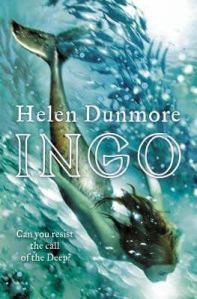
Ingo – Helen Dunmore

I always feel so honoured when someone tells me about one of their favourite books. Books have been such an integral part of my life and I know without a doubt that my experiences, hopes, dreams and pain, all mingled together, make certain books more personally significant than others. If I learn about a book that was important to someone in their childhood then I’m likely to want to dive straight in.

That’s what happened with this book. I was 8 pages into my next read when I learned of this book’s existence. Within the hour I had found a copy at my library (I love my library!) and begun reading. Sorry, other read.

There’s a track that runs from their cottage to the cove. The beach disappears at high tide but Sapphire and her older brother, Conor, know the tides and spend a lot of their time exploring and swimming there. Their father, Mathew, often takes his boat (the Peggy Gordon) out, fishing and taking photos, but their mother, Jennie, is afraid of the sea. It’s always been the four of them. Until the day Mathew doesn’t come home.

I wish this book had been available when I was a child. I was also a child of the water and would always answer ‘dolphin’ when asked what animal I would be if I had any choice in the matter. I would have loved getting a glimpse of the world beneath the waves. Adult me got excited when I learned there would be Mer, wanting to learn all about their way of life and whether I could visit them.

I wish I was away in Ingo

Far across the briny sea,

Sailing over deepest waters

Where love nor care never trouble me –

The only thing that deterred me from wanting to find a way to Ingo myself was learning that Mer don’t have books. Even if the learning curve required to survive under water didn’t kill me, not having access to books would.

Being an only child I envied Sapphire and Conor’s bond. I wanted to like Faro but found him quite obnoxious. I have high hopes for Elvira, his sister, who I met but didn’t get to know during this book. I’m hoping to get to know her in later books in the series. Maybe Faro will also grow on me in time.

One person that doesn’t need to grow on me is Granny Carne. I need an entire book devoted to her story.

“Some say she’s a witch”

While there’s an underlying message about marine conservation, what really hit home for me was how authentic Sapphire’s loss felt.

You know how the sea grinds down stones into sand, over years and years and years? Nobody ever sees it, it happens so slowly. And then at last the sand is so fine you can sift it in your fingers. Losing Dad is like being worn away by a force that’s so powerful nothing could resist it. We are like stones, being changed into something completely different.

Difficult topics can sometimes be watered down in children’s books and I loved that it wasn’t here.

The thought of Dad is always in my mind somewhere, like a bruise.

The impacts of this loss were evident throughout the story but none captured the effects of Sapphire’s pain to me as simply and clearly as this:

Mum thinks I go and see Katie, or one of my other friends, but I don’t. I feel cut off from them, because their lives are going on the same as ever, but mine has completely changed.

Although I haven’t experienced loss in the specific way that Sapphire and her family do in this book I could easily relate to Sapphire’s need to protect herself from additional pain:

“You’re like a – like a sea anemone. If anyone comes close, you shut yourself up tight.” “That’s how sea anemones survive,” I point out.

The way the author described scenes and emotions continually activated my senses:

Sometimes I think that if adult quarrels had a smell, they would smell like burned food.

It’s strange how characters you’ve only just met can get under your skin. Two days ago I’d never heard of Sapphire. Today I’m going to be asking my library to buy the rest of her story.

“Magic’s wild. You can’t put a harness on it, or make it do what you want. Even the best magic can be dangerous.”

Rating: 4 out of 5.

Once Upon a Blurb

I wish I was away in Ingo,

Far across the sea,

Sailing over the deepest waters,

Where love nor care can trouble me …

Sapphire’s father mysteriously vanishes into the waves off the Cornwall coast where her family has always lived. She misses him terribly, and she longs to hear his spellbinding tales about the Mer, who live in the underwater kingdom of Ingo. Perhaps that is why she imagines herself being pulled like a magnet toward the sea. But when her brother, Conor, starts disappearing for hours on end, Sapphy starts to believe she might not be the only one who hears the call of the ocean. 

We Are Monsters – Brian Kirk

Spoilers Ahead!

“It’s official. The Apocalypse has come to Sugar Hill.”

Alex, Eli and Angela work together in the forensics ward of Sugar Hill, which houses and treats the criminally insane. Angela is a social worker who is described by a friend as “Dr. Do Good by day and Little Miss Devil by night”. Alex Drexler is a psychiatrist whose views on treatment are diametrically opposed to those of his boss and mentor, Dr Eli Alpert, Sugar Hill’s Chief Medical Director. Eli’s approach is humanistic, with a focus on treating patients with dignity and respect. Meanwhile, Alex is in the process of trialling an experimental drug to cure schizophrenia.

Why did the mind have the capacity to create delusions? To hallucinate? To perceive the unreal? And why, so often, did such altered states appear to the perceiver as the actual reality? A world more real than this one.

When the funding for his trials is withdrawn, Alex winds up continuing his experiment. His latest subject is Sugar Hill’s newest patient, Crosby Nelson, the Apocalypse Killer. Because what could possibly go wrong when you use a mentally ill, traumatised serial killer as your guinea pig?!

More background information is provided about characters than I’m used to seeing in horror books. This took me out of the story initially although I could understand the relevance of this information later on. It’s not only the patients whose pasts haunt them and it’s not always obvious who should be a patient, especially when the workers’ own demons are revealed.

Either she is insane, or I am. Or nobody is. Or we all are. Either way, who am I to say?

The only character I really liked was Eli. I think I would have liked Crosby as well but I didn’t get much of a sense of who he was outside of his mental health and trauma histories. Fortunately it’s not necessary to love horror book characters. I enjoyed hoping Alex would get a taste of his own medicine and I couldn’t wait for a couple of other nasties to get their comeuppance.

At times it felt like a hallucinogen was wafting off the pages. I wasn’t always especially clear about what was really going on during the more trippy parts.

He was now unsure which reality had been a dream and which one was real.

If I’d encountered this sense of unease, not being able to easily discern reality, in another book I’d probably tell you it was a reason I didn’t like it. This book, though? It was like I was being given a glimpse into what life must be like all the time for some of the residents of Sugar Hill and it was scary to even contemplate living in their worlds.

While I’ve known a lot of people with various mental illnesses, my knowledge of schizophrenia and psychosis are limited to the DSM-5 and random articles and books I’ve read. Because of this I cannot comment on the accuracy of their depictions in this book but I didn’t come across anything that stood out to me as ‘there’s something wrong with this picture’ symptom wise.

Between the graphic violence (I almost DNF’ed this book when the dog died) and derogatory terms used for pretty much anyone you can think of, sometimes challenged but oftentimes not, this book isn’t going to be for everyone. If having anything uncomfortably close to your eyes makes you squeamish you may have trouble with some scenes.

Thank you so much to NetGalley and Flame Tree Press for the opportunity to read this book.

Rating: 4 out of 5.

Once Upon a Blurb

Some doctors are sicker than their patients. When a troubled psychiatrist loses funding to perform clinical trials on an experimental cure for schizophrenia, he begins testing it on his asylum’s criminally insane, triggering a series of side effects that opens the mind of his hospital’s most dangerous patient, setting his inner demons free.

Reasons to Stay Alive – Matt Haig

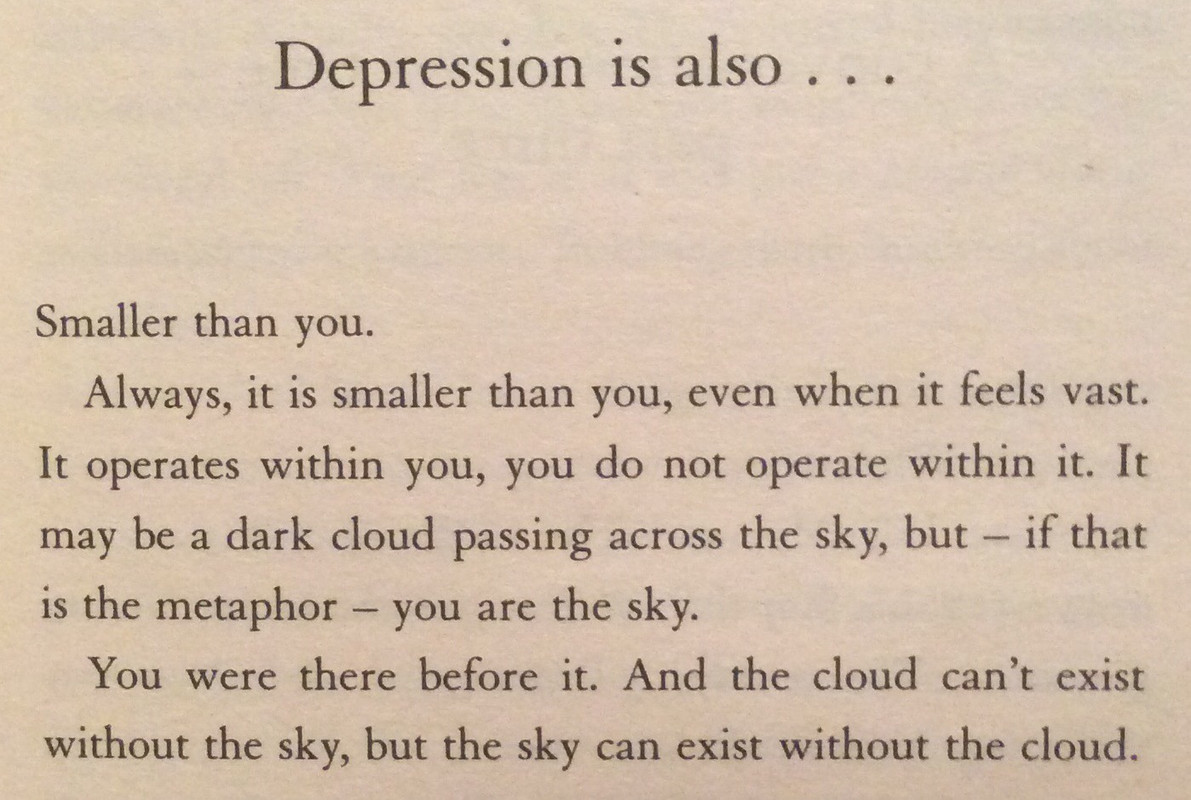
Books like this are so important. Let me tell you why.

Depression is isolating, so very isolating. When you’re in the middle of it it can feel like you’re the only person in the entire history of the world who has ever felt that way. You tend to isolate yourself from the rest of the world when you feel that bad, because who would want to be around such a worthless, pathetic, [insert put down of your choice here] waste of space, right? So you’re not exactly in much of a position to find data that doesn’t support your position.

Enter: books.

There is this idea that you either read to escape or you read to find yourself. I don’t really see the difference. We find ourselves through the process of escaping.

Books have the power to provide insight, reassurance and the sometimes lifesaving knowledge that not only are you are not alone but there is hope; things can get better. A lot better. And depressed person bonus points: you don’t actually have to interact with another human to find that hope. Yes, I am aware that contact with other humans is helpful but sometimes you just don’t wanna.

In the meantime, books. Now if you’re depressed you may not be able to concentrate all that well, which is one of the reasons I love the short chapters in this book. It’s bite sized portions of hope and ‘I’ve been there too and I can guarantee that you will not always feel exactly the way you feel right this second’. It’s easy to brush off the well intentioned words of people who don’t get it but when the person who’s doing the talking has walked the walk, well that’s someone you might want to pay close attention to.

THEN ME: Why would I stay alive? Wouldn’t it be better to feel nothing than to feel such pain? Isn’t zero worth more than minus one thousand?

NOW ME: Listen, just listen, just get this through your head, okay – you make it, and on the other side of this there is life. L-I-F-E. You understand? And there will be stuff you enjoy.

Did I learn a whole bunch of things about depression and anxiety that I didn’t already know from countless other books? Not really. Did it matter? Not really. Why not? Well, there’s a few reasons.

It doesn’t matter how many facts your brain has accumulated about a topic. There’s something cathartic about hearing someone else express thoughts that you assumed were unique to you when you first encountered them.

I wanted to be dead. No. That’s not quite right. I didn’t want to be dead, I just didn’t want to be alive.

Someone who’s not you may come up with a visual that describes an experience in a way that makes you stop and go, ‘huh, why didn’t I come up with that?!’, one that you want to memorise so you can use it to explain the experience to someone who is fortunate enough to not understand.

If you have depression on its own your mind sinks into a swamp and loses momentum, but with anxiety in the cocktail, the swamp is still a swamp but the swamp now has whirlpools in it.

Or

anxiety is an illness that wraps us up in our own nightmares.

I loved the concept of the “bank of bad days”. I’ve done this myself, gotten through a bad day by reminding myself I’ve already survived worse, but I didn’t have a cool name for it before now.

Once upon a niggle: I probably sound like a broken record at this point but in the past couple of years I’ve come to the realisation that the language we use to describe suicide is important. This book, like so many others, uses the term “committed suicide”. I much prefer the term “died by suicide”. People can and do die as a result of mental illness, just as they can as a result of physical illness, but I associate the word “committed” with criminal acts and don’t want to contribute to the stigma that already surrounds it. Having said that, this book was published several years before I personally began to seriously think about how we use language when we talk about mental health.

On the flip side, I absolutely adored the author’s discussion of “despite” versus “because”.

People often use the word ‘despite’ in the context of mental illness. So-and-so did such-and-such despite having depression/anxiety/OCD/agoraphobia/whatever. But sometimes that ‘despite’ should be a ‘because’. For instance, I write because of depression. I was not a writer before. The intensity needed – to explore things with relentless curiosity and energy – simply wasn’t there. Fear makes us curious. Sadness makes us philosophise.

While I can understand the wish for someone else to tell you (in detail, with step by step instructions) what your specific reasons for living should be I’ve been assured by mental health professionals that this is something you need to figure out for yourself. Someone else’s reasons may not resonate with you and vice versa. However I do believe that everyone has value and something unique to them that they bring to the world. Cliché or not, you are the only you that will ever exist in the entirety of humanity, past, present and future. You are important and we need you.

I think life always provides reasons to not die, if we listen hard enough. Those reasons can stem from the past – the people who raised us, maybe, or friends or lovers – or from the future – the possibilities we would be switching off.

I found a new (to me) word in this book – chiaroscuro – and I plan to now find ways to include it in everyday conversation until someone threatens to buy me a dictionary so I can come up with a new favourite word. Once I learn its correct pronunciation, that is.

P.S. If you’ve ever experienced depression, here’s something vitally important that you need to know.

Rating: 5 out of 5.

Once Upon a Blurb

I want life. I want to read it and write it and feel it and live it. I want, for as much of the time as possible in this blink-of-an-eye existence we have, to feel all that can be felt. I hate depression. I am scared of it. Terrified, in fact. But at the same time, it has made me who I am. And if – for me – it is the price of feeling life, it’s a price always worth paying.

Reasons to Stay Alive is about making the most of your time on earth. In the western world the suicide rate is highest amongst men under the age of 35. Matt Haig could have added to that statistic when, aged 24, he found himself staring at a cliff-edge about to jump off. This is the story of why he didn’t, how he recovered and learned to live with anxiety and depression. It’s also an upbeat, joyous and very funny exploration of how live better, love better, read better and feel more.

Wayward Children #5: Come Tumbling Down – Seanan McGuire

Illustrations – Rovina Cai

Spoilers Ahead!

“Once a wayward child, always a wayward child.”

I’ve been waiting as patiently as possible for my next quest –

No quests.

Right. So I’ve been counting the days until I was finally able to spend more quality time with my fellow Waywards and today we went to the Moors! Who’s ‘we’? I travelled with the girl with the “perpetual sugar buzz”, the “Goblin Prince in Waiting”, the girl “with the ocean in her hair”, a mad scientist, the boy with the bone flute and the girl “with the lightning-powered heart”.

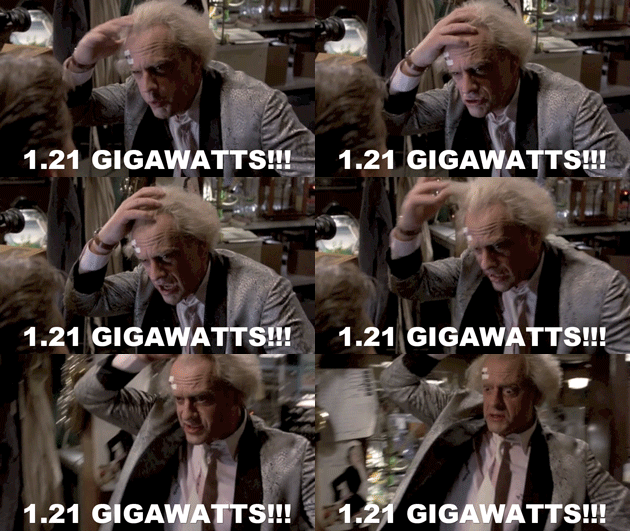
Travelling by lightning hasn’t been this much fun since I hitched a ride in a Delorean!

Having completed my most anticipated read of 2020 less than a fortnight into the year I now feel like I’ve wandered into a bittersweet limbo. I’m absolutely elated that, after a year of anticipation, my expectations (which were skyscraper looking down on clouds high) didn’t overshadow my enjoyment.

I’m proud of myself for savouring the experience, appreciating every sentence rather than bingeing the entire book in one sitting. I’m sad that I can never read this book for the first time ever again. I want to gush to anyone who will listen to me about every sentence I highlighted, every character, plot point, what I hope will happen next, what I fear will happen next … but spoilers.

“But I warn you, this isn’t a tale for the faint of heart. It is a story of murder, and betrayal, and sisterly love turned sour.”

I will tell you though, although this was not her story, Sumi was the standout wayward for me in this book. She somehow kept managing to snag the best lines and I don’t know which one of us this says more about but I understood every piece of Nonsense she uttered. I love that she gets to the heart of the issue and asks the truly important questions, like

“Why is the village of scary fish-people where you get your chocolate biscuits?”

One of the first things I tell anyone about me is that Every Heart a Doorway is my all time favourite book. I don’t care that I’m an adult; I will be searching for my door for the rest of my life and if you are also seeking admittance to your door, regardless of how different our true worlds look, I will consider you a kindred spirit.

Usually when I read a new addition to a beloved series there’s an anxiety that accompanies me. I’ve often found that the shine of the first book can be smudged when follow up books don’t meet my expectations. I’m aware that the pedestals I place books I love on can be difficult to reach and that’s part of the problem. So you’d think I’d be especially nervous whenever I begin a new Wayward Children book but I have absolute faith that my hopes, no matter how seemingly unrealistic they are, are safe with Seanan and she’s never let me down.

“New things are the best kind of magic there is.”

I don’t want this series to ever end. I want to visit every world. I want to secure a room at Eleanor West’s Home for Wayward Children while I wait for my own door to open. So far, none of the worlds I’ve visited with my fellow waywards have been my own, although I’ve caught glimpses of it in several. I fully expect that one day Seanan will write about my world and while I’m reading that story my book will magically transform into my very own door. I’m sure!

If you haven’t already read the first four books of this series, please remedy that ASAP before reading this one. Then you can join me as I begin the interminable wait for January 2021.

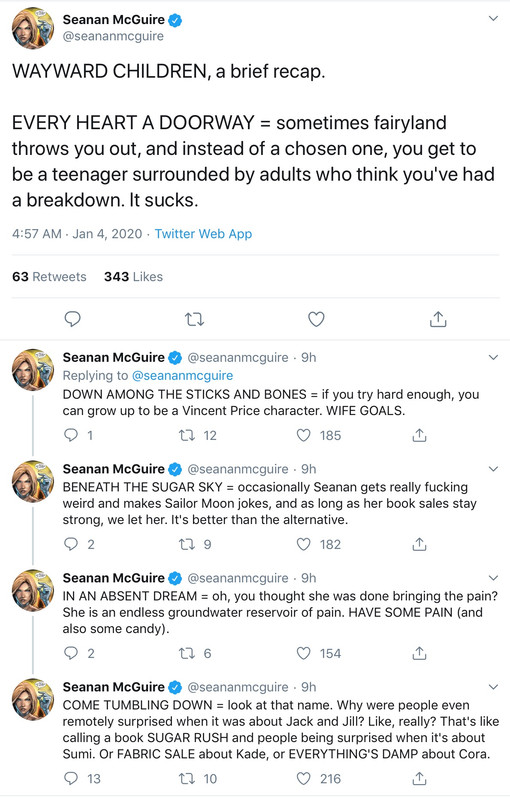
If you’ve read the first four books and are seeking a recap, check out the brilliance that is Seanan Twitter. If you haven’t read them, beware! Spoilers!

Also, if you want a more extensive catch up, read this. Beware! Much bigger spoilers!

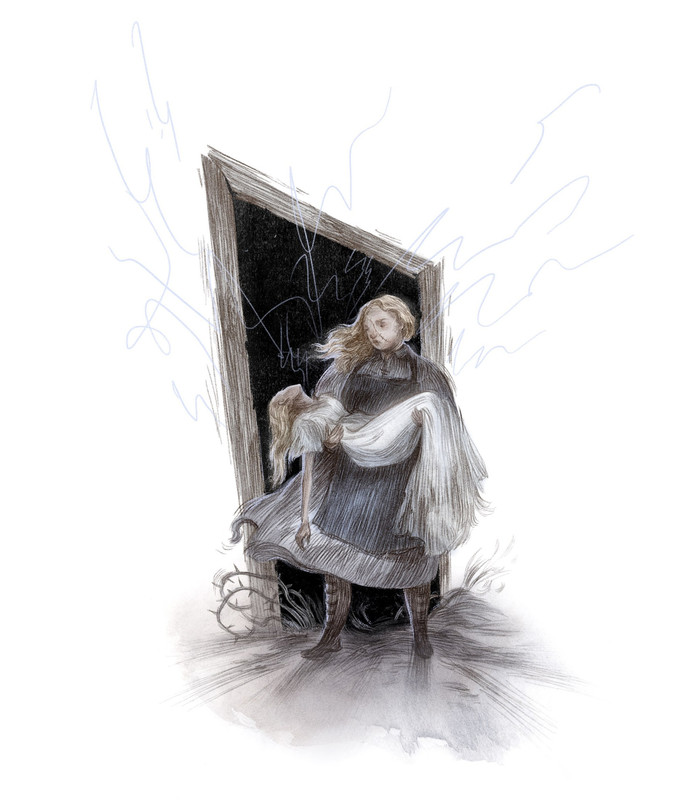
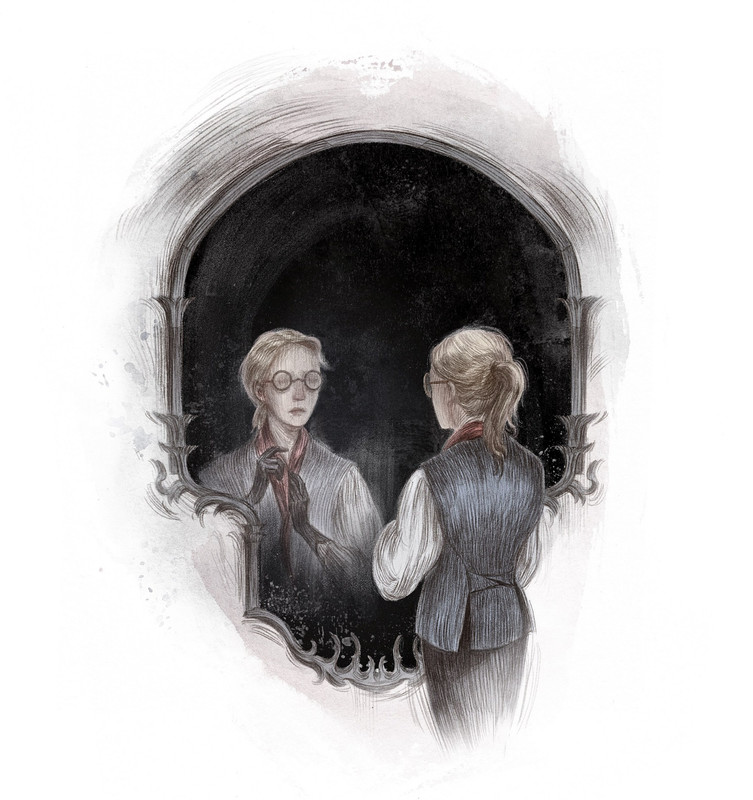
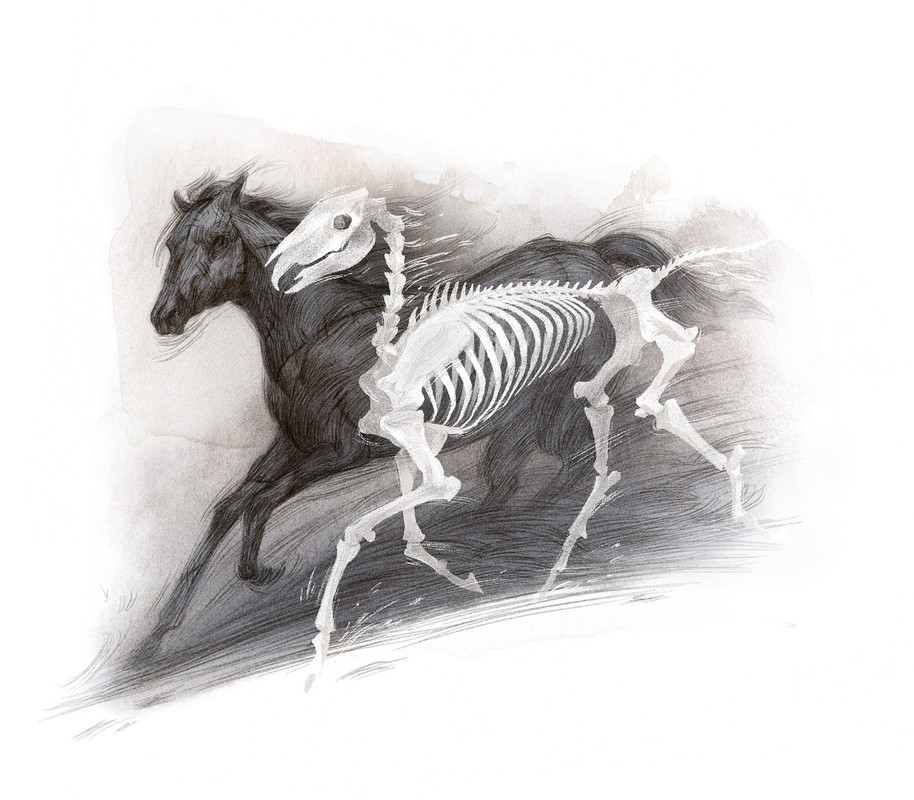
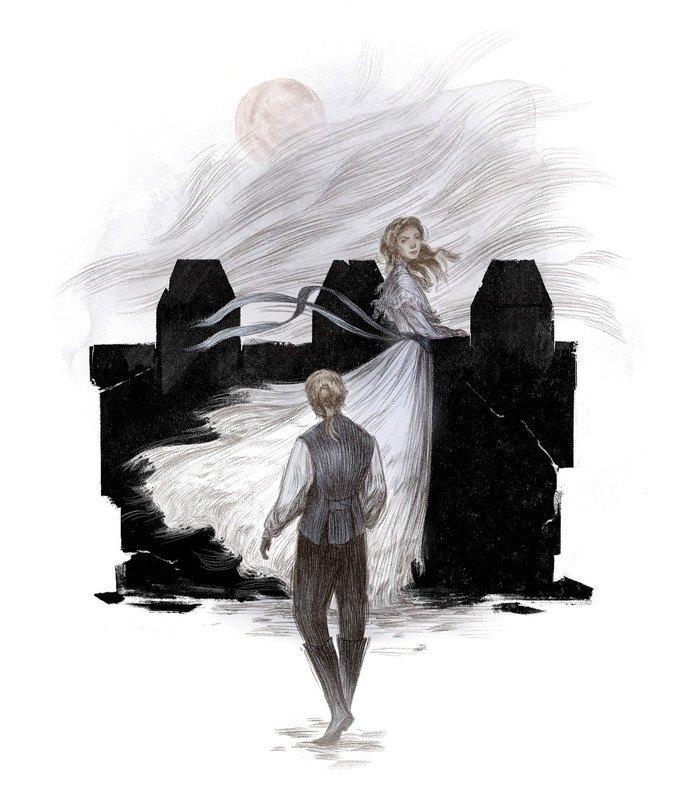
As usual I couldn’t wait to get to the next Rovina Cai illustration. I was only going to include my favourite one here but I can’t decide so here they all are! I’m hiding them as spoilers in case you don’t want to see them before you get to that part of the story yourself.

Since I highlighted so much of this book that I probably should have just gone ahead and highlighted it all, it’s practically impossible to choose a favourite sentence. This is the one that spoke the loudest to me when I reread all of my highlights:

“No one should have to sit and suffer and pretend to be someone they’re not because it’s easier, or because no one wants to help them fix it.”

If anyone needs me I’ll be reading the sixth book in the series.

[But it’s not released yet.]

“Hey! Don’t you go getting logical rules on my illogical life plans”

[I’m serious. You must wait for another excruciatingly long year before you are allowed to continue this journey.]

“This is the awful sprinkles on the sundae of doom.”

Rating: 5 out of 5.

Once Upon a Blurb

When Jack left Eleanor West’s School for Wayward Children she was carrying the body of her deliciously deranged sister – whom she had recently murdered in a fit of righteous justice – back to their home on the Moors.

But death in their adopted world isn’t always as permanent as it is here, and when Jack is herself carried back into the school, it becomes clear that something has happened to her. Something terrible. Something of which only the maddest of scientists could conceive. Something only her friends are equipped to help her overcome.

Eleanor West’s “No Quests” rule is about to be broken.

Again.

Smile #3: Guts – Raina Telgemeier

While I love the artwork in Raina’s graphic novels this is the first of her Smile series that I’ve actually finished reading.

Given how popular her graphic novels are I think my not falling in love with them is probably an ‘it’s me, not you’ thing.

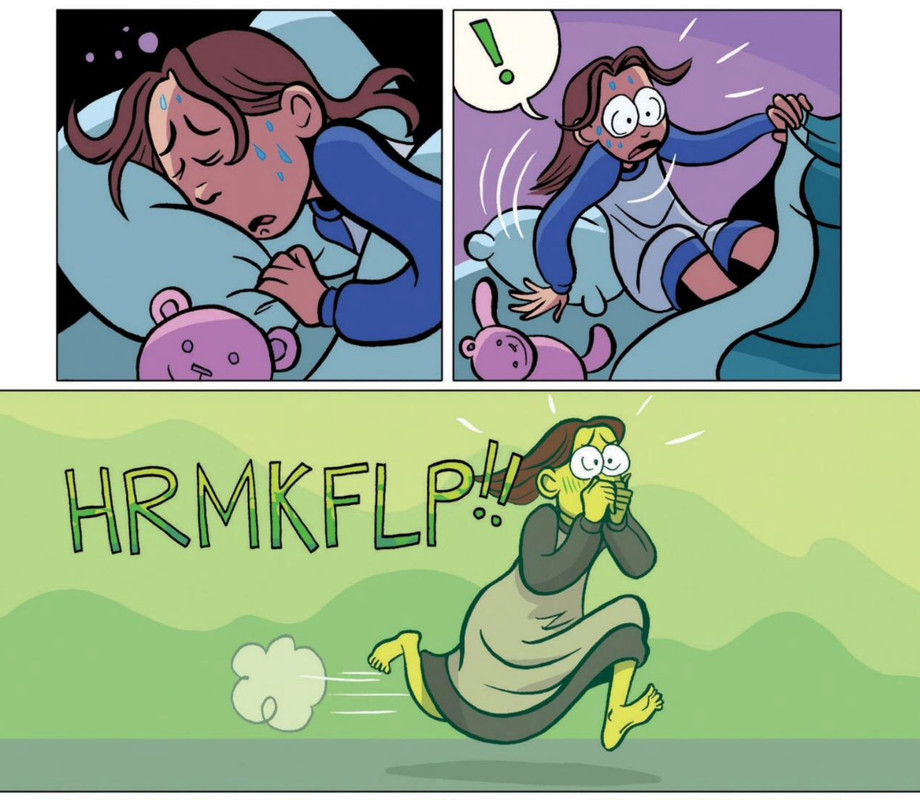
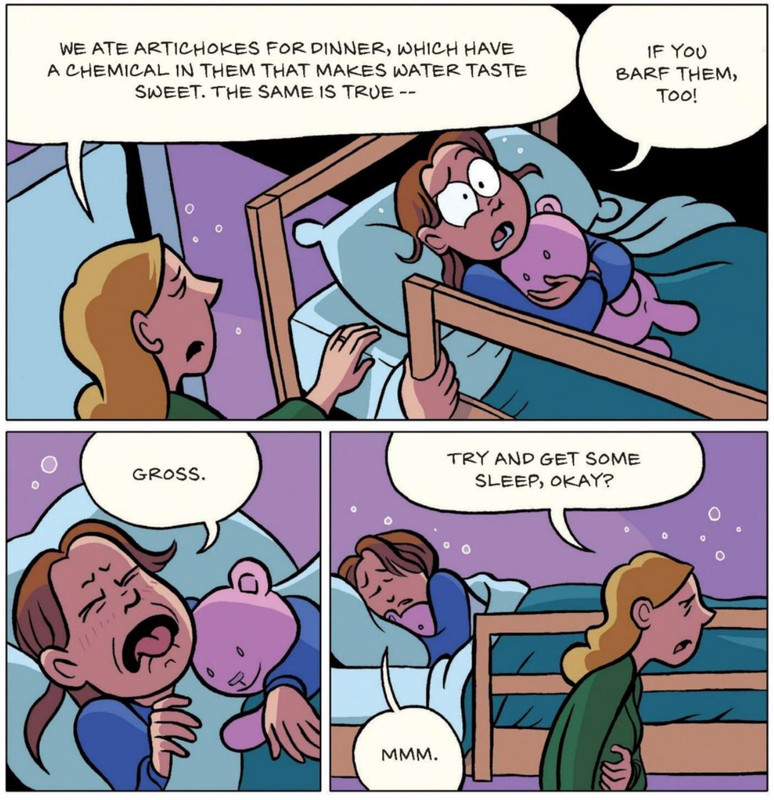
Even though I don’t have emetophobia I’m so glad I didn’t read this graphic novel while I was eating, as it definitely depicts a significant amount of vomiting, fear of vomiting and other stomach upsets.

While I’m not keen to reread this graphic novel I did really love the illustrations. I also learned something new: if you drink water after eating artichokes it takes sweet. I found that tidbit really interesting, but I wasn’t quite as smiley when I found out it also works if you reverse the process.

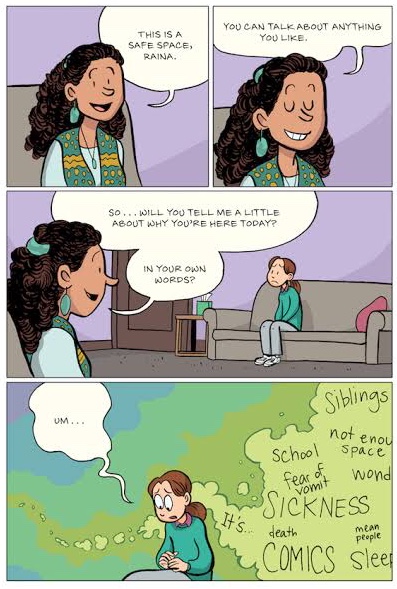
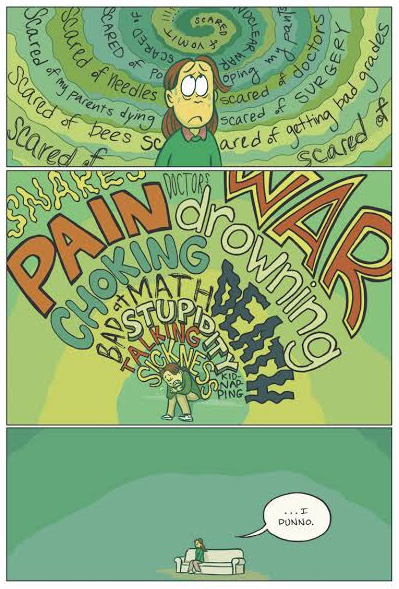
I loved the message that it’s perfectly okay to need therapy and I thought anxiety was portrayed realistically.

Rating: 3.5 out of 5.

Once Upon a Blurb

Raina wakes up one night with a terrible upset stomach. Her mum has one, too, so it’s probably just a bug. Raina eventually returns to school, where she’s dealing with the usual highs and lows: friends, not-friends, and classmates who think the school year is just one long gross-out session. It soon becomes clear that Raina’s tummy trouble isn’t going away … and it coincides with her worries about food, school, and changing friendships. What’s going on?

Raina Telgemeier once again brings us a thoughtful, charming, and funny true story about growing up and gathering the courage to face – and conquer – her fears.

Celeste the Giraffe Loves to Laugh – Celeste Barber

Illustrations – Matt Cosgrove

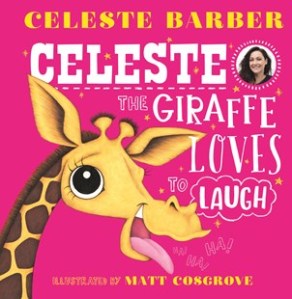
I’ve read this book at least five times but haven’t known what I’ve wanted to say before now. Today I was reminded of the importance of laughter when things aren’t going smoothly. As a result I’ve appreciated Celeste’s humour much more than I have during previous reads.

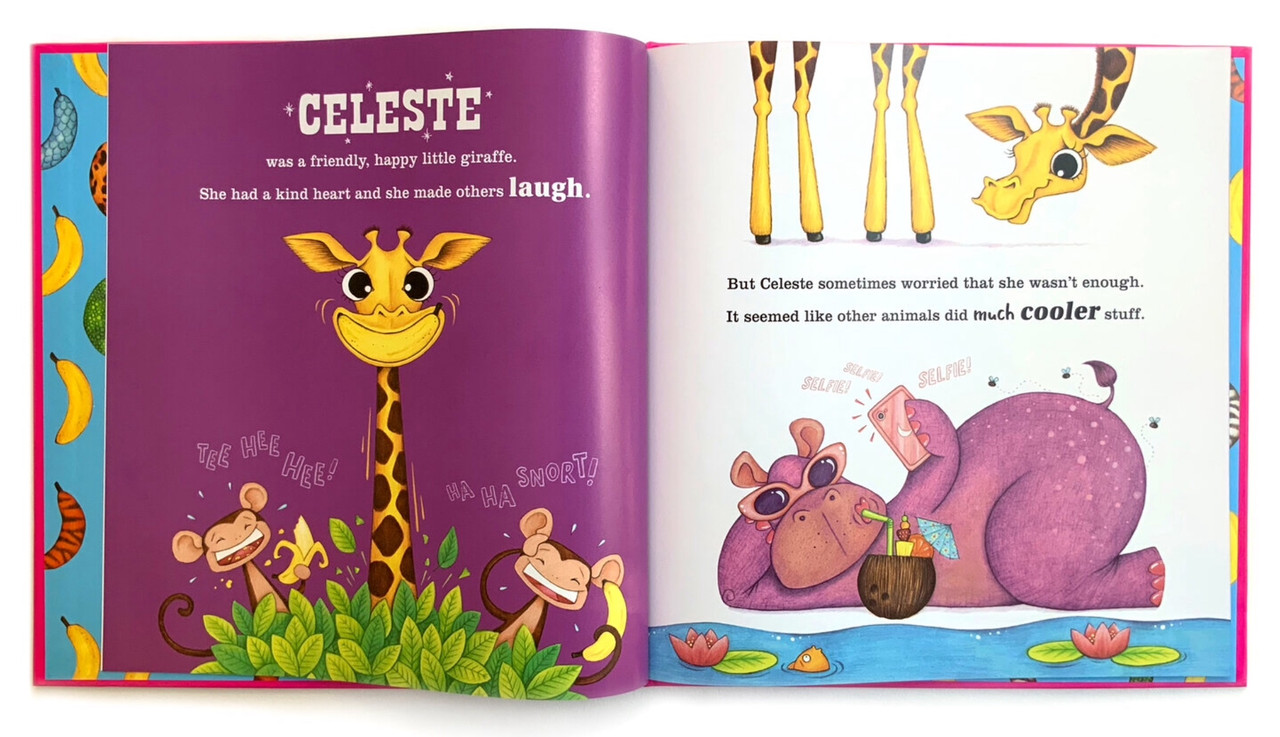
When Celeste the giraffe compares herself with the other animals she doesn’t think she’s good enough. She can’t roar like a lion. She’s not as fast as a cheetah. Each time she tries to imitate another animal she fails.

Eventually she realises that while she will never be a good snake, rhino, monkey or other animal, she is uniquely qualified to be herself.

The rhythm flows well most of the time and of course this book includes the requisite fart joke:

‘Maybe I could be a fish! I’m great at blowing bubbles!’ But the bubbles came out the other end, which started MAJOR TROUBLES.

Matt Cosgrove’s illustrations are adorable, bringing out the humour of Celeste’s attempts to mimic the other animals. The animals are all very expressive and the colours are vibrant.

My favourite Celeste expression comes when she crashes into a tree. I have a soft spot for the innate cuteness of an animal sticking its tongue out. Don’t worry; she’s okay!

If I was reading this book with a kidlet I don’t think I’d be able to resist pretending I was each of the animals in the book and encouraging them to do the same. I’m not saying that we’d be competing or anything, but I am saying I would win and would expect fits of giggles to ensue.

I’m definitely going to be recommending my librarians consider adding this book to the ones they read to local preschoolers. I think the kids would love it.

Rating: 4 out of 5.

Once Upon a Blurb

Celeste was a friendly, happy little giraffe. She had a kind heart and she made others laugh. But Celeste sometimes worried that she wasn’t enough. It seemed like other animals did much cooler stuff. Join Celeste the Giraffe on her hilarious journey as she finds out what it is that makes her unique.

Changing Ways – Julia Tannenbaum

Grace is 16 and a junior at Chuck L. Everett High School (“Chuckles”) in western Connecticut. She lives with her mother and younger brother, Jamie, and misses her father. She’s trying out for Varsity soccer this year.

I’ve never been satisfied with how I look – even when I was younger, I was self-conscious of my appearance. Now that I’m older, those insecurities are more profound than ever.

Recently Grace has secretly been self harming and restricting her food intake. When another student catches her self harming at school Grace winds up hospitalised.

“I don’t know what’s making me do it. That’s the problem.”

Grace is fortunate that her treatment begins a lot sooner than it does for most people but this doesn’t mean recovery will be easy. I appreciated that recovery from eating disorders and self harm were portrayed realistically. Grace’s isn’t a success only journey. Recovery isn’t linear and there are setbacks along the way.

Grace’s best friend, Lou, is “bold and strong-willed and brutally honest”. Lou’s mother is undergoing treatment for stage 4 breast cancer, although the gravity of this didn’t hit the mark for me.

The way Grace’s mother’s boyfriend was introduced made it seem like he was going to be detrimental to their family dynamic but this didn’t really go anywhere.

While the conversations between Grace, her family and Lou flowed well, those that took place in a treatment setting tended to feel more like therapy speak than what you’d expect between a group of teenagers dealing with such difficult issues. I found most of the other patients interchangeable, not really getting a sense of who they were outside of their diagnoses.

I think I would have gotten into this book more if I’d read it as a teenager. It may also have helped if I hadn’t already read other books that have addressed eating disorders and self harm in a way that grabbed me more on an emotional level.

Unfortunately, while I applaud the author for tackling such difficult and personal subject matter, I never forgot that I was reading a book written by a teenager. If I’d written a book while I was a teenager I expect it would have much the same feel to it. That’s not necessarily a bad thing but I am interested to see how the author’s writing develops over time.

Thank you to NetGalley and Wicked Whale Publishing for the opportunity to read this book.

Rating: 3 out of 5.

Once Upon a Blurb

Growing up sucks. Struggling to cope with the constant stress of school, her mother, and her confusing social life, sixteen-year-old Grace Edwards finds sanity in the most destructive of ways: dieting and self-harming. But just when Grace thinks she has everything under control, a classmate catches her cutting in the girls’ locker room, and Grace’s entire life is flipped upside down.

Now she’s faced with the unthinkable – a stint in a psych ward with kids who seem so much worse than she is. After all, she’s not sick. She’s totally okay. She’ll never do it again. But the longer Grace stays, the more she realises that the kids in the ward aren’t that different from her.

Slowly Grace comes to terms with her mental illness, but as her discharge date crawls closer, she knows that the outside world is an unpredictable place … and one which whispers temptations about hidden food, dangerous objects, and failure to stay in recovery.

Shame: A Brief History – Peter N. Stearns

I’d never given much thought to the history of emotions so when I came across this “work of emotions history” I was intrigued.

This study seeks to sum up most of the existing historical findings, with related insights from other disciplines, while also extending historical analysis particularly around developments in the United States over the past two centuries.

In exploring the history of shame, the author touches on its psychology and includes references to sociology, anthropology and philosophy. Socrates, Plato, Aristotle, Confucianism, Christianity, Islam and Hinduism are all mentioned.

In China, it has been estimated that up to 10 percent of Confucius’s writings center around the importance of shame.

This book differentiates between guilt and shame throughout history, contrasting guilt-based and shame-based societies. It focuses on shame and shaming in a number of contexts, both public (from stocks to Jerry Springer) and private. Anticipatory, reintegrative and punitive shame are addressed, with examples given from around the world. The focus, however, is on Western society.

Precisely because shame takes root in a fear that others will turn away from us and find us wanting, we keep our shame to ourselves – we fear that revelation will actualize the very rejection we worry about.

I found the information connecting shame and the criminal justice system particularly interesting. The role that parents, schools, religion, sports, politics and the media have played over time in redefining shame were also addressed. The disparity that has existed as a result of gender, race, culture, sexuality, disability, poverty and social status were discussed. The anonymity of the internet along with the history and current prevalence of slut shaming and fat shaming were also mentioned.

One of my pet peeves, that I mostly come across in textbooks, is when the author spends a significant amount of time outlining what will be explored later in the chapter or subsequent chapters, or recapping what’s already been explained. When I first picked up this book I gave up before I reached 10% because I was so frustrated by constantly reading passages that included:

The third major section of this chapter explores

The overall goal of the chapter

As Chapter 3 and 4 explore

It got to a point where it felt like their main purpose was to add to the word count and I came close to discarding the book a second time because of it. When the actual information was provided I found it quite interesting, despite some sections that were very dry. It definitely had that textbooky feel throughout the book (it’s published by a university, after all) but when I came across passages that weren’t telling me what I was going to read about later I enjoyed them.

I disagree with the author when they claim that shame is only a human emotion, that animals “lack appropriate awareness of hierarchy”. If you’ve ever caught a dog doing something they know they shouldn’t have been, then I think you’d also beg to differ.

The footnotes, which include references, are quite extensive, making up over 10% of the book.

Thank you to NetGalley and University of Illinois Press for the opportunity to read this book.

Rating: 3.5 out of 5.

Once Upon a Blurb

Shame varies as an individual experience and its manifestations across time and cultures. Groups establish identity and enforce social behaviours through shame and shaming, while attempts at shaming often provoke a social or political backlash. Yet historians often neglect shame’s power to complicate individual, international, cultural, and political relationships.

Peter N. Stearns draws on his long career as a historian of emotions to provide the foundational text on shame’s history and how this history contributes to contemporary issues around the emotion. Summarising current research, Stearns unpacks the major debates that surround this complex emotion. He also surveys the changing role of shame in the United States from the nineteenth century to today, including shame’s revival as a force in the 1960’s and its place in today’s social media.

Looking ahead, Stearns maps the abundant opportunities for future historical research and historically informed interdisciplinary scholarship. Written for interested readers and scholars alike, Shame combines significant new research with a wider synthesis. 

Crossroads Chronicles #1: Demon Bound – Chris Cannon

Spoilers Ahead!

As a long term romantiphobe it makes zero sense that I eagerly await the next book by an author who writes romance novels, but that’s the voodoo Chris Cannon has somehow managed to place upon me. After laughing at myself because of my accidental enjoyment of my first few Chris Cannon reads, I now get smiley when I realise there’s a new book on the horizon. See? Voodoo!

I don’t have to work to get into Chris’ books. I’m sucked in right about the time the main character is described as a bookworm. So, about page 1.

Meena lives in Crossroads, a small town in Southern Illinois with farmhouses and cornfields, a place she describes as “boring with a huge helping of judgmental”. Entertainment in Crossroads consists of the diner, library, pageants and bonfires. Meena isn’t a pageant kind of girl, unlike her older sister, so she spends a good portion of her time hiding out in the library. She lives in books and can’t wait to go away to college.

All of the trouble that follows Meena applying for a summer cleaning job with Wacky Winslow Old Lady Winslow Carol can be traced back to her need to feed her addiction to books, but as a fellow hopeless book addict I understand the pain of the money to book ratio only too well.

One of the reasons I liked to live in books is that real life mostly let me down.

Meena’s new job also requires she collects Carol’s orders from Madame Zelda, a fortune teller, whose nephew (sort of) is staying with her for the summer. I say ‘sort of’ because Zelda is actually Jake’s mother’s second husband’s aunt. Naturally Meena and Jake cross paths and then they’re practically insta-kissing, followed soon after by some insecurity and jealousy, then more kissing.

I was kind of afraid he’d forget about me as soon as another girl came along.

Previous Chris Cannon books I’ve read have been fun, bantery smooch-fests. This book also features some lip locking but a tad less banter than I’ve come to expect from Chris’ books. However, this one also includes some entertaining supernatural elements.

Witches, demons, spirits and vampires also make Crossroads their home, which makes for some interesting dynamics. Along with the good ol’ faithfuls like spells, wards and salt lines,

there are also imaginative additions like Super Soakers fuelled with holy water! I chuckled whenever a vampire said something “sucked”.

“Is it just me, or do you have a sense of impending doom?”

My favourite characters were Sybil, the vampire, and the familiars, Goblin and Sage. Bane, the crossroads demon, was an early contender but he creeped me out with his desire to keep touching Meena’s hair. He’s not the only supernatural being who seems fuzzy on the whole consent thing.

“You’re reading about demons? I’m flattered.”

Carol and Zelda, who seemed quite powerful in the lead up to the events in this book, disappointed me by seeming to accept the hands they were dealt without the fight that I expected from them. If there’s a sequel I’d love to see what they’re truly capable of.

It’s not a Chris Cannon book if I don’t get to drool over the food. I craved apple pie, pizza, hamburgers, chocolate shakes, cake, donuts,

cinnamon rolls, bacon, and ice cream during this book.

“Remember our family motto,” my dad said. “With ice cream, everything is possible.”

A few niggles and question marks (spoilers are included here!!):

I personally found some of the terms used, including “batshit crazy” and “nuts”, cringey. I also feel the language used when discussing suicide is important, so much prefer seeing ‘died by’ rather than ‘committed’ suicide.

When Meena says early on, “No, but it might explain the drinking”, she’s talking about Jake’s father. I’ve checked a few times and definitely acknowledge I could have missed something but as far as I can tell the only parent whose drinking had been mentioned up to that point was Meena’s father.

There’s a door that’s too small for Meena and Jake to use but when it’s opened from the other side they have no problem entering the room. I didn’t see any indication that the door changed size in the meantime.

Sage, Meena’s familiar, uses a credit card when he’s in human form. I wondered where he stores this when he transforms into a cat again. Also, what happens to the human clothing of familiars when they transform?

I may have misread this but there was a section which seemed to imply that dementia is a mental illness. My understanding is that dementia is a condition of the brain and sure, comorbidities with mental illnesses can and do exist, but isn’t one itself.

If Meena leaves her body for a week while she’s astral projecting, how did she not die of dehydration? Did the people around her physical body somehow get her to drink during that time? (Not to mention her bodily functions.)

When Jake says, “Did you call me to start a fight?”, it was he who called Meena, not the other way around.

I wanted to know more about the physical, emotional and behavioural impacts of being on a demon’s payment plan. One character mentions being more quick to anger since they’ve lost part of their soul but I’m greedy; if a concept like having your soul gradually removed is introduced, I want to know exactly how it works.

While this story is self contained there’s definitely room for a sequel. I’ll be hitching a ride to Crossroads if the story continues. I need to see a pageant in this town!

Thank you so much to NetGalley and Entangled Teen, an imprint of Entangled Publishing, LLC, for the opportunity to read this book.

Rating: 4 out of 5.

Once Upon a Blurb

When a summoning goes awry, suddenly booknerd Meena’s summer job becomes something drastically different. Instead of cleaning eccentric Carol’s house, she’s bound to a demon as his soul-collector. Soon Meena discovers that the boring, pageant-obsessed, bonfire-loving town that she’s never fit in to is a hotbed for soul-sucking demons, demon-hunting witches, and vampires who just wanna have fun … And then she comes into her own powers. 

Could things get any stranger? Good thing she meets new guy Jake – who gets her and still hangs around.

When Jake’s mum sends him off to his Aunt Zelda’s for the summer, he thought he’d be bored. But nothing is what it seems in this town. His aunt isn’t just odd, she’s a witch who fights demons and tries to maintain the magical balance of the town. Jake should get the hell out of there and, he would leave, except for bad-ass newbie witch Meena, who looks at him like he matters. 

He never counted on sticking around, but Meena’s bound to a demon who wants to destroy her soul – and Jake’s finally found someone worth fighting for.