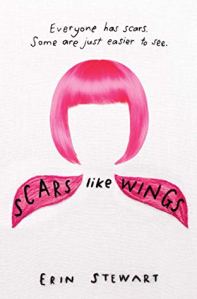
Scars Like Wings – Erin Stewart

Spoilers Ahead!

“Everyone has scars. Some are just easier to see.”

All the stars!!! That was gorgeous! It’s been almost three weeks since I finished reading this book and I’m still struggling to form meaningful sentences about it. There isn’t anything I can say that would do justice to the ways Ava and Piper made me feel so please just trust me when I say I want everyone to read this book.

Also, you may want to make sure you have plenty of tissues on hand before you begin. I was close to tears when I read the author’s note about eight year old Marius, whose own story helped to inspire Ava’s, and that was before the first chapter. Couple that with the comparisons between Scars Like Wings and Wonder, and you’ve essentially already got a foolproof recipe for a good ol’ ugly cry. And ugly cry I did, as well as some more minor dehydration inducing episodes, but they were of the ‘this is so beautiful!’ variety.

When a wound’s that deep, it’s the healing that hurts.

Ava survived the fire that claimed the lives of her parents and her best friend, but she doesn’t feel like the lucky one. After a year of excruciating treatments on her scarred body, 60% of which was burned, Ava is leaving hospital to live with her Aunt Cora, the “self appointed CEO” of the “Committee on Ava’s Life”, and Uncle Glenn.

The scars are all I see.

Ava doesn’t want any part of finding a ‘new normal’ but reluctantly agrees to attend school for two weeks to appease the Committee. If she can just make it through ten school days and show her Aunt she’s attempted ‘reintegration’, she will be able to resume hiding from the world indefinitely because she’ll have concrete evidence of its failure. She’s certain of it.

Those girls have no idea that I used to be a normal girl with friends

Except Ava doesn’t expect to meet people like Piper and Asad. Piper was my favourite character, partially because of her fluency in sarcasm and eccentricity, and also because I understand what it’s like to have a car accident turn your life into a Before and After. I appreciated her use of humour to deflect and deny the pain she was feeling.

“It’s like the universe dealt us this horrible hand in life and it’s our duty to scream back: ‘Well played, craptastic cosmos, but you haven’t met me yet.’”

Asad is a theatre geek, whose passion and personality stole my heart. Their empathy and compassion made me consistently want to give them bear hugs but they also snagged some great lines. About Wicked:

“It is nothing like The Wizard of Oz. It is like taking the yellow brick road and twisting it until it snaps in half and then you look inside and there’s a whole other world in that road that’s dark and deep and soul-exposing.”

I would tell you that Ava’s story is inspirational but she hates that word so instead I’ll tell you that it’s a reminder that the love, support and acceptance of others can make all the difference when you’re in pain, for whatever reason.

“She conquered her demons and wore her scars like wings.”

I loved the complexities of the characters. I can’t think of a single person who remained inside of the box that was initially labelled with them in mind. Perception or circumstances may have cast them in a specific role and while sometimes that may have been accurate to a degree, that’s not all they were; oftentimes they were also the opposite and I find that so encouraging.

At one point I nearly convinced myself to refuse to turn the page because I didn’t think I could handle it if what I feared was going to happen actually did. Thankfully I was mostly wrong about that part of the story. Had I been right, I’d probably still be ugly crying!

I figured out who was sending the messages to Piper early on, quite possibly accidentally, but this didn’t affect the way I felt about this book. By the time the truth was revealed it actually made even more sense to me why it had to be this person.

Thank you so much to NetGalley and Simon & Schuster (Australia) for the opportunity to read this book.

Rating: 5 out of 5.

Once Upon a Blurb

Everyone has scars. Some are just easier to see …

16-year-old Ava Gardener is heading back to school one year after a house fire left her severely disfigured. She’s used to the names, the stares, the discomfort, but there’s one name she hates most of all: Survivor. What do you call someone who didn’t mean to survive? Who sometimes wishes she hadn’t?

When she meets a fellow survivor named Piper at therapy, Ava begins to feel like she’s not facing the nightmare alone. Piper helps Ava reclaim the pieces of Ava Before the Fire, a normal girl who kissed boys and sang on stage. But Piper is fighting her own battle for survival, and when Ava almost loses her best friend, she must decide if the new normal she’s chasing has more to do with the girl in the glass – or the people by her side. 

Love, Heather – Laurie Petrou

Spoilers Ahead!

I gave myself some homework to complete before I would allow myself to pick up this book. I watched Heathers for the first time and it really helped having it fresh in my mind when I began reading. I understood references that likely would have whooshed over my head unnoticed otherwise and having just watched a revenge fantasy story, I had some idea of what was to come.

No one knows what she can do. No one has ever known.

Lottie and Stevie have been best friends all their lives. Stevie spends so much time at Lottie’s house she’s practically family and Lottie’s mother, Rhonda, is like a second mother to her. Lottie is a bookworm and Stevie loves movies (primarily those made between 1975 and 1995) so much that she’s had her own YouTube channel, FlickChick, since she was twelve.

Woepine High is like every other school: there’s a hierarchy.

The popular kids in their year have an undisputed leader – Athlete Barbie, A.K.A, Breanne. Then there’s Paige, Breanne’s “second in command”, and Paige’s boyfriend, Aidan. Lottie and Stevie have recently and quite accidentally become friends with them.

Some kind of wall went up when we started hanging out with all of them, and I’m not sure where the door is.

When a series of events results in Stevie being relentlessly bullied by ex-friends, other students and even complete strangers, her entire world comes crashing down and she has no one to turn to. Except Dee, the new girl.

“It’s people like us against the world, Stevie.”

Dee, who understands what Stevie’s going through. Dee, who decides it’s time the bullies were taught a lesson. Anonymously, of course. Each prank is accompanied by a message written in red lipstick: “LOVE, HEATHER”, an homage to teen revenge movie Heathers.

These acts of “mischief” soon take on a life of their own. The stakes are raised exponentially, with creative and sometimes brutal acts of revenge being played out across the school and beyond. What began with bullies being targeted becomes something where it’s harder to draw a line between bully and victim.

I mean, it’s hard to know who to root for, isn’t it?

I’ve agonised about what to write in this review for a couple of days. There was so much I loved about this book but there were also a couple of key points in the story that didn’t ring true and/or disappointed me. Please keep in mind that while yes, I had some niggles, that doesn’t necessarily mean you will agree with me.

After establishing the history of Stevie and Lottie’s friendship and Stevie’s sudden social pariah status, I felt this book then took off like a rocket. I was immersed in the acts of revenge and am fairly certain teenage me would have imagined some creative vigilante themed fantasies if I’d read this book then, much like when I conceived (but never acted upon) my own versions of poetic justice as I cheered Matilda on from the sidelines. Revenge fantasies are always fun, with their drama and the opportunity to cheer on underdogs.

If nothing else, this book reinforced my gratitude that I didn’t grow up surrounded by social media. Bullying is horrific enough when it’s physical and/or verbal. I can’t even imagine how the effects are compounded now that it follows you into your home, on your phone and spreading like a virus on the internet, where strangers can add fuel to the fire. Besides bullying, this book also delves into other complex and emotionally charged areas, including rape culture and gender identity.

Because I’m old now I have seen, or at least knew the general plot of, most of the movies referenced in this book but I’d be surprised if most young adults would have heard of the majority of them, unless their parents have introduced them to the movies they themselves grew up with. The lack of familiarity with these movies could potentially lead to the target audience not understanding some of the references to them in this book.

I found Lottie and Stevie’s friendship relatable and empathised with Stevie as she was bombarded with bullying and dealing with isolation. I ached for her as she was consistently let down by her parents. I kept wanting to read more about Pete and couldn’t decide if I was more interested in having them as my friend or teacher. I had problems with the character of Dee but can’t be specific because … spoilers.

I really enjoyed the majority of this book but I had a couple of fairly significant problems with it. When I got to the twist, my reaction pretty much mirrored this:

(Yes, I am binge watching Hart of Dixie at the moment.)

Variations of this particular twist have been done so many times before in so many other books and movies. Because I’ve come across it too many times I’m desensitised to it and I expect I probably even have a bias against it now. It would take something remarkable to occur in conjunction with that particular twist for me to not groan or roll my eyes when I encounter it. My main problem with that twist being in this book was that the psychology of it just didn’t sit right with me. However, to partially undo this entire paragraph, I need to acknowledge that because this book’s target audience are young adults, (i.e., not me) this may well be the first time some readers encounter this particular brand of twist and I hope they are blindsided by it.

My biggest problem with this book was its ending. It felt rushed and too neat. All things considered, the consequences seemed minimal and peoples’ responses to the character in question were too easy. After spending sufficient time setting up the important aspects of the friendships, bullying and pranks, the finale fizzled for me. This was quite a dark book in places and the end felt much too polite. Where was the rage and all of the other complicated feelings that would be expected after what happened?

Sidebar: Had I known before reading this book that Lottie and Stevie had exchanged best friend necklaces I would have called the demise of their friendship immediately, without even reading the blurb. Those curses that came in the innocent forms of hearts that declare you’re ‘BEST FRIENDS’ and break in two so you each get half of the words and heart were the present when I was growing up but whenever anyone I knew shared them, they wound up having a massive, often irreparable, fight shortly afterwards. You may think that this is mere coincidence or paranoia talking but I kid you not: those cutesy charms have some sort of friendship voodoo attached to them! Exchange them with extreme caution! 😜

Thank you so much to NetGalley and Crooked Lane Books for the opportunity to read this book.

Rating: 3.5 out of 5.

Once Upon a Blurb

Award-winning author Laurie Petrou makes her YA debut with this atmospheric thriller exploring the addictive pull of revenge.

What you see isn’t always what you get.

Stevie never meant for things to go this far. When she and Dee – defiant, bold, indestructible Dee – started all this, there was a purpose to their acts of vengeance: to put the bullies of Woepine High School back in their place. And three months ago, Stevie believed they deserved it. Once her best friend turned on her, the rest of the school followed. Stevie was alone and unprotected with a target on her back. Online, it was worse.

It was Dee’s idea to get them all back with a few clever pranks, signing each act Love, Heather – an homage to her favorite 80’s revenge flick. Despite herself, Stevie can’t help getting caught up in the payback, reveling in every minute of suffering. And for a while, it works: it seems the meek have inherited the school.

But when anonymous students begin joining in, punishing perceived slights with increasingly violent ferocity, the line between villain and vigilante begins to blur. As friends turn on each other and the administration scrambles to regain control, it becomes clear: whatever Dee and Stevie started has gained a mind – and teeth – of its own. And when it finally swallows them whole, one will reemerge changed, with a plan for one final, terrifying act of revenge.

Hello I Want to Die Please Fix Me – Anna Mehler Paperny

This book is part memoir and part journalistic investigation, with a fair amount of acknowledged subjectivity based on the author’s experiences with depression, suicidal ideation and attempts, and various treatments. In trying to explain the contents of this book I couldn’t go past this quote:

It’s an uncomfortably personal exploration of a sickeningly common illness no one likes talking about, one that remains under-treated and poorly treated and grossly inequitably treated in part because of our own squeamishness in confronting it or our own denial of its existence as an illness and the destruction it wreaks when left to its own devices.

I found myself cycling between wondering how wise it was to be describing the methods used in so much detail because it could potentially be read as instructions in the wrong/right hands and admonishing myself for wanting to control the narrative because people who live with suicidal ideation are already silenced in so many ways.

It’s difficult to sit and think about depression and suicide for any extended period of time and I did find my mood changing as I read, especially the early sections where the author recounts her “entry point into a labyrinthine psychiatric care system via the trapdoor of botched self-obliteration”. I think I’d be more concerned if reading a book like this didn’t have any impact on me, though. I was able to binge watch some TV to effectively switch the channels in my brain for a while for some respite. I am keenly aware that this is a luxury someone experiencing chronic depression and/or suicidal ideation do not have.

While some of the information contained in this book is specific to Canada and/or America, overall there’s something for pretty much everyone. Given the prevalence of depression, it’s likely to have touched your life in some way, either personally or through someone you love.

This book:

  • Demystifies suicide – no, asking someone if they are considering suicide does not cause someone who isn’t suicidal to suddenly become so
  • Offers some protective measures – loved ones, curiosity, procrastination
  • Discusses various treatment options – “pharmacological treatment of mental disorders has all the precision of surgery conducted with a chainsaw”
  • Outlines some studies and research
  • Highlights the additional barriers to getting treatment if you’re not white or you’re poor or from a remote community or a child or Indigenous or from a culture that shames seeking mental health treatment or, heaven forbid, any combination of these – “We fail the most marginalized at every level, then wonder why they worsen”; and
  • Provides insights into depression and suicide through stories of people who’ve experienced them up close and personal.

I found some of the language used in this book referencing mental illness iffy at best: “nuts”, “crazy”, “nutbars”. While I’m never going to be okay with those words myself, I don’t have the right to tell someone who’s describing their experience what words they’re allowed to use to do so.

Subsumed by such an agency-stealing disease, we need all the empowering we can get.

While it covered a lot of information I already knew (I’ve read a lot previously in this area), I learned about some studies and potential future treatments I wasn’t aware of and the details of the author’s experiences in hospital opened my eyes.

I appreciated the author’s honesty and her down to earth approach, which made difficult topics more accessible for me. The amount of interviews with various health professionals, researchers and others who are consistently dealing with mental illness provided a well rounded exploration, with a variety of points of view.

I would definitely recommend this book to anyone whose work involves interaction with people who experience mental illness as it holds valuable insights into what it’s like to have to live with an illness that people silence, shame and shy away from.

Thank you so much to NetGalley and Penguin Random House Canada for the opportunity to read this book.

Rating: 4 out of 5.

Once Upon a Blurb

In her early twenties, while outwardly thriving in her dream job and enjoying warm familial support and a strong social network, award-winning journalist Anna Mehler Paperny found herself trapped by feelings of failure and despair. Her first suicide attempt – ingesting a deadly mix of sleeping pills and antifreeze – landed her in the ICU, followed by weeks of enforced detention that ran the gamut of horrifying, boring, hilarious, and absurd. This was Anna’s entry into the labyrinthine psychiatric care system responsible for providing care to millions of Canadians.

As she struggled to survive the psych ward and as an outpatient- enduring the “survivor’s” shame of facing concerned family, friends, and co-workers; finding (or not) the right therapist, the right meds; staying healthy, insured, and employed – Anna could not help but turn her demanding journalist’s eye on her condition and on the system in which she found herself. She set off on a quest to “know her enemy,” interviewing leading practitioners in the field across Canada and the US – from psychiatrists to neurological experts, brain-mapping pioneers to heroic family practitioners, and others dabbling in novel hypotheses.

She reveals in courageously frank detail her own experiences with the pharmacological pitfalls and side effects of long-term treatment, and offers moving case studies of conversations with others, opening wide a window into how we treat (and fail to treat) the disease that accounts for more years swallowed up by disability than any other in the world. 

A Witch's Guide to Escape: A Practical Compendium of Portal Fantasies – Alix E. Harrow

Apex Magazine Issue 105, February 2018

A Witch’s Guide to Escape: A Practical Compendium of Portal Fantasies is a 2019 Hugo Awards finalist in the Best Short Story category.

He reached towards the book and the book reached back towards him, because books need to be read quite as much as we need to read them

I first read this short story three months ago and loved it. When I was about to begin my reread I realised that it was written by Alix E. Harrow. I have been fortunate enough to secure an advanced copy of their debut novel, The Ten Thousand Doors of January. While it hasn’t reached the top of my to be read pile yet I’ve had a sneak peek and it definitely looks like my kind of book. After rereading this short story I now can’t wait to read it.

Anyone could see that kid needed to run and keep running until he shed his own skin, until he clawed out of the choking darkness and unfurled his wings, precious and prisming in the light of some other world.

I love magic portals, libraries and witches, so this story hit one of my literary trifectas. Books can be life changing and the right one can even save your life.

This is a story about a librarian who connects readers with books by “divining the unfilled spaces in their souls and filling them with stories and starshine”, a foster child and one of those books.

You can read this short story online here.

Rating: 5 out of 5.

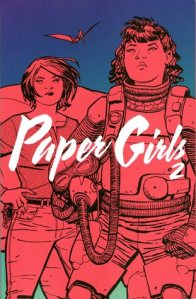
Paper Girls Volume 2 – Brian K. Vaughan

Illustrations – Cliff Chiang

Colours – Matt Wilson

Spoilers Ahead!

A note about spoilers: I don’t know how to review this Volume without including them, especially since I’m using this review to remind myself of what I already know when I make it to Volume 3. Please proceed with caution if you haven’t already read this Volume.

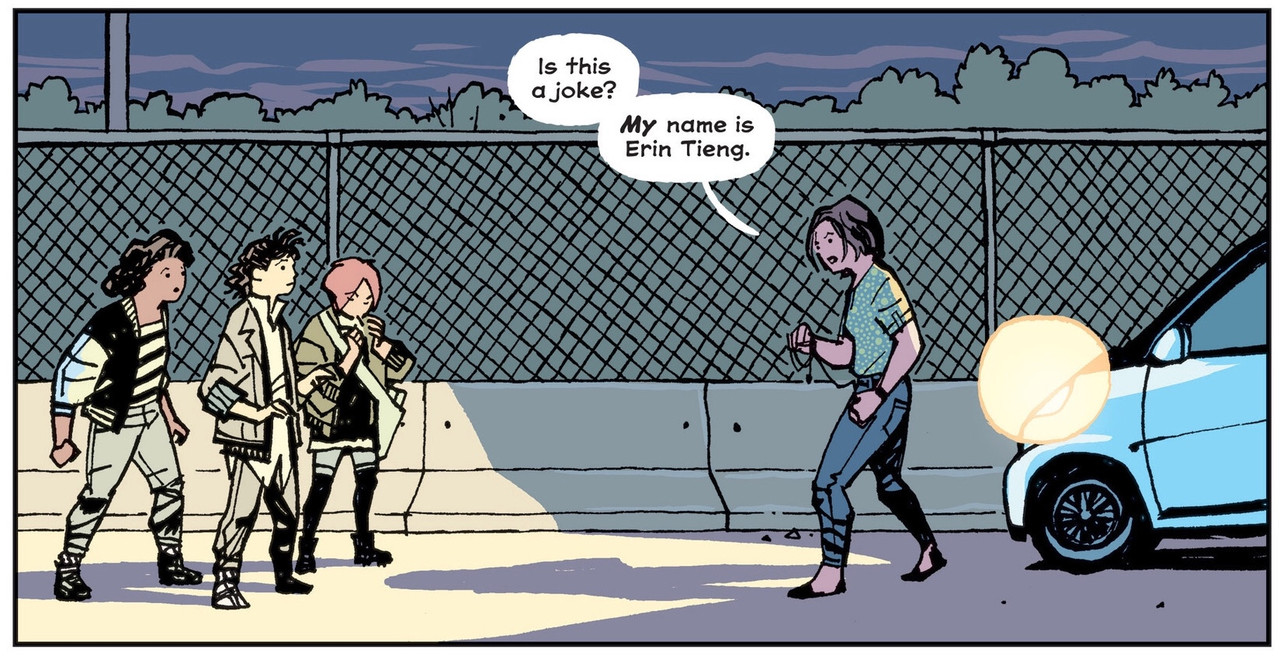
Tiffany, Mac and Erin had a really weird All Saints morning in 1988 and now their friend KJ is missing. Or maybe they are because here they are, standing in front of Erin (same Erin, but all grown up) in 2016. Cue The Twilight Zone theme right about now.

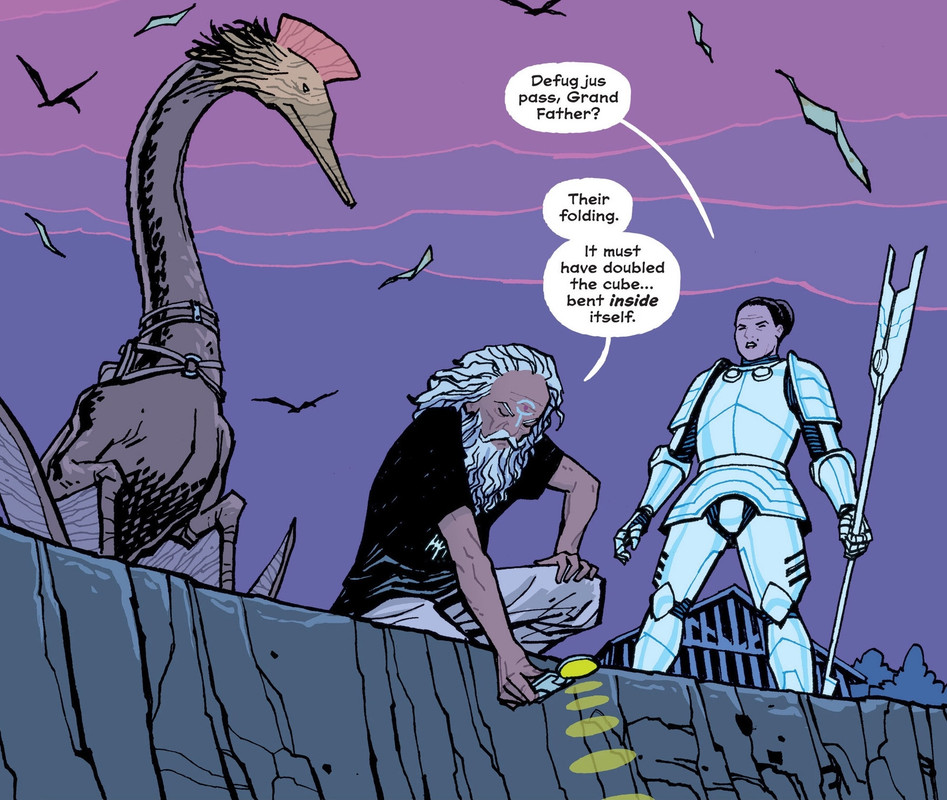
Meanwhile, the old-timers in 1988 seem to think they know what happened. Our girls have been “timelined”, same place, different time. Except they could be “anywhere in time” so that doesn’t exactly narrow things down for the old-timers.

The Cardinal is the lady in the stormtrooper cosplay, the guy with the white beard is Grand Father, whose mother was born in 2016, and the one on the left? Yeah, that’s a pterodactyl!

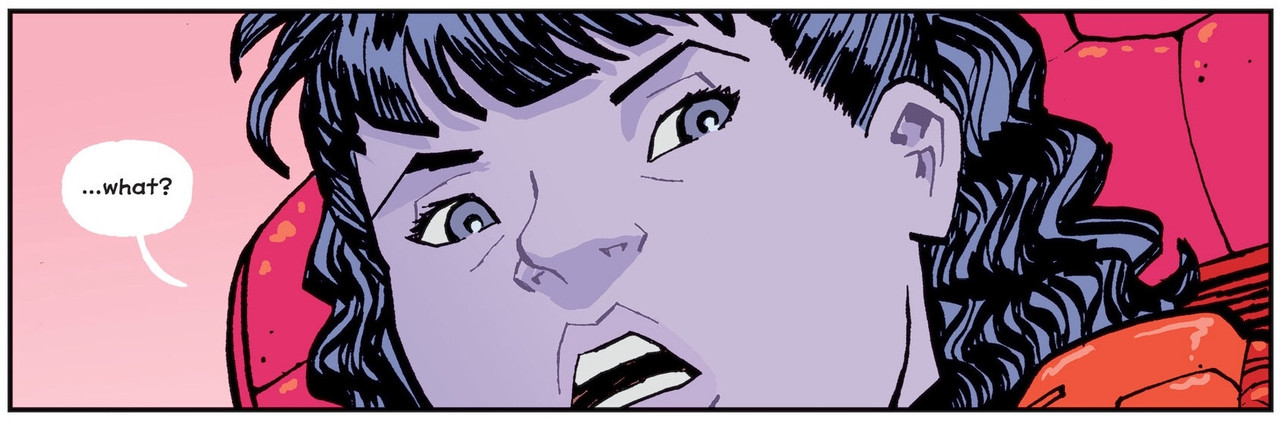
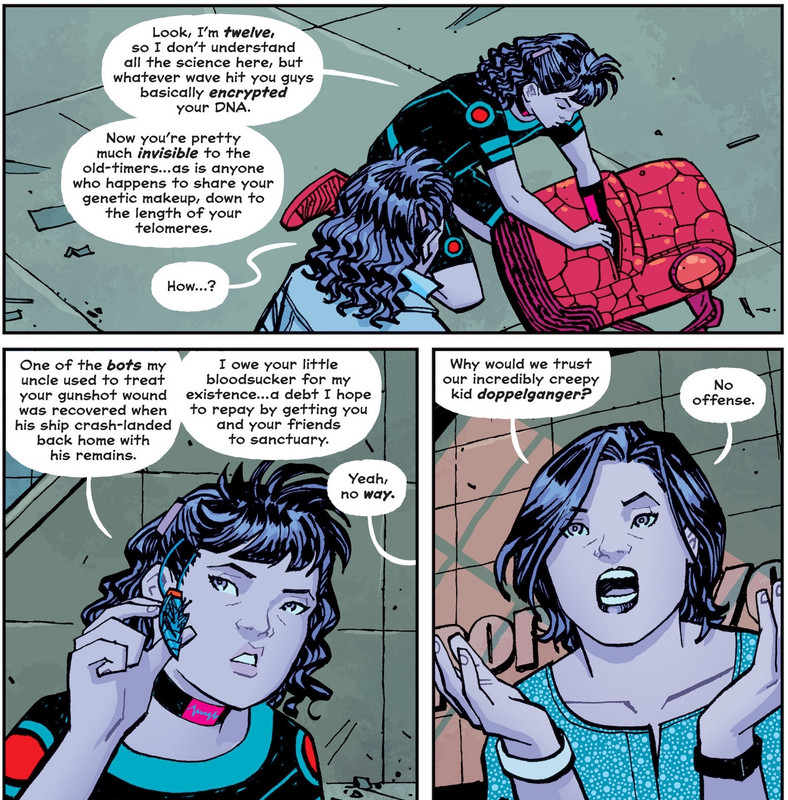
Then, as if two Erins weren’t enough, a third one shows up.

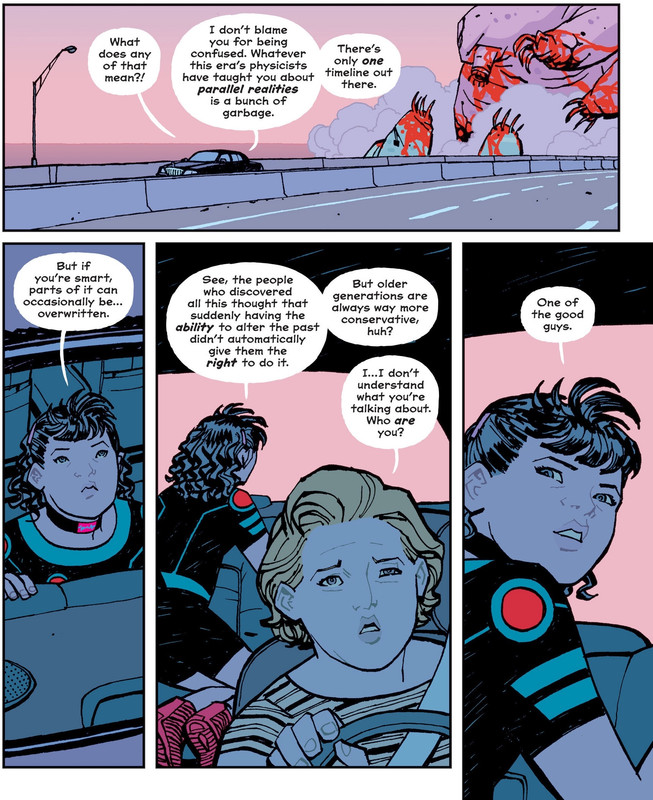
This one actually seems to know what’s going on and I’m guessing this is probably not all that unusual of a conversation for a Uber driver and their passenger to be having.

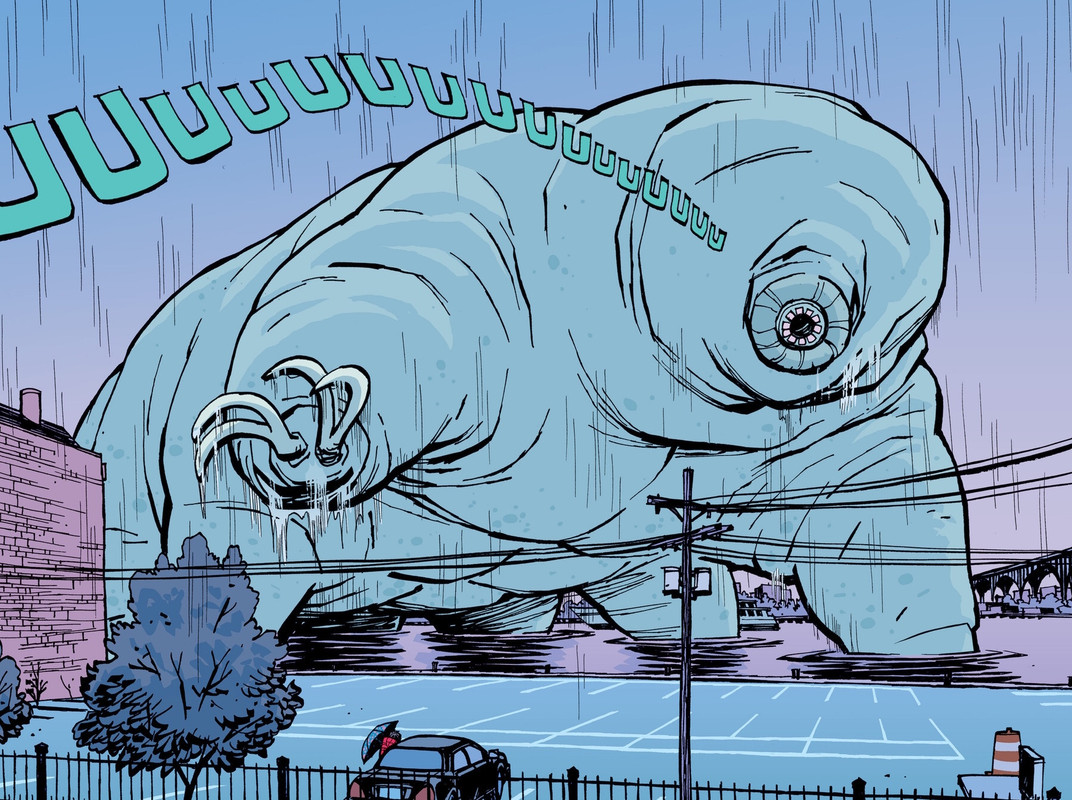
This creature shows up. He’s a gigantic tardigrade.

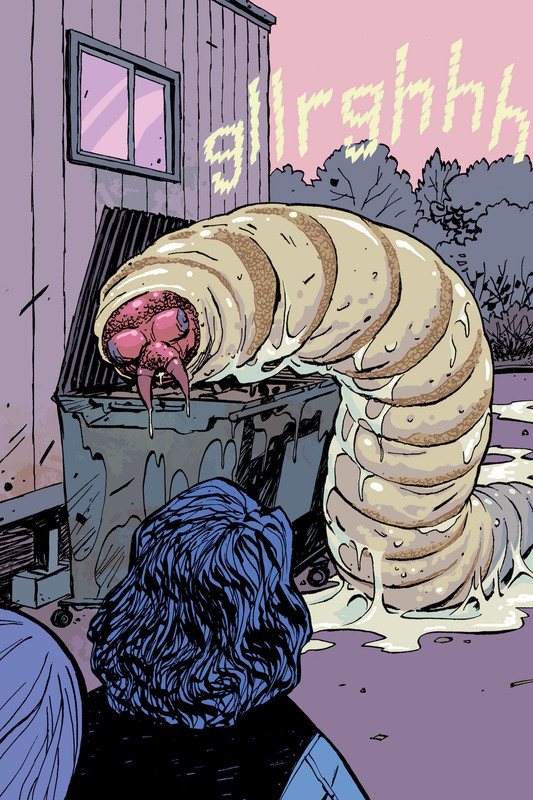
Then there’s this maggot.

Okay, so the massive creepy crawlies aren’t the prettiest. But at least this happens.

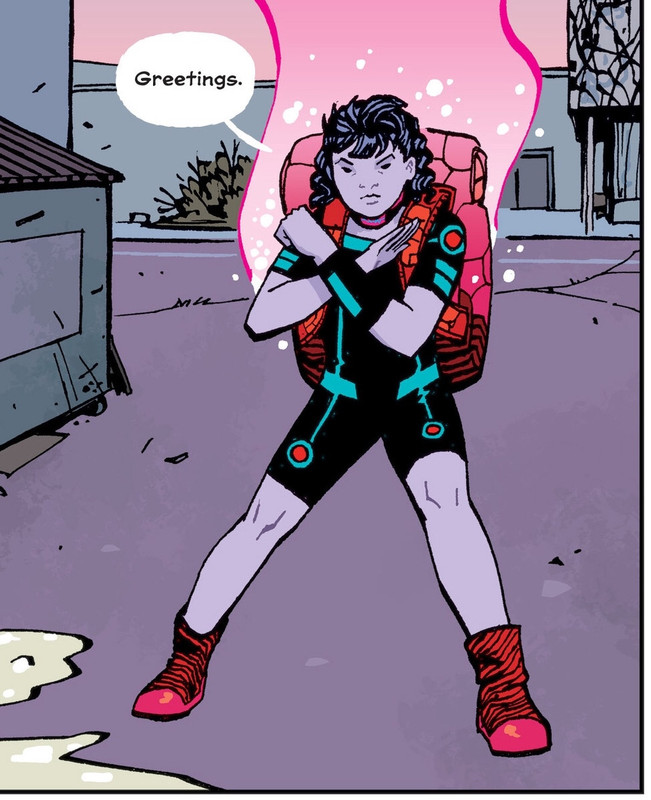
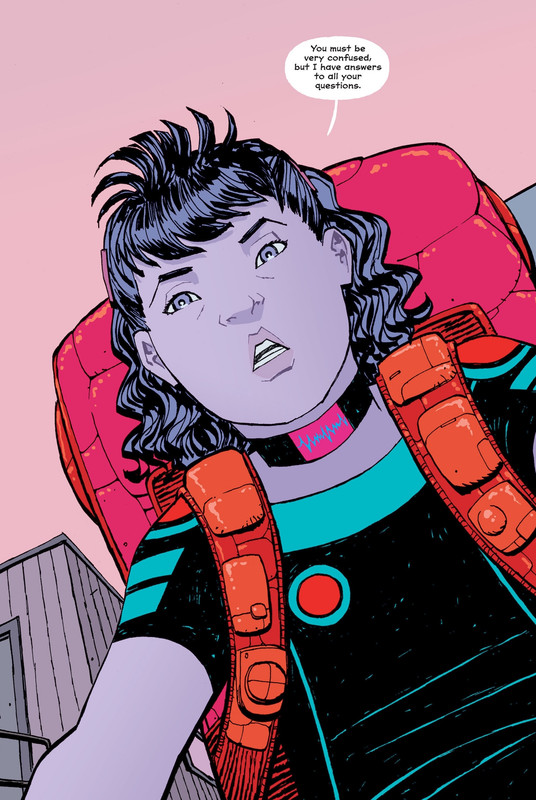
Yes, please Erin III. Please give me all the answers.

We learn the Erin I’m calling Erin III (red backpack Erin) is actually a clone and she knows Naldo and Uncle (?) Heck, the teenagers from another time that helped our four original paper girls in the first Volume. Although when both of the new Erins are telling our paper girls different things, who are they supposed to trust?

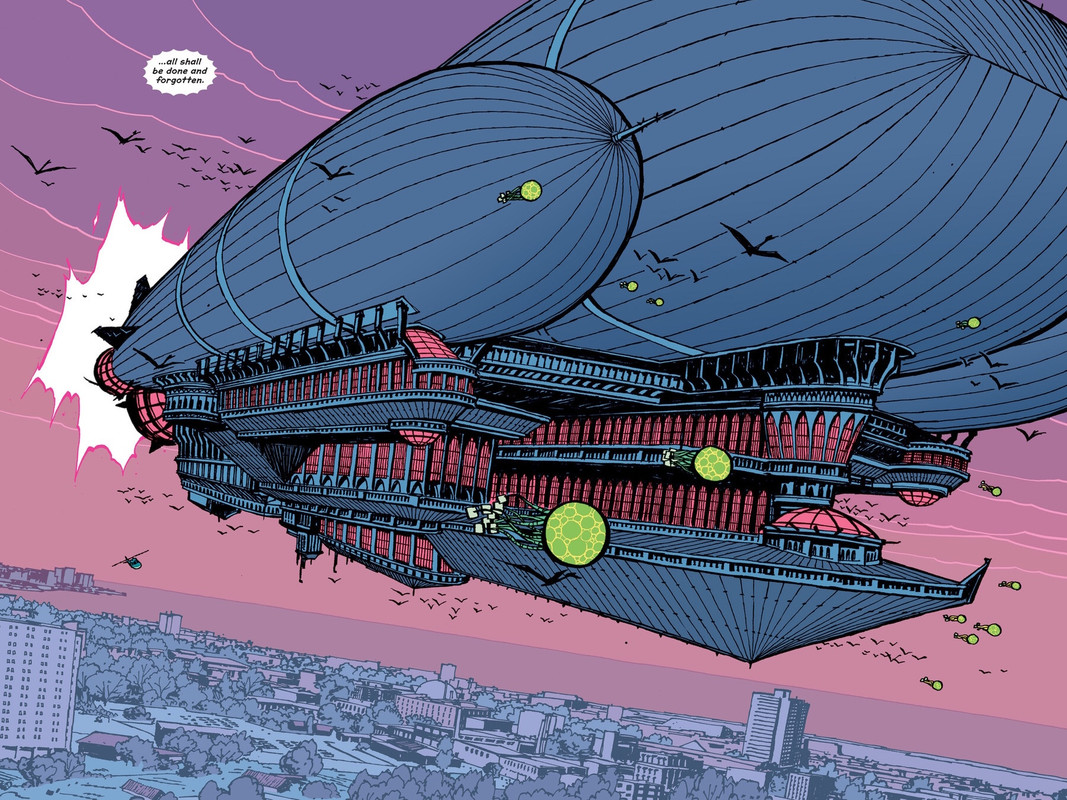
We may not know much about the old-timers (or anyone, really) yet but we now know that old-timers travel in some serious style. Check this awesomeness out!

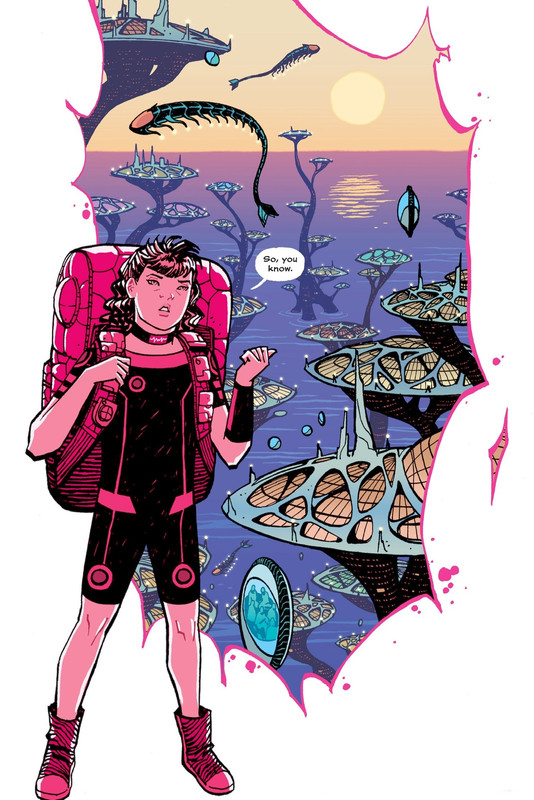
We even get a glimpse of the future in this Volume and while it looks pretty interesting, it appears global warming has followed through on at least one of its promises.

While I’d much rather read a book than keep up with what’s happening in the world of politics I did appreciate the not so subtle political jabs included in this Volume.

Raising all sorts of fun Back to the Future-ish quandaries and space-time continuum conundrums, including what to do if you find out you don’t exist in the future, I found this second Volume a lot easier to follow than the first. I’m now keen to continue the series, despite and maybe even because it raises interesting and potentially scary questions, like what your kid self would think of the adult you became and what you’d want to tell your kid self if you met them now.

Rating: 4 out of 5.

Once Upon a Blurb

After surviving the strangest night of their lives in the Cleveland suburb of Stony Stream, intrepid young newspaper deliverers Erin, Mac, and Tiffany find themselves launched from 1988 to a distant and terrifying future … the year 2016.

What would you do if you were suddenly confronted by your 12-year-old self? 40-year-old newspaper reporter Erin Tieng is about to find out in this action-packed story about identity, mortality, and growing older in the 21st century.

Collects Paper Girls 6-10.

Maybe You Should Talk to Someone – Lori Gottlieb

Do you know how difficult it is to whisper an ugly cry? I do. There I was at 3:30am, relaxed and enjoying the insight and surprising humour of this book, caught up in a ‘just one more chapter’ loop. Then, out of nowhere, I was ugly crying as quietly as possible so I didn’t wake up the sensible people in my home, those who actually sleep when it’s considered an acceptable time to do so. Okay, so it wasn’t exactly ‘out of nowhere’; I knew it was coming at some stage with that particular patient but I wasn’t expecting it right then.

That wasn’t the only time I cried during this book (there may have been another four tissue grabs and some very dignified sniffling involved) and it wasn’t the only time my tears caught me off guard (who knew I’d cry about the patient I initially loved to sneer at!) but it did remind me of some of the reasons why I never formally used my psychology degree.

Reason #1: Although I don’t cry a lot about my own stuff, I am a champion crier when it comes to pretty much anything else. Movies. TV shows. Songs. Books. When you cry about your stuff. When I think about your stuff and consider how brave, resilient, [insert any number of adjectives here] you were, are or are going to be. Who wants to come to therapy and feel like they need to console their therapist about their reaction to their patient’s problems?!

Reason #2: There would be certain types of people and life experiences where I just know I couldn’t remain impartial. ‘Oh, so you’re a child molester? Allow me to introduce you to another patient of mine, the one that keeps getting imprisoned for assault. I’m sure you’ll get along just fine.’

Reason #3: The goodbyes. See Reason #1.

Full disclosure: I started reading this book while my own therapist was on leave. Besides confirming my decision to not actually be a therapist (you’re so welcome, all of the people whose lives would have crossed my path in this way. I hope you found a Wendell instead!) I also got a glimpse of what it’s like behind the scenes for therapists, something I’ve always been interested in, something that’s difficult to obtain because of that pesky ‘confidentiality’ thing.

I’m not ashamed to say that I have my very own Wendell, who is awesome by the way. None of us get out of life unscathed and I think pretty much everyone could benefit from therapy at some point in their lives. One of the perks this book offers is a therapeutic ‘try before you buy’; if you’ve been considering therapy but are hesitant to schedule that initial appointment, then reading this book will give you some idea of what to expect – from the therapist, from the experience, and how it looks when it’s done right.

Sitting-with-you-in-your-pain is one of the rare experiences that people get in the protected space of a therapy room, but it’s very hard to give or get outside of it

I enjoyed Lori’s down to earth approach, her compassion and ability to bring truth to a situation, while still making me smile along the way. She humanises our experience of pain and even when she’s talking about her own therapy, her insight and openness had me smiling in recognition much more frequently than the narrative made me cry. Of her own therapy:

Yes, I’m seeking objectivity, but only because I’m convinced that objectivity will rule in my favor.

Of her therapist:

He looks at me meaningfully, like he just said something incredibly important and profound, but I kind of want to punch him.

A quote I love:

defenses serve a useful purpose. They shield people from injury … until they no longer need them. It’s in this ellipsis that therapists work.

And another:

People often mistake numbness for nothingness, but numbness isn’t the absence of feelings; it’s a response to being overwhelmed by too many feelings.

Oh, and I have to share this one too:

When the present falls apart, so does the future we had associated with it. And having the future taken away is the mother of all plot twists. But if we spend the present trying to fix the past or control the future, we remain stuck in place, in perpetual regret.

I highlighted so many passages in this book that each time I started another binge read it felt like I was experiencing my very own mini therapy session. I saw myself in Lori and in her patients, even the initial ‘love to sneer at’ one, probably because I saw something of myself in them as well. I saw my own therapist in Wendell and felt probably too much pride in having found myself such an amazing ‘Wendell’ to help me navigate my presenting problem as well as the real issues behind the facade.

From the presenting problem to the “doorknob disclosures”, “what-aboutery” and self-sabotage, all the way to the “termination” (seriously, can therapists collectively find a less aggressive way to label someone’s graduation from therapy?), I ‘just one more chaptered’ my way through this book.

Although at times I felt voyeuristic, have some outstanding questions about Lori’s patients I’m not entitled to know but still want to (Would you please tell me John’s real name or at least the name of the TV show you kept referencing so I can binge watch it?) and had at least one ugly cry headache as a result of reading this book, I wouldn’t hesitate to recommend it to pretty much anyone.

Much like the way Lori talks about who therapy can’t help, I think the only people who wouldn’t benefit in some way by reading this book are those “who aren’t curious about themselves.” I’ll leave you with what’s currently my favourite quote:

There’s no hierarchy of pain. Suffering shouldn’t be ranked, because pain is not a contest.

Rating: 5 out of 5.

Once Upon a Blurb

One day, Lori Gottlieb is a therapist who helps patients in her Los Angeles practice. The next, a crisis causes her world to come crashing down. Enter Wendell, the quirky but seasoned therapist in whose office she suddenly lands. With his balding head, cardigan, and khakis, he seems to have come straight from Therapist Central Casting. Yet he will turn out to be anything but.

As Gottlieb explores the inner chambers of her patients’ lives – a self-absorbed Hollywood producer, a young newlywed diagnosed with a terminal illness, a senior citizen threatening to end her life on her birthday if nothing gets better, and a twenty-something who can’t stop hooking up with the wrong guys – she finds that the questions they are struggling with are the very ones she is now bringing to Wendell.

On a Scale of One to Ten – Ceylan Scott

Some words of warning before I tell you anything else: I expect some people whose experiences resemble its themes will find understanding and a sense that they’re not alone if they read this book. Others may be triggered by its contents so please, please do not read this book if you’re not in a good place psychologically.

I know that Iris is dead. I know that it was sudden and so shocking that the waves of horror shimmered in the distance for months afterward. I also know that it is my fault, that one second she was there and her heart pumped crimson blood through her veins, and the next she was gone, blood frozen solid, and I could have prevented it, but I did not.

Tamar has been admitted to a psychiatric hospital as a result of a recent suicide attempt and history of self harm. She feels overwhelming guilt over the death of her friend, Iris, a death she is certain she is responsible for. During her time at Lime Grove she meets other adolescents who are similarly dealing with mental health issues, ranging from eating disorders to bipolar and psychosis.

Tamar’s internal turmoil feels authentic, likely because, although the story is fiction, its author shares her main character’s diagnosis of borderline personality disorder. Although this character’s behaviour does seem to tick many of the borderline personality disorder boxes, it isn’t until near the end that this is even mentioned and it’s never actually explained to Tamar on page. Hats off to the author for tackling subject matter so close to home at such a young age though.

I don’t know if this story is reflective of what psychiatric hospitals in England are like in general, or anywhere for that matter, although in the Author’s Note she does mention an admission when she was a teen but I was appalled by the lack of security measures. The patients could easily escape and bring prohibited items into the hospital.

The staff appeared to be a blend of people simply waiting for their next pay check and those who sincerely wanted to make a positive difference in the lives of their patients. The psychiatrist’s seemingly narrow view of what constitutes self harm allowed Tamar’s behaviour during an overnight home visit to be glossed over rather than addressed. There’s a huge difference between empathy and applauding obvious self harm behaviour simply because someone used a different method than they normally would. This psychiatrist didn’t even recognise what she did as self harm on that occasion.

Although I would have loved knowing what eventually became of invincible Elle and some of the others Tamar met at Lime Grove it felt more authentic to not have that resolution. In that kind of setting I expect it would be more unusual to have the blanks filled in.

While Elle and Jasper became real to me most of the other characters felt two dimensional, even Iris. The teens at Lime Grove felt like the usual suspects in a psychiatric patient setting, with little to differentiate them from their diagnoses. Given how young the author is I expect their background characters will become more memorable and fleshed out in future books.

I admit that I initially picked up this book because I (wrongly) assumed the title foretold a story about chronic pain/illness, something I’m unfortunately very familiar with. I detest the “rate your ‘whatever’ on a scale of 1 to 10” question for its subjectivity and lack of real meaning. Seriously, what’s a 7 for me may be a 2 or 10 for you and if you asked me the same question tomorrow I may have just received great news; my symptoms that I reported as a 7 yesterday may generate a response of 4 today. Because of my interest in mental health I decided to read this book anyway and am glad I did but it has resulted in my ‘1 to 10 scale’ disdain growing to encompass mental health as well as physical.

I couldn’t help making comparisons between this story and Girl Interrupted – the movie because I haven’t read it yet. (I know! The book will be better!) The escape and subsequent hitchhiking, the main characters with the same diagnosis and the parallels between Elle in this book and Lisa in Girl felt eerily similar.

I’d be hesitant to recommend this book to anyone, mostly because I wouldn’t know what thoughts or feelings it may trigger in the reader. There are scenes in this book that could easily be viewed as lessons in how to self destruct more efficiently and for people who are already vulnerable in those areas it could be dangerous.

If you are struggling with depression, addiction, self harm or suicide To Write Love on Her Arms is a great resource for information – https://twloha.com. There’s also a Help page where you can search for contact details of resources in your country.

Rating: 3 out of 5.

Once Upon a Blurb

Tamar is admitted to Lime Grove, a psychiatric hospital for teenagers. 

Lime Grove is home to a number of teenagers with a variety of problems: anorexia, bipolar disorder, behaviour issues. Tamar will come to know them all very well. But there’s one question she can’t … won’t answer: What happened to her friend Iris? As Tamar’s emotional angst becomes more and more clear to her, she’ll have to figure out a path to forgiveness. A shocking, moving, and darkly funny depiction of life in a psychiatric world. 

A stunning journey of one girl’s mental illness and the redemptive power of truth and healing.

The Truth About Keeping Secrets – Savannah Brown

When you live in a fishbowl, everything seems bigger, magnified, and no one was safe. People said that, in Pleasant Hills, everyone got their scandal. Fifteen minutes of infamy. I was to get more.

Sydney’s father, the only therapist in Pleasant Hills, has died. Sydney isn’t convinced her dad’s car accident was accidental. After all, he knew all of his clients’ secrets and maybe one of those secrets got him killed. And why was June Copeland, golden girl of Pleasant Hills, at his funeral?

The November of my junior year became permanently etched into my mind as the first month of June.

Told in a strangely beautiful way, this is a story about a grief that’s so pervasive it feels like it could eat you alive, fear so tangible it may choke you if you don’t find a way to escape or confront it, and obsession disguised as love.

Abstract is scarier than physical. Unknown is scarier than known – not because of what it is, but because of all the things it could be.

With the heightened drama of adolescence and undercurrents of potential danger and ongoing mystery, I found myself hooked from the first page and wished on more than one occasion that it was socially acceptable to highlight my library book.

June convinced me that we were all open books if only we found the right person to read us.

I was caught up in Sydney’s grief and loneliness from the beginning and liked her, even when she was being a crappy friend, because she was so relatable. I could easily imagine someone thinking and feeling the way she did, and I respected that her grief wasn’t pretty and contained. Her strengths and quirks felt authentic.

I adored Leo and wish I could have gotten to know him better. For a while it seemed like he would get the page time he deserved but gradually he began to feel like he was only there to provide Sydney with a specific skill set.

I enjoyed the mystery surrounding June and liked her complexity but one thing she did that annoyed the hell out of me was, like, how often she, like, said, “like”, like that. I found her character fascinating but, honestly, each time she said “like” I wanted to claw her eyes out. I did have some nostalgic “dude” moments with her though, offset by ‘wow, is “dude” back?’

I did pick up on a few clues early on that gave away some of the spoilery bits but that may be my life experience showing rather than an indication that this book was predictable.

I can’t believe a 22 year old wrote this! I didn’t even know who I was at 22 and here this woman is, writing a book that made me want to keep digging deeper into the lives of book friends I only met a few days ago. I’m definitely going to be looking out for this author’s next novel.

Rating: 4.5 out of 5.

Once Upon a Blurb

Sydney’s dad is the only psychiatrist for miles around their small Ohio town.

He is also unexpectedly dead.

Is Sydney crazy, or is it kind of weird that her dad-a guy whose entire job revolved around other peoples’ secrets-crashed alone, with no explanation?

And why is June Copeland, homecoming queen and the town’s golden child, at his funeral?

As the two girls grow closer in the wake of the accident, it’s clear that not everyone is happy about their new friendship.

But what is picture perfect June still hiding? And does Sydney even want to know? 

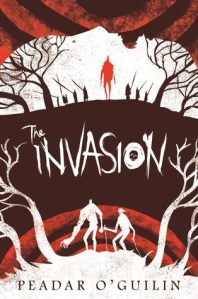
Grey Land #2: The Invasion – Peadar Ó Guilín

The Invasion is a 2019 Hugo Awards finalist in the Lodestar Award for Best Young Adult Book category.

In The Call we were introduced to Nessa and Anto. Despite incredible odds they both survived their Calls, so this should be the story of their happily ever after, right? Yeah, maybe not. Your first clue is the book’s title, The Invasion. Any happiness is fleeting and we’re at war here, people! There may not even be an ever after!

Three minutes and four seconds. That’s how long the Called are missing. Then they come back, living or dead; twisted into hideous shapes or bewildered and whole. But return they always do. Or at least they used to.

This sequel introduces plenty of new characters but also continues the story of some we’ve already spent time with. I was looking forward to the continuation of Nessa and Anto’s story. I was surprised that Aoife’s role increased as she didn’t make a huge impression on me in the first book. I was eager to see what the consequences of Melanie’s actions in the first book would be.

We made the Sídhe into monsters, now they make monsters of us.

I found I either loved or hated the women in this book. I loved Karim and Taaft, who commanded respect with their strength, leadership, determination and bravery. Although they were badasses in battle, they weren’t one dimensional; they cared about the people they fought alongside and had stories that extended beyond their job descriptions.

The professor intrigued me and I wished for more time to get to know them. They did not get anywhere near the page time that I had hoped they would. I wanted more time with Melanie as well (although the resolution of her story satisfied me) and I wanted to find out what happened after we saw Angela last. I had high hopes for Liz Sweeney but her contribution to the story fell flat for me.

When characters refer to themselves in the third person I find it infuriating so Annie quickly became the character I most wanted the Sídhe to play with – “But Annie has seen it all, so she has.”, “Annie feels”, “Annie doesn’t like”. Ugh! She’s right here, Sídhe! Come and get her!

Most of the people who died in this book were simply names to me. I didn’t know much, if anything, about them so their deaths didn’t even make me pause. The one death that I thought should have had an emotional impact didn’t.

Although I didn’t come away with any substantial emotional connections I loved being able to revisit the Grey Land and enjoyed the introduction of some of its landscape and creatures I wasn’t previously aware of. Like piranha bats! And sniffers!

I had no idea what was going to happen next during The Call, other than the certainty that most of the characters I met would not survive, of course. Unfortunately I found The Invasion quite predictable. This may be because I already knew some of the rules at play in the Many-Coloured and Grey Lands but I found myself highlighting key sentences, knowing they were important before the characters did and more often than not I knew what those sentences foretold. I even figured out who the Big Bad was as soon as I met them and found them underwhelming.

Despite this I was satisfied by the ending, with key characters behaving how I hoped they would when faced with horrors. I’m caught between wishing The Call had been a standalone and glad I read the sequel.

Although this book does provide enough answers for the story to be “Called” complete, other potential worlds were mentioned briefly but not explored. I love the Sídhe so much and would joyfully read on if their world ever collided with another.

Once Upon a Nitpick or Two: The first time something was likened to a cartoon or a cartoon character I enjoyed the visual. I was over it by the fourth time it happened. There were also more typos remaining in the Kindle version I purchased than I would have liked.

description

Rating: 4 out of 5.

Once Upon a Blurb

After so much danger, Nessa and Anto can finally dream of a happy life. But the terrible attack on their school has created a witch-hunt for traitors – boys and girls who survived the Call only by making deals with the enemy. To the authorities, Nessa’s guilt is obvious. Her punishment is to be sent back to the nightmare of the Grey Land for the rest of her life. The Sídhe are waiting, and they have a very special fate planned for her.

Meanwhile, with the help of a real traitor, the enemy come pouring into Ireland at the head of a terrifying army. Every human they capture becomes a weapon. Anto and the last students of his old school must find a way to strike a blow at the invaders before they lose their lives, or even worse, their minds. But with every moment Anto is confronted with more evidence of Nessa’s guilt.

For Nessa, the thought of seeing Anto again is the only thing keeping her alive. But if she escapes, and if she can find him, surely he is duty-bound to kill her …

Speak: The Graphic Novel – Laurie Halse Anderson

Illustrations – Emily Carroll

If ever a story seemed destined to become a graphic novel, it’s Speak, which I finally read for the first time less than two months ago, and it was everything! I feared I’d Humpty Dumpty while reading Speak, which is why it took so long for me to gather the courage to finally begin reading it. I wish I’d had a Speak to tell me I wasn’t alone when I was Melinda’s age.

I asked my library to buy this graphic novel for me and they did! I love my library! I was under the delusion that I’d read this once and then move on. Hah! As if I wasn’t going to then buy a copy for myself immediately so I could reread it to my heart’s content!

Much like my experience with the novel I kept the graphic novel near me, planning to read it all month, but once again I was afraid of Humpty Dumptying. It’s due tomorrow and someone else has reserved it so I could avoid it no longer. But like Speak before it, it was AMAZING!!!

I’m left with a cacophony of exclamations fighting to be the loudest in my head:

”Where has this graphic novel been my whole life?!”

“Everyone need to read this!”

“How different could my life have been if this had been published when I was Melinda’s age?!”

“This graphic novel is going to introduce Laurie’s story to a whole new audience!”

“The illustrations portray the aftermath of sexual assault perfectly!”

Everything I said in my Speak review stands but Emily Carroll’s illustrations have brought Melinda’s story to life in a way that, while maintaining Laurie’s sensitive portrayal, provides a whole new dimension to it, showing what life after sexual assault can look like.

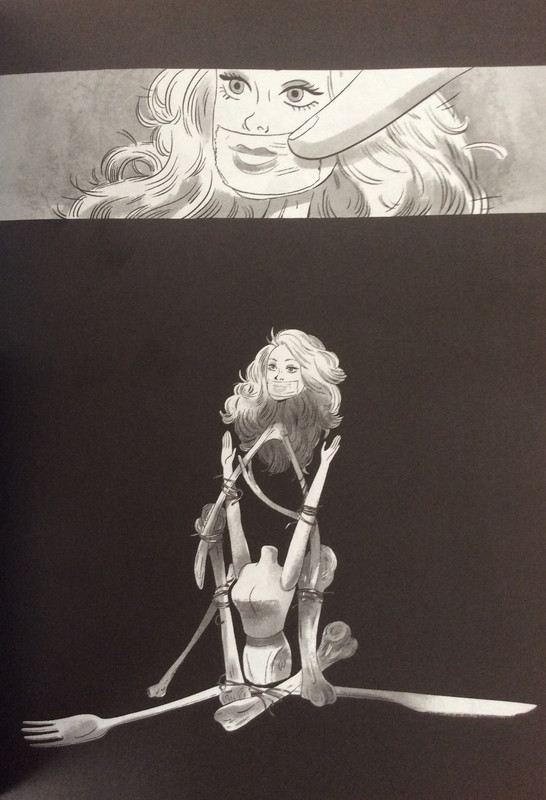
You get to watch Melinda’s expressions as she attempts to navigate high school, the same high school where It walks the halls. You can’t help but see how the trauma is affecting her throughout the story. You witness her growing from a scared rabbit to someone who not only has a voice but uses it! I got to see her turkey-bone sculpture outside of my imagination and it was perfect! (Apologies for the dodgy image. I took a photo of this page in my library book.)

I got to see what Melinda’s final tree looks like and I loved it. The only thing that could have made that image even better for me would be if a splash of colour had been added. Greyscale works perfectly for this book but a hint of colour (probably green for symbolism) would have delighted me.

I’ve never done this before but I’m going to add a couple of Post-it’s before I return this book to the library. While I’d never actually deface a library book I want to add the phone number of my state’s Rape Crisis Centre to the list of resources and a little something to let future borrowers know that they’re not alone.

Rating: 5 out of 5.

Once Upon a Blurb

The modern classic Speak is now a graphic novel.

“Speak up for yourself – we want to know what you have to say.” 

From the first moment of her freshman year at Merryweather High, Melinda knows this is a big fat lie, part of the nonsense of high school. She is friendless – an outcast – because she busted an end-of-summer party by calling the cops, so now nobody will talk to her, let alone listen to her. Through her work on an art project, she is finally able to face what really happened that night: She was raped by an upperclassman, a guy who still attends Merryweather and is still a threat to her.