Violet’s father is appalled by her behaviour (climbing trees is most inappropriate) and is threatening to send her to finishing school so he can marry her off to an eligible young man. Violet wants to be a scientist. She would also like to be allowed to wear trousers. No one understands her “insect obsession”.
‘Is there something wrong with me?’
Kate – 2019
When Kate leaves her abusive relationship, she goes to Weyward Cottage, which was owned by her great-aunt. It is here that she will come to terms with her past and discover her heritage.
I am the monster.
The first Weyward child is always a girl. This is the story of three of them, centuries apart yet connected.
Although each Weyward is given a voice in this story, Altha’s is the only one told in first person. I found something to like about all three women. In particular, their affinity with nature endeared them to me.
Be aware that on page violence against women is part of the story in every timeline. The graphic nature of some of this abuse may be triggering for some readers. Thankfully, women reclaiming their power and having the courage to be themselves was also part of the story.
Favourite no context quote:
Perhaps one day, she said, there would be a safer time. When women could walk the earth, shining bright with power, and yet live.
Thank you so much to NetGalley and The Borough Press, an imprint of HarperCollins UK, for the opportunity to read this book.
⭐⭐⭐⭐
Rating: 4 out of 5.
Once Upon a Blurb
Kate, 2019 Kate flees London – abandoning everything – for Cumbria and Weyward Cottage, inherited from her great-aunt. There, a secret lurks in the bones of the house, hidden ever since the witch-hunts of the 17th century.
Violet, 1942 Violet is more interested in collecting insects and climbing trees than in becoming a proper young lady. Until a chain of shocking events changes her life forever.
Altha, 1619 Altha is on trial for witchcraft, accused of killing a local man. Known for her uncanny connection with nature and animals, she is a threat that must be eliminated.
But Weyward women belong to the wild. And they cannot be tamed…
Weaving together the stories of three women across five centuries, Weyward is an enthralling novel of female resilience and the transformative power of the natural world.
I’m fascinated by why humans do the strange things we do. This book answered some of the questions I’ve had, as well as some I didn’t have until I started reading.
While I have an interest in neuroscience, I don’t have a scientific background so am usually hesitant to dive into books that explore it. The blurb made this one sound like it would be accessible without a bunch of prior knowledge so I took a chance. I loved it so much that I practically inhaled it.
I have so much more appreciation for the complexities of the brain and how much we still don’t know about how it works. Given how many of its parts are involved in tasks that we often do without a second thought, it’s astounding that we function at all.
Just speaking a simple sentence, for example, requires the successful execution of operations such as word retrieval, the application of syntax (i.e., the rules used to properly arrange words in a sentence), coordinating the activity of the muscles involved in speech, sprinkling in appropriate changes in tone and pitch, and so on. Each of these tasks might require the contribution of different parts of the brain, causing language to be reliant on a large number of functioning brain regions for it to be fully operational.
This book explains how the different parts of the brain work but I’m also much more aware now of the many ways that things can go wrong. Illness, trauma and other unexpected bumps in the road that affect even one part of the brain can have life changing consequences.
Each chapter covers a different area of behaviour: identification, physicality, obsessions, exceptionalism, intimacy, personality, belief, communication, suggestibility, absence, disconnection and reality.
There are so many disorders and syndromes covered in this book, some I’d already heard of but others that were new to me. There’s Cotard’s syndrome, where you’re convinced you’re dead or have lost organs, blood or body parts, and Capgras syndrome, where you believe people close to you have been replaced by imposters. There’s clinical lycanthropy/zoanthropy, pica, hoarding, objectophilia, dissociative identity disorder, the placebo effect, folie à deux, agnosia, alien hand syndrome, Alice in Wonderland syndrome and more.
Despite how strange some of them may seem, they often just represent the extremes of the spectrum of normal human tendencies – and they are not completely foreign to us.
A lot of the stories will stay with me but probably none more so than that of Kim Peek, who had a condition called an encephalocele, “where an incompletely developed cranium allows part of the brain to bulge outside the skull – potentially twisting, distorting, and damaging brain tissue in the process.” Despite considerable brain damage, Kim was able to do something extraordinary.
He eventually could read a page in 8 to 10 seconds while memorizing all the information on it. He even began reading and comprehending the right and left pages of a book simultaneously (with his right and left eyes).
By the time he died in 2009 at the age of 58, Kim had read – and memorized – more than 12,000 books.
Morbid curiosity may make you want to read this book but, thanks to the author’s approach, you never lose sight of the fact that these are real people you’re reading about, people who have often suffered greatly as a result of what’s happening in their brain.
This book did what I’m always looking for in non-fiction. I learned plenty of interesting new things. It held my attention. It made me think. It made me want to learn more.
Thank you so much to NetGalley and Nicholas Brealey Publishing, an imprint of John Murray Press, for the opportunity to read this book.
⭐⭐⭐⭐⭐
Rating: 5 out of 5.
Once Upon a Blurb
The human brain is an impossibly complex and delicate instrument – capable of extraordinary calculations, abundant creativity and linguistic dexterity. But the brain is not just the most brilliant of evolutionary wonders. It’s also one of the most bizarre.
This book shows a whole other side of how brains work – from the patient who is afraid to take a shower because she fears her body will slip down the drain to a man who is convinced, against all evidence, that he is a cat, and a woman who compulsively snacks on cigarette ashes.
Entertaining though they are, these cases are more than just oddities. In attempting to understand them, neuroscientists have uncovered important details about how the brain works. Bizarre will examine these details while explaining what neuroscience’s most unusual patients have taught us about normal brain function -ideal both for readers seeking a better appreciation of the inner workings of the brain and those who simply want some extraordinary topics for dinner party conversation.
“You know, it’s not the worst thing in the world to have someone know who you are.”
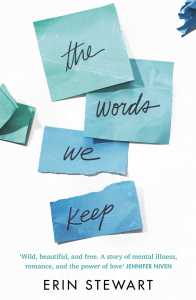
Lily hasn’t seen her sister, Alice, since the Night of the Bathroom Floor. She can’t bring herself to visit her at Fairview Treatment Centre. Straight A student Lily thinks she needs to keep her school life separate from her home life if she’s going to stay afloat. She’s desperately trying to hold her family together.
As long as I keep moving, whatever got Alice can’t get me, too.
Lily hopes to stay as far away from Micah, who met Lily at Fairview, as possible. She’s scared of what will happen if her home life intrudes on her school life. This seems all but inevitable when Lily and Micah are paired up for a class project.
“We’re combining our classes to explore what happens when words and art collide”
While this book delves into some really dark places, at its heart it’s about acceptance. I enjoyed spending time with Lily and Micah as they got to know each other. The process of Lily learning to stop hiding was painful at times but ultimately rewarding. I adored the guerilla poetry.
Books that include characters struggling with their mental health can sometimes feel like a balancing act. They need to be real enough to be relatable but there needs to be some hope too. The author definitely doesn’t shy away from the hard stuff here but there are some rays of sunshine as well. The characters’ thoughts and emotions have an authenticity that are clearly drawn from the author’s lived experience, discussed in the Author’s Note at the end of the book.
“You are enough. Right now. Just the way you are.”
Thank you so much to NetGalley and Simon & Schuster for the opportunity to read this book.
⭐⭐⭐⭐
Rating: 4 out of 5.
Once Upon a Blurb
It’s been two months since the Night on the Bathroom Floor – when Lily found her sister, Alice, hurting herself. Ever since then, Lily has been desperately trying to keep things together, for herself and for her family. But now Alice is coming home from her treatment program and it is becoming harder for Lily to ignore all of the feelings she’s been trying to outrun.
Enter Micah, a new student at school with a past of his own. He was in treatment with Alice and seems determined to get Lily to process not only Alice’s experience, but her own. Because Lily has secrets, too. Compulsions she can’t seem to let go of and thoughts she can’t drown out.
When Lily and Micah embark on an art project for school involving finding poetry in unexpected places, she realises that it’s the words she’s been swallowing that desperately want to break through.
I know quite a few people who live with depression, anxiety, PTSD, OCD and bipolar disorder, but no one has disclosed to me that they live with schizophrenia. This is not to say I don’t know anyone living with this condition, only that so much stigma is attached to schizophrenia that people often don’t feel comfortable sharing their diagnosis with the people in their life. I’m hopeful that books like this one will help break the silence that surrounds it.
Prior to reading this book I probably could have muddled my way through the DSM-5 criteria and maybe rattled off some statistics. However, the only times I’ve only heard from people who’ve been diagnosed with schizophrenia is in documentaries about mental health whose focus is invariably on the more well known diagnoses of depression and anxiety. The stories about those with schizophrenia were told in passing, usually referred to in hushed voices and terminology that you’d expect more in reference to people who are terminally ill.
The truth is, the schizophrenia many of us think we know fails to reflect the reality of the schizophrenia that most people experience.
In this book, the author opens up the conversation about what life looks like for people living with schizophrenia and their loved ones. They look at environmental risk factors, such as trauma and poverty, and explore the stigma that surrounds diagnosis and the different models of mental health. Contrary to their portrayal in the media, people with schizophrenia are more likely to be victims of violence than perpetrators.
The importance of peer support and the limitations of our health care, housing and justice systems are explained. The experiences of a number of people living with schizophrenia are told throughout the book, and it becomes abundantly clear the role privilege plays in the way schizophrenia is treated (or not) and how individuals are able to manage their condition.
I was encouraged by how well the author’s mother’s schizophrenia has been managed but was also very aware of the privilege that facilitated such positive outcomes. Being able to afford and access appropriate medical care from the time that symptoms appear, as well as having secure housing and a network of supportive family and friends are luxuries that many people don’t have.
I was relieved that Elfy’s mother didn’t have to deal with a lot of the struggles that other people diagnosed with mental illness face but, as someone who needs to advocate for myself in a broken health system, I also found myself envious of the privilege that allowed her to get the treatment she’s needed when she’s needed it. I imagine if I was reading this book as a family member of someone diagnosed with schizophrenia, this disparity would hit me even harder.
The author openly acknowledges this privilege. This book also includes the voices of people who I expect would represent the majority of people who live with schizophrenia, those who don’t have access to adequate medical care and who don’t have secure housing and an abundance of supportive people in their life.
Even with all of the resources their family had, their mother’s schizophrenia was an open secret for Elfy and her siblings when they were growing up.
Her condition didn’t feel shameful to speak about so much as it just felt quite scary and dark – too jarring to make sense in our day-to-day lives outside of the house and too big to concern other people with. And so it became a secret.
One of my pet peeves, talking about what we’re going to talk about before getting into the talking about it, was present in this book. To be fair, this is something I come across more often than not in nonfiction reads and it probably says more about my impatience to get on with the learning than anything else. Once I made it past the introductory material, the stories shared by the people with lived experience hooked me.
Where this book shone was its inclusion of the voices of so many people living with schizophrenia, as well as schizoaffective disorder and bipolar disorder. Diagnostic criteria and statistics can only take you so far. It should go without saying but if you want an understanding of what it’s like to live with a condition, listening to the people who know it from the inside is invaluable. You can know in theory that people who live with schizophrenia experience stigma but until someone with lived experience explains how that impacts them personally, you can stay several steps removed from that reality.
If a quarter of all Australians are affected by a complex mental health condition in some way, whether through firsthand experience or by way of a relative or friend, then we’re forced to ask: Why aren’t we talking about these issues on a national scale? Why does it seem like nobody cares? And who does it serve for us not to care?
Thank you so much to NetGalley and Pantera Press for the opportunity to read this book.
⭐⭐⭐⭐
Rating: 4 out of 5.
Once Upon a Blurb
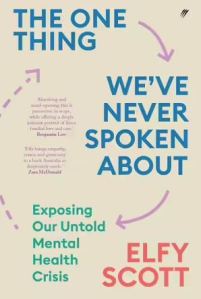
An investigation into the failings of Australia’s mental healthcare system, grounded in a personal story of a mother–daughter relationship.
Journalist Elfy Scott grew up in a household where her mother’s schizophrenia was rarely, if ever, spoken about. They navigated this silence outside the family home too; for many years, this complex mental health condition was treated as an open secret.
Over the past two decades, we have started talking more about common mental health conditions like depression and anxiety. But complex conditions like schizophrenia, bipolar disorder and psychosis have been left behind, as have many of the people who live with these conditions or who care for them.
Part memoir, part deep-dive investigation, The One Thing We’ve Never Spoken About is filled with rage at how our nation’s public discourse, emergency services and healthcare systems continue to fail so many people. It is also a work of care, telling the little-heard stories of people who live with these conditions and work at the front lines of mental health. Above all, this timely, compelling book is informed by hope and courage, breaking down taboos and asking big questions about vulnerability, justice and duty of care.
Don’t you think it’s funny how people say “lost” as if they were just misplaced? But maybe it’s a different meaning of “lost,” in that you don’t know where they went.
Juliet has written letters to her mother for years, first when she was overseas photographing war zones and now when she’s much closer to home but can no longer write back.
We just thought on paper to each other.
Declan is doing community service when he finds one of Juliet’s letters at her mother’s grave. Most people think they know the type of person Declan is because of his arrest.
I say I don’t care what people think of me, but that’s a lie. You’d care, too, if everyone thought you were nothing more than a ticking time bomb.
Declan understands Juliet’s pain and writes back to her. Those two words change both of their lives.
Soon Juliet and Declan are writing to each other regularly. Their anonymity makes them feel safe enough to reveal parts of themselves that they usually keep hidden.
I don’t even know you, but I feel like I understand you.
I feel like you understand me.
And that’s what I like so much about it.
They don’t realise that their paths have already crossed.
I’m all mushy about this book. And I’m not a mushy person.
Part of my love of this book came from the pain the main characters experienced. As they began to connect, I was torn. I wanted them to find one another and connect in person but I loved their vulnerability on the page and didn’t want that to end. Mostly I needed them to know that someone understood what they were going through.
I’m not into romances. At all. But I spent this entire book wanting the senior class reject and cemetery girl to finally get together, dammit! I mean, how can you not get all melty when you read a sentence like this:
She’s the fiercest girl I’ve ever met, but I want to sit in the dark and hold her hand to show her she’s not alone.
Because I read these books out of order, I’d already met Juliet in passing. However, when I read More Than We Can Tell, I didn’t realise the significance of her casually taking photos in the school cafeteria, as if it wasn’t a huge accomplishment.
I’m so glad Rev gets his story told in the next book and that we find out why he only eats sugared cereal as a treat instead of for breakfast.
I loved the parts of the story that focused on photography. Its ability to tell an entire story in a single image… The walk down memory lane to the days of film, when we had no idea whether the magic we saw in the moment was captured until days or weeks later when we got the film developed…
While I adored the main characters, my favourites were those who supported them when it would have been easier to ignore their pain. Frank, Mrs Hillard and Mr Gerardi cared enough to look beneath the surface.
“Every moment is meaningful.”
Because I’m me, I checked each of the email addresses mentioned in this book. None of them currently exist.
⭐⭐⭐⭐⭐
Rating: 5 out of 5.
Once Upon a Blurb
Juliet is drowning in grief after her mother’s death.
Declan is trying to escape the demons of his past.
Leaving handwritten letters on her mother’s grave is the only way Juliet can process her loss. When Declan finds a letter and answers it anonymously, they continue writing back and forth, not knowing who is on the other side. Juliet is instantly intrigued by this stranger who understands the loss she feels. Declan discovers someone who finally sees the good in him.
Such an immediate and intense connection with a perfect stranger is astonishing and wonderful, and soon they are baring their souls to each other. But this secret world can only sustain Juliet and Declan for so long … as the reality surrounding them threatens to shatter everything they’ve created.
For better or for worse, life can change in a matter of seconds. People take their first and last breaths. Cars crash, planes plunge into oceans. The healing process after decades of hurt can begin with a simple gesture.
Or a question: ‘Are you all right?’
When we meet Meredith, she hasn’t left her home for 1,214 days. Fred, her cat, is her constant companion. Her only visitors are the Tesco delivery man, Sadie (her best friend) and Sadie’s kids, James and Matilda. Meredith spends a lot of her time working on jigsaw puzzles.
I’ve been collecting boxes filled with places I’ll never go – works of art I’ll never see.
Meredith doesn’t have any contact with her mother or Fiona (Fee), her older sister. It’s complicated.
On day 1,215, Meredith meets Tom from Holding Hands.
On day 1,219, Meredith meets Celeste, AKA, CATLADY29.
My life is divided into before and after, and the before remains out of my grasp.
Over the course of just over 300 days, the puzzle pieces of how Meredith’s before became her after come together.
I binged this book in a day and enjoyed getting to know Meredith and the people who found their way to her front door. What struck me most was how vital the people around Meredith were to her, giving her the connections she needed and the safety to both confront her past and grow beyond her limitations.
A lot of social issues are explored in this book, many of which have the potential to be quite confronting. While their inclusion made sense in the context of the story and individual characters, some deserved more page time.
While I spent the book cheering Meredith on, sometimes her wins felt like they came too easy. Yes, she did work hard to achieve everything she did. Considering what her life looked like when we met her, though, I would have expected her recovery to be more two steps forward, one step back than it was, over a longer period of time.
Meredith can cook for me anytime she’d like.
I love when books teach me new concepts. Oubaitori comes from kanji for four trees that bloom in spring: cherry blossoms, plum, peach, and apricot.
桜梅桃李
While each blossom looks similar, they bloom differently, with varying shapes and smells. Oubaitori applies this concept to people.
In Japanese philosophy it’s the art of never comparing yourself to others, but recognizing value in your own unique character.
⭐⭐⭐⭐
Rating: 4 out of 5.
Once Upon a Blurb
Meredith Maggs hasn’t left her house in 1,214 days. But she insists she isn’t alone…
She has her cat Fred. Her friend Sadie visits when she can. There’s her online support group, StrengthInNumbers. She has her jigsaws, favourite recipes, her beloved Emily Dickinson, the internet, the Tesco delivery man and her treacherous memories for company.
But something’s about to change.
Whether Meredith likes it or not, the world is coming to her door… Does she have the courage to overcome what’s been keeping her inside all this time?
Frances Hallowell is mourning the recent death of her brother. Her life gets a lot more complicated when her super slimy boss attacks her after hours and she sorta kinda accidentally kills him. Oops!
When it looks certain that Frances is going to be convicted as a murderer, salvation comes to her by way of an ambulance. She’s told she’s very unwell and is promptly taken to Haxahaven Sanitarium to be ‘treated’. Only Haxahaven isn’t what it’s advertised to be. It’s actually a school for witches…
The premise of this book hooked me: secret witchy school, murder mystery, underdog battling the Big Bad. The reality of the book surprised me, and I’m still conflicted.
I was entirely engaged until I learned that the witchcraft that was being taught at Haxahaven was limited to producing good little wives and domestic help. I switched off a little at that point and was even able to put the book aside for a few weeks without any trouble.
I wasn’t sure if I wanted to finish reading but figured I’d give it another try. I found it easy to get back into. I hadn’t forgotten who the characters were or what was happening for each of them when I pressed pause. It didn’t take me long to get into the rest of the story, the parts that didn’t involve magical bread-kneading.
While I wasn’t the hugest fan of Frances, I absolutely adored Maxine and Lena. I wanted to get to know Oliver better.
I think perhaps this is how we survive in the world. Passing little bits of our magic back and forth to each other when the world takes it from us. It’s survival. It’s love. It’s family.
Thank you so much to NetGalley and Simon & Schuster Books for Young Readers for the opportunity to read this book.
⭐⭐⭐⭐
Rating: 3.5 out of 5.
Once Upon a Blurb
In 1911 New York City, seventeen year old Frances Hallowell spends her days as a seamstress, mourning the mysterious death of her brother months prior. Everything changes when she’s attacked and a man ends up dead at her feet – her scissors in his neck, and she can’t explain how they got there.
Before she can be condemned as a murderess, two cape-wearing nurses arrive to inform her she is deathly ill and ordered to report to Haxahaven Sanitarium. But Frances finds Haxahaven isn’t a sanitarium at all: it’s a school for witches. Within Haxahaven’s glittering walls, Frances finds the sisterhood she craves, but the headmistress warns Frances that magic is dangerous. Frances has no interest in the small, safe magic of her school, and is instead enchanted by Finn, a boy with magic himself who appears in her dreams and tells her he can teach her all she’s been craving to learn, lessons that may bring her closer to discovering what truly happened to her brother.
Frances’s newfound power attracts the attention of the leader of an ancient order who yearns for magical control of Manhattan. And who will stop at nothing to have Frances by his side. Frances must ultimately choose what matters more, justice for her murdered brother and her growing feelings for Finn, or the safety of her city and fellow witches. What price would she pay for power, and what if the truth is more terrible than she ever imagined?
When Annae moves to England to complete her PhD, she meets Dr Górski, both of them. Having experienced academic abuse by her former supervisor, Annae is wary, using her ability to read people to feel safe.
Annae was the subject of fascination when she was an undergraduate, using magic to remove fear in rats.
“But with magic like this, it would theoretically be possible to edit our response to trauma, to cure mental illness of all kinds – just a little change in the way we feel and that makes all the difference.”
While the premise fascinated me, the intersection of magic with mental illness and trauma, and the exploration of consent didn’t captivate me like I’d hoped. I somehow managed to hover on the surface of the story, feeling disconnected from the characters.
I wanted Annae’s science themed knitting patterns to endear her to me. I wanted to know more about the two Górski’s and the process of making a homunculus. I’m still not entirely sure why I couldn’t connect with any of them.
It’s become a habit for me to send test emails to any email addresses mentioned in fiction I read. There were two in this story; neither currently exist.
Thank you so much to NetGalley and Tor for the opportunity to read this novella.
⭐⭐⭐
Rating: 3 out of 5.
Once Upon a Blurb
Annae, a brilliant graduate student in psychiatric magic and survivor of academic abuse, can’t stop reading people’s minds. This is how she protects herself, by using her abilities to give her colleagues what they each want out of their relationship with her.
When Annae moves to the UK to rebuild her life and finds herself studying under the infamous, misanthropic magician Marec Górski, she sees inside his head a dangerous path to her redemption. Annae now faces two choices – follow in Dr. Górski’s lead, or break free of a lifetime of conditioning to follow her own path.
As far as I can tell, Debbie Tung’s Quiet Girl in a Noisy World and Book Love were essentially her way of not so subtly telling me she’s been stalking me for my entire adult life. She tried to throw me off the trail by focusing on the ‘aww, aren’t they adorable?’ relationship she and Jason have in Happily Ever After & Everything In Between. Now, in her fourth graphic novel, Debbie takes a deep dive into my mental health.
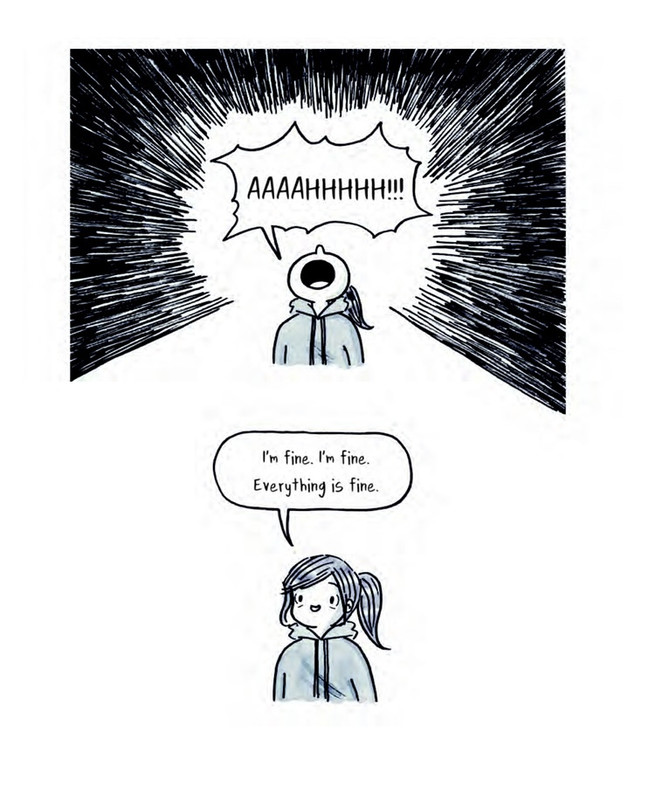
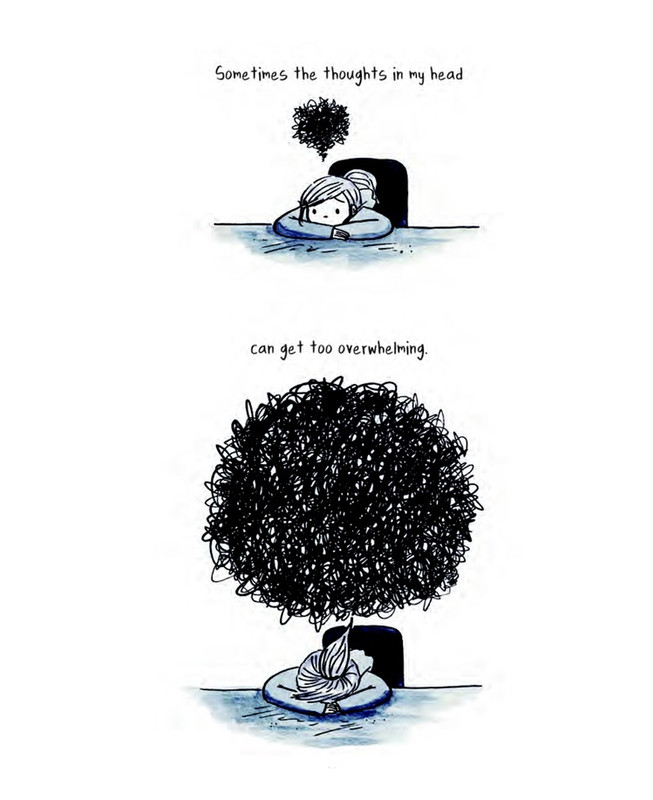
From telling people you’re fine when you’re anything but to sleepless nights spent questioning every decision you’ve ever made, Debbie speaks honestly about mental health. Depression. Anxiety. Panic attacks. Suicidal ideation. You not only hear the thoughts that accompany them, you see what they feel like.
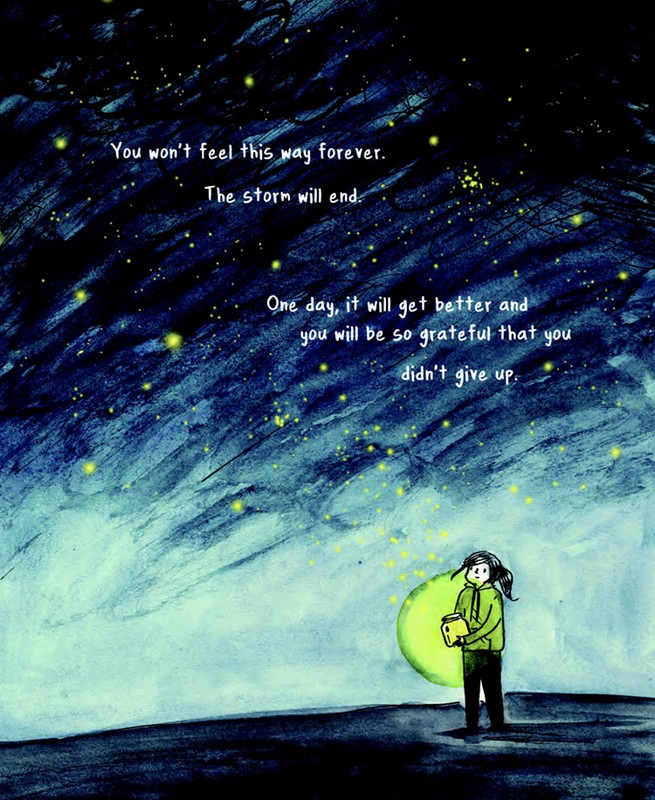
Sometimes just knowing you’re not alone is enough and that’s what this graphic novel does. Debbie’s story acknowledges the darkness but also provides hope.
Asking for help was the most courageous thing I ever did.
It meant that I refused to give up and I wanted to give myself a chance to heal.
It’s one thing to know the types of things that can have a positive impact on your mental health – counselling, self care, celebrating the small wins, gratitude, mindfulness – but hearing how those strategies have helped someone with lived experience gives them more weight.
I’m not an artist so can’t explain this very well but some art feels lofty and unapproachable to me, like I’m being kept at arm’s length. Debbie’s style, though, feels relatable and down to earth. She draws me in with her art and her words.
One thing I really loved about this graphic novel was the use of blue throughout. It’s such an appropriate choice given the subject matter and the muted tones somehow both set the tone and made the content feel non-threatening. The bursts of colour, when they did make an appearance, had a greater impact.
Thank you so much to NetGalley and Andrews McMeel Publishing for the opportunity to read this graphic novel.
⭐⭐⭐⭐⭐
Rating: 5 out of 5.
Once Upon a Blurb
Everything Is OK is the story of Debbie Tung’s struggle with anxiety and her experience with depression. She shares what it’s like navigating life, overthinking every possible worst-case scenario, and constantly feeling like all hope is lost.
The book explores her journey to understanding the importance of mental health in her day-to-day life and how she learns to embrace the highs and lows when things feel out of control. Debbie opens up about deeply personal issues and the winding road to recovery, discovers the value of self-love, and rebuilds a more mindful relationship with her mental health.
In this graphic memoir, Debbie aims to provide positive and comforting messages to anyone who is facing similar difficulties or is just trying to get through a tough time in life. She hopes to encourage readers to be kinder to themselves, to know that they are not alone, and that it’s okay to be vulnerable because they are not defined by their mental health struggles. The dark clouds won’t be there forever. Everything will turn out all right.
Four years of police interviews, 900,000 words in victim statements, endless therapy sessions, a lifetime of pain
I thought I was going to tell you that this is one of the best books I’ve read about mental health and sexual assault but, while that’s accurate, it falls short of what I really want to say. This is one of the best books I’ve ever read. One of the most painful and difficult to read, sure, but absolutely one of the best.
I’ve read about Multiple Personality Disorder/Dissociative Identity Disorder (MPD/DID) before so I thought I already knew the basics and I guess I did. Before this book, though, I’d never truly appreciated how incredible people with MPD/DID are.
There are three factors that typically cause DID: the experience of the most extreme forms of abuse, usually extending over many years; this abuse is perpetrated by caregivers, typically parents, that the child relies upon; and it begins while the child’s mind is young, or plastic, enough, to employ high-level dissociative strategies.
The fact that such unimaginably horrific abuse is perpetrated on young children by people they should be able to trust to protect them is mind-boggling. That the brain is able to develop such a highly developed coping strategy to survive abuse of this magnitude is awe-inspiring.
Told by Jeni, some of her alters and their psychiatrist, Dr George Blair-West, this is the most comprehensive account of MPD/DID you are likely to ever read. Jeni has Highly Superior Autobiographical Memory (HSAM) so is able to recall, in detail, her experiences from when she was an infant.
MPD/DID is a response to being a victim of extreme criminal acts.
Because so much of what Symphony and the alters she created have experienced is more brutal than anything you’ll likely see in your worst nightmare, this isn’t a book you’ll want to binge. You’ll need time out to take care of yourself: go for a walk, remember that the world still holds beauty, remind yourself that Jeni, against all odds, is okay.
I really appreciated the care shown by both the publisher and Dr Blair-West, warning readers of the potential impacts of reading this book before you’ve even begun. A couple of times Jeni warns you that the content you’re about to read is even more difficult than what you’ve encountered to that point, giving you the option to skip that section.
While I read those parts, I was grateful for the warnings so I could prepare myself as best I could. At the same time, though, the fact that Jeni and her alters spent their entire childhood protecting her mother and siblings and is now taking steps to protect readers both touched and saddened me. No one protected Jeni from the torture she experienced, yet she cares enough about people she’ll likely never meet to want to make sure they’re okay.
Jeni even protects the reader by not including all of the details of the unrelenting abuse she was subjected to. Her police statement, at 900,000 words, didn’t even cover everything that happened to her. For context, that’s significantly longer than the entire Lord of the Rings trilogy.
Jennifer Margaret Linda was the original birth child, with Symphony taking her place when she was six months old. Symphony then created the alters. In this book we hear from Jennifer Margaret Linda, Symphony, Erik, Little Ricky, The Rulebook, The Assassin, Jenny, Linda, Muscles, Captain Busby, Janet, Squadron Captain, Amber, Judas, Happy, Zombie Girl, Magsy, The Joker, Maggot, Volcano, The Student, Ed the Head, Charlotte, Gabrielle, Mr Flamboyant, Jeni and The Entity Currently Known as Jeni.
That Jeni even survived her childhood is a testament to how incredibly well her system works. The fact that she’s able to function and is even surthriving is remarkable.
Life should be about thriving as we find meaning and purpose – hence the idea of rising above to ‘surthrive’.
Everyone who works in a helping profession should read this book. Jeni’s case was the first to use a diagnosis of MPD/DID for the prosecution, not the defence, paving the way for other survivors of extreme abuse to seek justice. This book, because of the openness of the alters who contributed to it, will provide much needed insights, so hopefully others with MPD/DID won’t be failed by the people who should be helping them the way Jeni was.
My abuse didn’t happen in a vacuum. It happened before a school fete, behind the closed doors of my father’s respectability.
I’ve spoken a lot about Jeni and her alters but I need to point out that I found the insights Dr Blair-West gives in this book so helpful. He has the ability to take something that’s complex and explain it in a way that makes it feel like it’s not complex at all. I’ve read a lot about PTSD, dissociation and the way the brain manages trauma but Dr Blair-West’s explanations have given me a much better understanding of them.
To Jeni, Symphony, the alters who contributed to this book and those I haven’t met: Thank you for telling your story. I feel honoured to have been introduced to so many of you. I can only imagine how traumatic it was to revisit these experiences in order to write about them. Your story means more to me than you’ll ever know. You are brave and resilient and I’m in awe of you. You are truly extraordinary.
Thank you so much to Hachette Australia for the opportunity to read this book.
⭐⭐⭐⭐⭐
Rating: 5 out of 5.
Once Upon a Blurb
‘I didn’t know that you’re only supposed to have one personality. I didn’t realise that having lots of voices in your head was abnormal. But you are protecting yourself. You are protecting your soul, and that’s what I did.’
An intelligent, poised woman, Jeni Haynes sat in court and listened as the man who had abused her from birth, a man who should have been her protector, a man who tortured and terrified her, was jailed for a non-parole period of 33 years. The man was her father.
The abuse that began when Jeni was only a baby is unimaginable to most. It was physically, psychologically and emotionally sadistic and never-ending. The fact she survived may be called a miracle by some – but the reality is, it is testament to the extraordinary strength of Jeni’s mind.
What saved her was the process of dissociation – Multiple Personality Disorder (MPD) or Dissociative Identity Disorder (DID) – a defence mechanism that saw Jeni create over 2500 separate personalities, or alters, who protected her as best they could from the trauma. This army of alters included four-year-old Symphony, teenage motorcycle-loving Muscles, elegant Linda, forthright Judas and eight-year-old Ricky.
With her army, the support of her psychiatrist Dr George Blair-West, and a police officer’s belief in her, Jeni fought to create a life for herself and bring her father to justice. In a history-making ruling, Jeni’s alters were empowered to give evidence in court. In speaking out, Jeni’s courage would see many understand MPD for the first time.
The Girl in the Green Dress is an unforgettable memoir from a woman who refused to be silenced. Jeni Haynes is an inspiration and her bravery and determination to live is a powerful reminder of the resilience of the human spirit. This is a unique and profoundly important book as it is not only a story of survival, it also includes incredible insight from Dr George Blair-West, Jeni’s psychiatrist and an expert in DID.




 Schizanthus Nerd