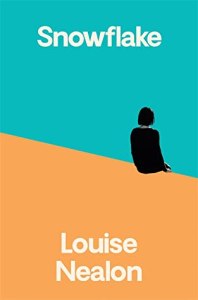
This book is an exploration of mental health and it’s a coming of age story. It’s about our relationships, with other people and with ourselves. It’s about how our feelings of not being good enough, pretty enough, thin enough, smart enough, [insert your own adjective here] enough can manifest in self-destructive behaviours. It’s about cows and snowflakes and stars and dreams.
Debbie grew up in Kildare. She and her Mam, Maeve, live on a dairy farm owned by her uncle Billy. Billy lives in a caravan on the property. Maeve has been writing a book about dreams practically forever and Billy is an alcoholic.
Debbie doesn’t have any friends and her most complicated relationship is with the boy who stands at the back of mass, a boy she’s never spoken to. Now Debbie, a self-proclaimed culchie, is going to university. There she meets Xanthe.
My only friend. Friend? Acquaintance? Person who knows my name?
I’m struggling to think of ways to explain what I liked about each character without getting into spoiler territory. Instead of telling you about specific characters, I’ll tell you what I loved about the characters as a whole.
Every major character is damaged in some way, whether by a personal trauma or the way they see themselves. Every character is trying the best they can with what resources, external and internal, they have to work with. Things might knock them down but they don’t stay down. Everyone is a work in progress.
‘There’s no way to catch a snowflake. And I haven’t met anyone who is able to catch a dream.’
There was an authenticity in the way mental health conditions and emotional pain were addressed throughout the book. Sometimes a sentence that appeared simple enough on the surface felt more profound when I slowed down and reread it.
The bathroom is where I go to recharge, let myself cry and pull myself together just enough to define my edges so I seem solid on the outside.
There were aspects of the story I wanted to delve into further: Maeve’s dreams, Debbie’s dreams, Billy’s mental health…
A character that I could have read an entire book about was Audrey. I wanted to go with her on the journey that led to her making her curiosity cabinet. I felt like she had a backstory that was worth exploring.
Oh, and that quote at the beginning of my review? It’s an Irish saying that means “People live in each other’s shadows.” Basically put, we need one another. I love it!
⭐⭐⭐⭐⭐
Rating: 4.5 out of 5.
Once Upon a Blurb
Eighteen-year-old Debbie White lives on a dairy farm with her mother, Maeve, and her uncle, Billy. Billy sleeps out in a caravan in the garden with a bottle of whiskey and the stars overhead for company. Maeve spends her days recording her dreams, which she believes to be prophecies.
This world is Debbie’s normal, but she is about to step into life as a student at Trinity College in Dublin. As she navigates between sophisticated new friends and the family bubble, things begin to unravel. Maeve’s eccentricity tilts into something darker, while Billy’s drinking gets worse. Debbie struggles to cope with the weirdest, most difficult parts of herself, her family and her small life. But the fierce love of the White family is never in doubt, and Debbie discovers that even the oddest of families are places of safety.
A startling, honest, laugh and cry novel about growing up and leaving home, only to find that you’ve taken it with you, Snowflake is a novel for a generation, and for everyone who’s taken those first, terrifying steps towards adulthood.
“Someone always wants to kill us. It’s never over.”
Dr Carol Elliott has been conducting regular group sessions with final girls for sixteen years. Our final girls are:
Marilyn Torres, who won’t let leather touch her skin
Adrienne Butler, who was a counsellor at Camp Red Lake
Dani Shipman, whose babysitting job didn’t quite go to plan
Heather DeLuca, who faced off against the Dream King
Julia Campbell, whose experiences were turned into the Stab movies
Lynnette Tarkington, who tells the story.
These women have watched friends and family members being butchered by “monsters” but they survived the unsurvivable. Many have even survived sequels. Their stories have been made into successful movie franchises, some have attended conventions and then there are the superfans to contend with.
No one except another final girl can truly understand what it’s like to live with the impacts of this type of trauma. Their scars are both physical and psychological. And it’s really hard to try to move on because there’s never any certainty that the past will stay in the past. These monsters have a habit of not staying dead, after all.
We get subjected to sequels. That’s what makes our guys different, that’s what makes them monsters – they keep coming back.
The final girl support group has been the one constant in the lives of many of these survivors but it’s no longer safe. Someone has been planning their deaths and it’s time for them to fight for their lives. Again.
“This is the sequel or a crossover, or I don’t know what.”
This book was so much fun! I was delighted to discover that the atrocities these women have survived were based on some of my favourite horror movie franchises. Between them, these women have survived Freddy Krueger, Michael Myers, Leatherface, Jason and Mrs Voorhees, Ghostface, and Billy and Ricky Chapman. I have never seen the Silent Night, Deadly Night movies but I’ve binged all of the others many times. Some details have changed but the basic plots remain the same.
I loved picking up on the similarities and differences between the backstories of these women and the movies I know so well. The chapter titles are spot on: The Final Girl Support Group’s New Nightmare, Season of the Final Girls, The Final Chapter, The Final Chapter II.
Even the names of the characters are perfect. For example, the woman whose story represents the Scream movies is called Julie Campbell. Neve Campbell, Scream’s final girl, played a character called Julia in Party of Five. Details like that really stood out to me.
After the trauma they have all experienced, it’s not surprising that the final girls live with a variety of long term impacts. I particularly appreciated that there was no ‘one size fits all’ approach in this book. While they all experienced living nightmares, these women cope with their trauma in individual ways. Their different personalities, their support systems (or lack thereof) and their individual strengths and weaknesses all play a part in what their lives look like now.
“Are those guys really that scary?” he asks.
“Scarier than you can ever imagine,” I answer.
In between the blood spatter I started thinking about serial killers. The names of those who commit heinous crimes are usually burned into our brains but how well do we remember the names of the people they murdered? I know the names and predilections of so many infamous serial killers. I often know in detail what they did to their victims but I’d be hard pressed to tell you the names of their victims. I think it’s time for me to rectify this.
Because I’m me, I tested out the address that a character in the book receives emails from. As usual, I was disappointed to get an automatic response saying my email was undeliverable. One of these days an author or marketing person is going to set up the email address that’s included in a book and I’ll finally get a real response. I’m hoping for an exclusive short story, a personal message from the character that I’ve emailed or even a treasure hunt or details of a competition where I can win a signed copy of the book. One day…
I own every single one of Grady Hendrix’s books. I knew I’d love them but somehow they made it into my Kindle’s black hole of good intentions so this is my first Grady Hendrix read. Believe me when I say it will not be my last!
Thank you so much to NetGalley and Titan Books for the opportunity to read this book.
⭐⭐⭐⭐⭐
Rating: 5 out of 5.
Once Upon a Blurb
Ever wonder what happens to those Final Girls? After the cops eliminate them as suspects, after the press releases their brace-faced, pizza-cheeked, bad-hair-day class photos that inevitably get included on the cover of the true crime book? After the candlelight vigils and the moments of silence, after someone plants the memorial shrub?
For Lynette Tarkington, it’s been a support group. Her, five other final girls, a therapist. Close to twenty years. Today’s the last day for group, but Lynne doesn’t know it yet. It’s also going to be the last day for one of the group. And maybe the final day for all of the final girls, because someone’s been planning a nasty surprise for them for a long time.
When you want to be dead, there’s nothing quite like being dead.
Heather B. Armstrong has lived with depression since she was a child but her experience in 2017 was more intense than anything prior. She spent eighteen months severely depressed, wanting to be dead but forcing herself to go through the motions, doing “All the Things Needing to Get Done”, because of her children.
It was during this time of desperation that Heather learned of an experimental study being run by Dr Brian Mickey. She was only the third person to qualify for and agree to participate in Dr Mickey’s study. About three times a week for ten sessions, Heather was put to sleep with propofol anaesthesia.
Dr. Bushnell would eventually clarify that they weren’t technically killing me; it was more of a really, really intense induced coma. They were just almost killing me.
Heather’s writing style is engaging, taking the reader on the journey with her: the good, the bad, the TMI, the scary and the funny. I met her family, some of her friends and the professionals treating her. I learned about the abyss and found the humour in Heather’s inability to recall what year it was when she was coming out of anaesthesia (1979 or 2012, every single time).
I particularly loved how candid Heather was in describing her depression, including the fact that she was able to hide its severity from many people for so long.
No one knew that I wanted to be dead. That’s how good I am.
Heather’s story not only showcases her perseverance and bravery, it also highlights how integral supportive family and friends are for people living with mental illness. I adored Heather’s friend, Stacia, who stayed the night with her when she didn’t have the internal safety to be alone.
However, Heather’s mother, Linda, and stepfather, Rob, were the ones who stole my heart. The practical and emotional support they offered almost had me ugly crying. They are everything you need family to be when you need help. I could have hugged Linda when she said:
“We have nothing else to do this month other than be there when you wake up.”
As I read, I kept thinking back to times when I’ve had suicidal ideation and the more I thought about it the more courageous Heather seemed. Regardless of how desperate I was, I don’t think I could have attempted a treatment option with a possible side effect (however rare) of death. That may sound absurd to you. Here I am saying I wanted to die yet I would have been too scared to try a treatment that might kill me. Isn’t that exactly what I wanted?
Well, yes and no. See, to submit yourself to an experimental treatment like Heather did, you would have to think that it’s the only or best option for you. But because it’s labelled as ‘treatment’ a part of you, even if that part is teensy, would hope that it might work. That’s the part that would have terrified me: the prospect of holding hope while knowing that hope could literally kill me.
It can be hard for a lot of people to ask for help when they need it. It’s especially difficult when your brain is lying to you, telling you that the people who love you would be better off without you. Heather’s recovery, with the help of the medical profession as well as her family and friends, will hopefully convince readers that it’s perfectly okay to ask for help and accept it when it’s offered.
⭐⭐⭐⭐
Rating: 4 out of 5.
Once Upon a Blurb
Author and blogger Heather B. Armstrong writes about her experience as one of only a few people to participate in an experimental treatment for depression involving ten rounds of a chemically induced coma approximating brain death.
For years, Heather B. Armstrong has alluded to her struggle with depression on her website. But in 2016, Heather found herself in the depths of a depression she just couldn’t shake, an episode darker and longer than anything she had previously experienced.
This book recalls the torturous eighteen months of suicidal depression she endured and the month-long experimental study in which doctors used propofol anaesthesia to quiet all brain activity for a full fifteen minutes before bringing her back from a flatline. Ten times. The experience wasn’t easy. Not for Heather or her family. But a switch was flipped, and Heather hasn’t experienced a single moment of suicidal depression since. The Valedictorian of Being Dead brings to light a groundbreaking new treatment for depression.
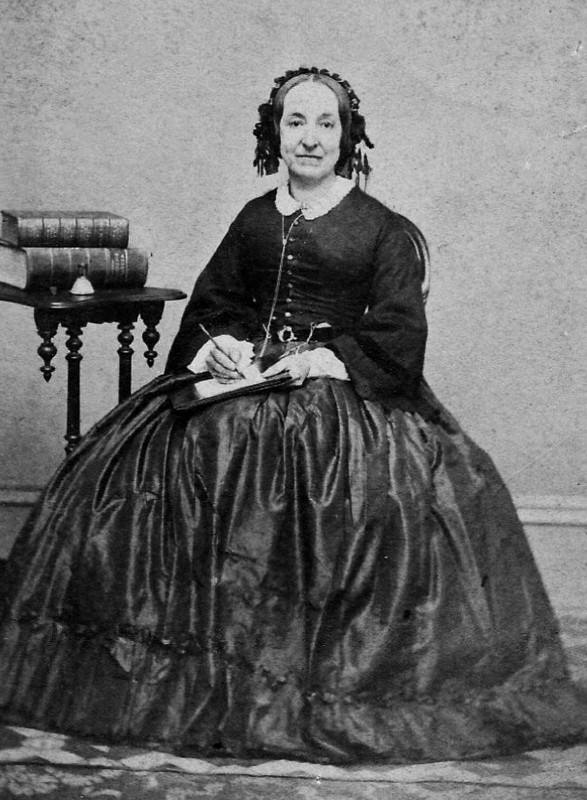
“Can [a woman] not even think her own thoughts, and speak her own words, unless her thoughts and expressions harmonize with those of her husband?”
Taking inspiration from the #MeToo movement, Kate Moore delved into the history of women who, more often than not, have been labelled ‘crazy’ and silenced for speaking the truth. Kate wondered if there was a woman whose perseverance, despite everything that was done to discredit her, prevailed.
She found Elizabeth Packard who, in 1860, was taken against her will to Jacksonville Insane Asylum, two hundred miles from her home, because of her “excessive application of body & mind.” The person who was responsible for this injustice was her husband of 21 years and the father of her six children.
The evidence of her so called insanity?
“I, though a woman, have just as good a right to my opinion, as my husband has to his.”
Elizabeth, after being a dutiful wife, mother and homemaker for almost all of her adult life, heard about the women’s rights movement and gave herself permission to think for herself. She also disagreed with her preacher husband about matters of religion and, with her great intellect and her persuasive arguments, he was afraid of the consequences of her speaking her mind.
This was a time when most states “had no limits on relatives’ “right of disposal” to commit their loved ones”, where an insanity trial had to take place before you were admitted to a state hospital (but not if you were a married woman) and where “married women had no legal identities of their own.”
The thought of me living in 1860 terrifies me. I’m certain I too would have been institutionalised and I don’t know I would have been able to sustain the fortitude that Elizabeth displayed. Don’t think that you wouldn’t have also been at risk of such a fate, as
one common cause of committal to an asylum in Elizabeth’s time was “novel reading.”
In the asylum, Elizabeth met other patients, including other sane women who had been trapped there for years, similarly pathologised for their personality. The asylum served as a “storage unit for unsatisfactory wives”. She also witnessed patients being abused by the staff.
Elizabeth was determined to prove that she was sane and secure her release from the asylum. She also wanted to enact change that would see her new friends also released and to protect the mentally ill from abuse. But what Elizabeth wanted more than anything was to be able to parent her children again.
This is a thoroughly researched and well written account of the life of a woman I’m sad to say I had never heard of before but will certainly not forget.
So in the end, this is a book about power. Who wields it. Who owns it. And the methods they use.
And above all, it’s about fighting back.
Thank you so much to NetGalley and Sourcebooks for the opportunity to read this book.
⭐⭐⭐⭐⭐
Rating: 4.5 out of 5.
Once Upon a Blurb
From the New York Times, USA Today, and Wall Street Journal bestselling author of The Radium Girls comes another dark and dramatic but ultimately uplifting tale of a forgotten woman whose inspirational journey sparked lasting change for women’s rights and exposed injustices that still resonate today.
1860: As the clash between the states rolls slowly to a boil, Elizabeth Packard, housewife and mother of six, is facing her own battle. The enemy sits across the table and sleeps in the next room. Her husband of twenty-one years is plotting against her because he feels increasingly threatened – by Elizabeth’s intellect, independence, and unwillingness to stifle her own thoughts. So Theophilus makes a plan to put his wife back in her place. One summer morning, he has her committed to an insane asylum.
The horrific conditions inside the Illinois State Hospital in Jacksonville, Illinois, are overseen by Dr. Andrew McFarland, a man who will prove to be even more dangerous to Elizabeth than her traitorous husband. But most disturbing is that Elizabeth is not the only sane woman confined to the institution. There are many rational women on her ward who tell the same story: they’ve been committed not because they need medical treatment, but to keep them in line – conveniently labeled “crazy” so their voices are ignored.
No one is willing to fight for their freedom and, disenfranchised both by gender and the stigma of their supposed madness, they cannot possibly fight for themselves. But Elizabeth is about to discover that the merit of losing everything is that you then have nothing to lose…
I didn’t originally plan on reading this book. I was actually wanting to read Herman’s Trauma and Recovery, which I’ve heard spoken of as one of the go to books about trauma. I’m not sure if this is a geographical problem or not but when I went to buy a Kindle copy of that book I discovered it didn’t exist. I then decided to see what else Herman had written and came across this book, which was available on Kindle. Thinking there’d probably be significant overlap between the two I decided to dive right in. Without having read Trauma and Recovery yet I can’t say for sure but I’m guessing they’re quite different books.
Although I’ve read quite a few fiction and non-fiction books about sexual assault, I haven’t read a great deal specifically about incest. I often feel as though the gears move almost imperceptibly slowly where sexual assault is concerned, from the attitudes that surround it to practical help for survivors and reforms to the legal system.
I usually read recently published books that explore sexual assault so to encounter things I take for granted as revolutionary ideas was a whole new experience. At once a history lesson and confirmation of how important early studies into taboo subjects are in shining light into the darkness, this might not have been the book I was expecting to read but I still took a lot away from it.
Much of the information I came across in this book, which was groundbreaking when it was first published in 1981, read to me as either common sense or confirmation of information I’ve already come across. I found that encouraging because it proved we are actually making progress, even though it doesn’t always feel that way.
This book came about as a result of two women, Lisa Hirschman and the author, speaking in 1975 about the patients they’d both encountered who had disclosed a history that included incest. Both women contributed to the research but it was Judith Lewis Herman who eventually wrote this book.
Since nothing satisfactory seemed to have been written about father-daughter incest, we were finally driven to write about it ourselves.
This book is divided into three parts:
Using “survey data, clinical material, anthropological literature, popular literature, and pornography”, the author takes a look at the history of how society has dealt with incest. Spoiler: not well at all. From Freud lying about his own findings to pretty much anyone who could have have a positive influence on the lives of survivors instead discrediting, disbelieving and downright pathologising them, it’s a wonder survivors have had the courage to speak at all.
I know I don’t want to hear it. I have no idea what to do with these cases. And I don’t think I’m unusual.
Quote from a therapist
The author and Hirschman conducted their own clinical study, interviewing forty survivors of incest and twenty women whose “fathers had been seductive but not overtly incestuous”. Yes, I cringed every time I read the word ‘seductive’ in this context.
Consumed with inner rage, they nevertheless rarely caused trouble to anyone but themselves. In their own flesh, they bore repeated punishment for the crimes committed against them in childhood.
Dealing with the “social responses to discovered incest”, this section explores crisis intervention, family treatment and prosecution. This section also talks about prevention.
As long as fathers rule but do not nurture, as long as mothers nurture but do not rule, the conditions favoring the development of father-daughter incest will prevail.
The studies referred to throughout the book are mostly from the 1970’s and those discussed in the afterward, which was written in 2000, were predominantly published in the 1990’s. I’d be interested, now that another twenty years have passed, to find out what else has been learned, confirmed or disproven.
Although I’m cautiously optimistic that we’re still moving in the direction of more openness and less stigma for survivors of incest, I’m also very much aware that this topic remains taboo. It was telling for me when I compared the Goodreads statistics of this book and Herman’s Trauma and Recovery.
At the time of writing this review, Trauma and Recovery has almost 11,000 ratings and over 450 reviews. This book, in contrast, has just over 100 ratings and about a dozen reviews. I wonder if so few people have read this book, which was first released about a decade prior to Trauma and Recovery, or if many readers have chosen not to add this book to their Goodreads shelves, not wanting to admit they read a book about this topic…
The abuses have gone on for too long. Too many survivors have disclosed their secrets. It is too late now to go back to silence.
⭐⭐⭐⭐
Rating: 4 out of 5.
Once Upon a Blurb
Through an intensive clinical study of forty incest victims and numerous interviews with professionals in mental health, child protection, and law enforcement, Judith Herman develops a composite picture of the incestuous family. In a new afterword, Herman offers a lucid and thorough overview of the knowledge that has developed about incest and other forms of sexual abuse since this book was first published.
Reviewing the extensive research literature that demonstrates the validity of incest survivors’ sometimes repressed and recovered memories, she convincingly challenges the rhetoric and methods of the backlash movement against incest survivors, and the concerted attempt to deny the events they find the courage to describe.
There’s only so much horror and pain any living creature can take before it loses its mind.
Sean, unable to speak due to a trauma in his past, is going to live with his grandfather. He knows Grandad used to be a writer but that’s about the extent of his knowledge as they only met two months ago. It is at Grandad’s that Sean learns of the existence of the Baku. He’s going to wish he hadn’t.
While the Baku, a creature otherwise known as the ‘dream eater’, is not a new concept (its mythology spans centuries), the author has brought it to life in an imaginative way, imbuing it with a whole new level of creepy. I can see the appeal of what appears to be an easy way of getting rid of your nightmares but this is definitely not the incarnation of the Baku you want to feed.
For there’s a darkness deep in me,
That feeds on pain and misery.
Give it to me, relinquish dread,
And fall asleep in peace instead.
I felt Sean’s pain throughout the book, both physical and the pain of grief. His underdog status and innate likeability had me empathising with him even more. I wanted this kid to be okay and I hoped everything would work out in his relationship with his Grandad, who I absolutely adored from the get to.
Towards the middle of the book I began to wonder if the story was going to start feeling too repetitive but new elements and additional information about Sean’s past alleviated my concerns. There’s a growing dread as the days progress at The Paddock, something that may even be enhanced by the use of repetition, as you anticipate what’s next for the main characters. The horror is amplified by Sean’s inability to communicate what he’s experiencing to anyone.
It is as though each unspoken sentence dries to create a thicker barrier for those behind it and now his voice is blocked behind an impenetrable concrete wall.
I loved the inclusion of the rowan tree in Grandad’s garden. Given the themes that were explored in the book, the choice of this specific type of tree felt especially significant. Although I want to say more about this tree I won’t because spoilers. However, I will recommend you read about its mythology and symbolism once you’ve read the book so you can see for yourself how brilliantly it all lines up. I particularly like the explanations given here and here.
Thank you so much to NetGalley and Titan Books for the opportunity to read this book.
⭐⭐⭐⭐⭐
Rating: 4.5 out of 5.
Once Upon a Blurb
A Monster Calls meets The Shining in this haunting YA dark fantasy about a monster that breaks free from a story into the real world.
Sean hasn’t been able to speak a word since he was put into care, and is sent to live with his grandad, a retired author whom he has never met before. Suddenly living an affluent life, nothing like the world of the estate he grew up in, where gangs run the streets and violence is around every corner, Sean spends his time drawing, sculpting and reading his grandad’s stories.
But his grandad has secrets of his own in his past. As he retreats to the shed, half-buried in his treasured garden, Sean finds one of his stories about ‘The Baku’, a creature that eats the fears of children.
Plagued by nightmares, with darkness spreading through the house, Sean must finally face the truth if he’s to have a chance to free himself and his grandfather from the grip of the Baku.
“Twenty-six letters and some punctuation marks and you have infinite words in infinite worlds.”
The author calls this book a “love letter to books, and to booksellers” and there are so many bookish delights:
📖 I got to read about other people who love books as much as I do.
📖 The chapter headings are book titles! Why didn’t I think of that?! [Must steal borrow this idea if I ever write a book…]
📖 Bookish references in abundance! Books within books are one of my top five favourite bookish things. Book titles are casually scattered throughout the book. Storylines of well known books are mentioned. Movies that began their lives as books are discussed (the book was better).
“Seriously? It was also a book first?”
“Seriously.”
“Are all movies books first?”
“Just the best ones.”
If you’re like me and likely to panic around the halfway point when you wish you’d been making a list of all of the books that have been mentioned, don’t worry; there’s a bibliography at the end.
📖 Independent bookstores! We get to hang out in not one, but two of them! With booksellers who desperately love books and about making sure the book the reader needs finds its way to them.
“Tell me: What’s the last book you read that you loved?”
📖 The main bookstore has genres grouped together in a way that makes so much sense.
I could happily spend my entire review talking about the books, bookstores and booksellers but there’s more to this book than books. We also come face to face with some pretty difficult topics. Multiple characters are dealing with addiction, either their own or a loved one’s. Likewise, multiple characters are grieving. Chad, my favourite character, is living with a spinal cord injury.
I adore Chad, although I expect I wouldn’t have been a huge fan of him before his accident. He’s had some pretty impressive post traumatic growth and his attitude is amazing. I could have done without him saying “dawg” and “son” all the time but I guess no one’s perfect.
Speaking of not being perfect, Aaron (our main character) is definitely a work in progress. I really didn’t like him at all for a good portion of the book, during which he basically treats everyone around him like garbage. He did begin to make more sense to me as I got to know him but until then, ugh!
I loved Aaron’s father, Ira, because he loves books so much. The fact that he’s still so passionate about them, despite grief, anxiety and depression, made me love him even more. He truly comes alive when he talks books and that resonated with me.
I liked the Lumberjacks, getting to know Ike the best. He came up with my favourite line (pardon his French):
“Fudge a duck on a hot sidewalk!”
You might be interested in this book because of the romance, which is pretty insta, but it’s not the main focus of the book. Aaron, a young man who doesn’t like music, falls for a young woman who’s in a band.
Every time I see her, I feel that thing: the inevitable.
The thing is: I don’t trust the inevitable.
I mean, what has inevitable done for me?
Ruined my life is what.
I was ready to love Hannah but never formed an emotional connection with her. Her purpose seemed to be to act as a mirror for Aaron. I didn’t feel like I got to know Hannah that well and her bandmates are even more of a mystery to me. I really wanted to find out more about Jax, especially when it looked as though they were going to become more integral to the story, but pretty much all I know for sure about them is their pronouns (they/them).
A few things didn’t make sense to me. If Aaron’s brother’s addiction cost their family so much (and right now I’m only talking about the cost to their finances), how did he ever manage to collect such an extensive collection of rare vinyls? Wouldn’t he have spent that money on drugs? Even if he did manage to accumulate so many, in the grips of addiction, wouldn’t he have sold them? I know he gave them to Aaron but that only explains the final five months of his life.
Also, early in the story we learn that Ike’s wife’s fibromyalgia symptoms stopped her from being able to come to the bookstore years ago. Towards the end of the book she’s at the bookstore several times. It is mentioned once that she has a walker but it didn’t ring true to me. If she‘s well enough to be at the bookstore now, wouldn’t she have already been there before the renovations began?
“Are the answers to all life’s questions in books?”
“Of course,” he says. “That’s what makes them miracles.”
Thank you so much to NetGalley and Simon & Schuster Children’s Books, an imprint of Simon & Schuster UK, for the opportunity to read this book.
⭐⭐⭐⭐
Rating: 4 out of 5.
Once Upon a Blurb
‘I got this whole-body feeling … it was like a message from future me to present me, telling me that in some way we weren’t just bound to happen, that we had, in some sense, already happened. It felt … inevitable.’
So far, the inevitable hasn’t worked out so well for Aaron Stein. While his friends have gone to college and moved on with their lives, Aaron’s been left behind in the Cascade Mountains of Washington State, running a failing bookshop with his dad, Ira. What he needs is a lucky break, the good kind of inevitable.
And then he meets Hannah. Incredible Hannah – magical, musical, brave and clever. Could she be the answer? And could they – their relationship, their meeting – possibly be the inevitable Aaron’s been waiting for?
As you move through the experiences of your past, know that no matter what happened, your being here, vibrant and alive, makes you worthy.
You alone are enough.
Sometimes a book will come into your life at exactly the right time. Traumas, both from childhood and more recent times, have been making themselves known to me with an urgency I haven’t experienced before, at a time that seems more inconvenient than pretty much any other time in my life. Although I’d love to push it all to the side, with a ‘Not now! Can’t you see I’m busy reading?’, there’s also a knowing that there’s never going to be a good time and that maybe, just maybe, there’s a reason it’s all coming up for me now.
So, here I am, trying to figure out what healing will look like for me and having conversations with people who are seeing my resilience from the outside in vastly different ways than I’m perceiving it from the inside. Then this book, which covers the trifecta of what my brain has decided is my priority right now (trauma, resilience and healing), makes its way into my world.
The shift from asking ‘what’s wrong with you?’ to ‘what happened to you?’ is something I’ve yearned to hear for most of my life. Western society is so fixed on labels, which I know have their place and can be useful, but all too often pasting a diagnosis (or multiple diagnoses) on someone marginalises them more than it helps them. If we don’t get to the core of why a person behaves the way they do then we’re really missing the point, and the opportunity to best support them.
All of us want to know that what we do, what we say and who we are, matters.
Dr. Perry’s work in understanding how the brain’s development is impacted by early trauma helps explain why we behave the way we do, for example, why some people lash out in anger and others withdraw into themselves.
There’s science in this book but it was explained in a way that made sense to me, someone who hasn’t formally studied science since high school. Even if you don’t understand a concept the first time it’s mentioned it’s okay as it will be referred to in later conversations. If words like ‘brainstem’, ‘diencephalon’, ‘limbic’ and ‘cortex’ make you want to disengage, I’d encourage you to hold on because how the science relates to someone’s life will be explained. This, in turn, will make it easier to apply what’s being said to your own life. You’ll read about people Dr. Perry has worked with, people Oprah has interviewed and about Oprah’s own experiences.
Knowledge truly is powerful and simply having an understanding of why a smell or sound (‘evocative cues’) can cause people with PTSD to have flashbacks, making them feel as though they’re right back in that moment, feels like half the battle. If you’re not caught up in judging yourself for your brain responding the way that it does, then it frees up so much energy that you can use to regulate yourself.
I learned about how our view of the world becomes a “self-fulfilling prophecy”, why self harm makes so much sense to the people who do it (even though it baffles the people who don’t), the importance of rhythm in regulation, how vital connections with other people are to healing and why I need to learn more about neuroplasticity.
I gained a much better understanding of flock, freeze, flight and fight. Dissociation, which I thought I knew all about from personal experience, make much more sense to me now, as does why I find reading so helpful in my everyday life.
I love facts and there were some that really put what I was reading into context for me.
During the first nine months, fetal brain development is explosive, at times reaching a rate of 20,000 new neurons ‘born’ per second. In comparison, an adult may, on a good day, create 700.
This book isn’t about blaming anyone for your trauma and it’s not giving you an excuse for bad behaviour. It does explain why you react the way you do and can help silence the voice inside you that tells you there’s something wrong with you because of it – your reaction is reasonable given your history but there is also hope; you can heal.
I would recommend this book to so many people. Before I’d even begun reading I’d recommended it to my GP and would not hesitate in recommending it to anyone who works in a profession that brings them into contact with young children and their families or trauma survivors.
To this day, the role that trauma and developmental adversity play in mental and physical health remains under appreciated.
I would recommend it to trauma survivors, although with a few caveats: that they stay safe while reading (some of the content is bound to be triggering), read at their own pace and make good use of their support system as needed. Loved ones of trauma survivors will find explanations for why their friend or family member behaves the way that they do and ways they can help.
I’m not someone who usually listens to audiobooks but if there’s a book that would be more suited for that format than this one, a series of conversations between Dr. Perry and Oprah, I can’t think of it. Of course, having grown up with Oprah, I heard everything she said in her voice as I read anyway but I’m definitely planning to reread via audiobook.
It takes courage to confront your actions, peel back the layers of trauma in our lives and expose the raw truth of what happened.
But, this is where healing begins.
Thank you so much to NetGalley and Bluebird, an imprint of Pan Macmillan, for the opportunity to read this book.
⭐⭐⭐⭐⭐
Rating: 5 out of 5.
Once Upon a Blurb
Through wide-ranging, and often deeply personal conversation, Oprah Winfrey and Dr. Perry explore how what happens to us in early childhood – both good and bad – influences the people we become. They challenge us to shift from focusing on, ‘What’s wrong with you?’ or “Why are you behaving that way?,” to asking, ‘What happened to you?’ This simple change in perspective can open up a new and hopeful understanding for millions about why we do the things we do, why we are the way we are, providing a road map for repairing relationships, overcoming what seems insurmountable, and ultimately living better and more fulfilling lives.
Many of us experience adversity and trauma during childhood that has lasting impact on our physical and emotional health. And as we’re beginning to understand, we are more sensitive to developmental trauma as children than we are as adults. ‘What happened to us’ in childhood is a powerful predictor of our risk for physical and mental health problems down the road, and offers scientific insights in to the patterns of behaviours so many struggle to understand.
A survivor of multiple childhood challenges herself, Oprah Winfrey shares portions of her own harrowing experiences because she understands the vulnerability that comes from facing trauma at a young age. Throughout her career, Oprah has teamed up with Dr. Bruce Perry, one of the world’s leading experts on childhood trauma. He has treated thousands of children, youth, and adults and has been called on for decades to support individuals and communities following high-profile traumatic events. Now, Oprah joins forces with Dr. Perry to marry the power of storytelling with the science and clinical experience to better understand and overcome the effects of trauma.
In conversation throughout the book, the two focus on understanding people, behaviour, and ourselves in the context of personal experiences. They remove blame and self-shaming, and open up a space for healing and understanding. It’s a subtle but profound shift in our approach to trauma, and it’s one that allows us to understand our pasts in order to clear a path to our future – opening the door to resilience and healing in a proven, powerful way.
Grounded in the latest brain science and brought to life through compelling narratives, this book shines a light on a much-needed path to recovery – showing us our incredible capacity to transform after adversity.
This book introduces you to the lived experience of 101 contributors, people whose experiences run the gamut of what it means to be human but who have all struggled with hopelessness and found reasons to hope. Rather than attempt mini reviews for each contributor, instead I will share my favourite quote from each of the book’s eleven sections.
Always Hope
To me, hope is a gentle bridge between what is and what could be. A bridge that if crossed will lead you from desire, to belief, to knowing. Knowing that tomorrow will be different and can be better. Hope is the understanding that things will change and that life will eventually move for you, too.
Jada Sezer
Acceptance
This is some of the best advice I have had: to take each day as it comes. Just focus on the next hour and reach for support if you need it, from people or helplines. Don’t suffer in silence as you are never truly alone, even if it feels that way.
Eleanor Segall
Peace
It’s ok to not be ok. It doesn’t mean you’re weak or a bad person. Admitting you’re unwell is a sign of strength, not weakness.
Oliver Kent
Tool Kits
It generally feels better when you say it out loud. It enables you to reality check your thoughts and feelings, to shine a light on them and test them out, rather than keeping them hidden in the echo chamber of your mind. Above all, it gives you the chance to connect with others and to realise you are not alone.
Benna Waites
Compassion
For it is people who create hope; it is people who give us the strength to carry on.
Dick Moore
Courage
Imparting hope is profound and may just be enough to save a life.
Erin Turner
The Right Words
Trying to avoid it, because you’re scared of how it will make you feel, will only make things worse. So instead you let the feeling be. ‘This is me,’ you can say to yourself, ‘experiencing grief.’ Does it hurt? Yes. Will it kill you? No. Will it pass? Yes. Is it serious and important? Yes. Is it also just a feeling? Yes.
Aaron Balick
Inspiration
So here’s my first piece of advice: be gentle and forgiving with yourself, as if you were talking to someone you loved. It’s OK to be weak and fallible, or at least just human, to have limits. It’s OK to stop and take a moment for yourself.
Frank Turner
Resilience
And yet hope is determined, hope is always there, even if you can’t see it or hear it. It’s in the tiniest of moments, shining its dim light, hoping you notice it. And hope is potent stuff, you only need the smallest glimmer, the tiniest drop, to make a difference.
Jo Love
Kindness
‘You don’t have to wait to be in a crisis to get help,’ Leah said, thirteen soothing words that finally granted me permission to speak.
Amy Abrahams
Connection
Everyone’s feelings make sense once you get to know their story.
Martin Seager
There are plenty of darkness and light analogies, things that contributors would like to tell their younger selves and many writers who mentioned the importance of good nutrition and getting enough sleep and exercise. I know we all know the importance of these in maintaining both our physical and mental health but there’s something about hearing things you already know from people with lived experience that make you want to pay attention. If they helped these people, then maybe, just maybe, they might work for you too.
Some contributions had sections that read a bit like a Hallmark card, although I’m not certain that that’s a criticism; Hallmark haven’t made bajillions by telling people things they don’t want to hear. It wasn’t always clear to me why specific contributions were included in a section.
One of my favourite contributions was from David Wiseman, whose descriptions of what life looks like from inside PTSD are some of the most authentic that I’ve ever come across. I highlighted more of David’s words than any other writer. I can’t choose a favourite passage so I’ve chosen the shortest one that I highlighted.
Living with PTSD means having to have a busy mind because a relaxed mind will automatically fill with things you don’t want to think about. It means being tired all the time because that amount of thinking takes energy.
Thank you so much to NetGalley and Bluebird, an imprint of Pan Macmillan, for the opportunity to read this book.
⭐⭐⭐⭐
Rating: 3.5 out of 5.
Once Upon a Blurb
There is always hope, even when we cannot seem to seek it within ourselves.
From the best advice you’ll ever get to the joy of crisps, the 101 brilliant contributors to The Book of Hope will help you to find hope whenever you need it most. Award-winning mental health campaigner Jonny Benjamin, MBE, and co-editor Britt Pflüger bring together people from all walks of life – actors, musicians, athletes, psychologists and activists – to share what gives them hope.
These 101 key voices in the field of mental health, from the likes of Lemn Sissay, Dame Kelly Holmes, Frank Turner and Zoe Sugg, to Joe Tracini, Elizabeth Day, Hussain Manawer and Joe Wicks, share not only their experiences with anxiety, psychosis, panic attacks and more, but also what helps them when they are feeling low. This joyful collection is a supportive hand to anyone looking to find light on a dark day and shows that, no matter what you may be going through, you are not alone.
You never know what’s going on inside someone else’s head – how they’re hurting – even if you put the hurt there yourself.
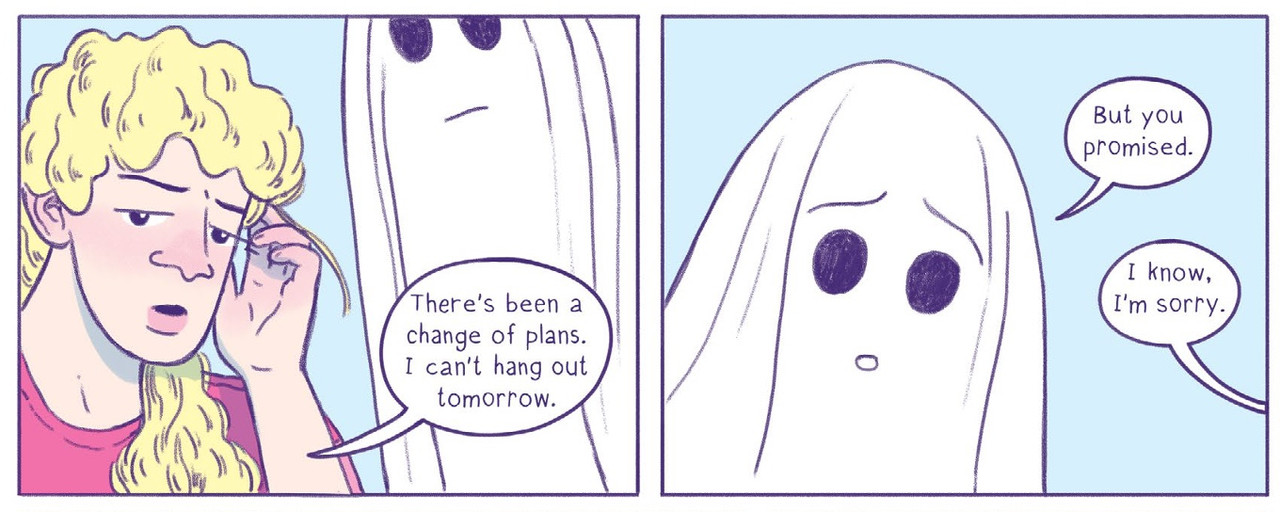
Marjorie, who felt like a ghost in Sheets, has recently started the eighth grade. In order to fit in, she hides who she really is from her new friends. Marjorie and her family are, each in their own ways, grieving the death of her mother.
Eliza is an outcast who is repeating the eighth grade.
“Sometimes I feel like a ghost, but maybe a ghost in the wrong place, you know?”
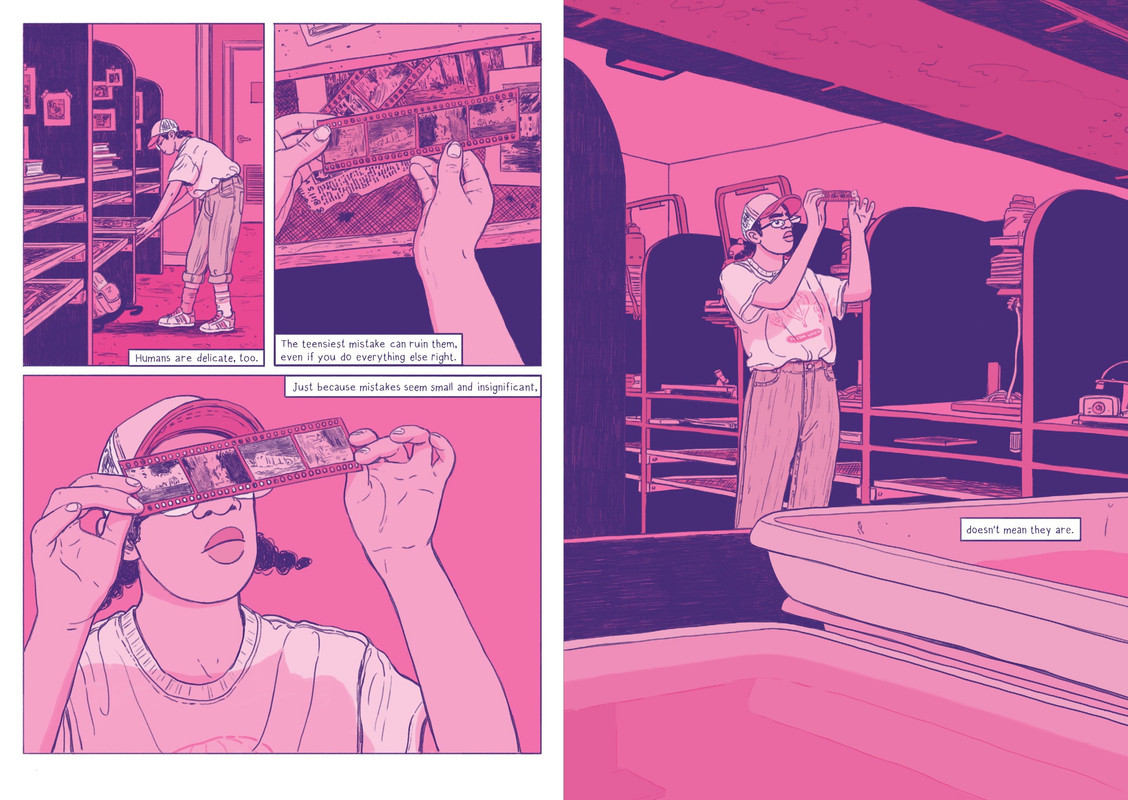
Eliza spends her time trying to capture ghosts on Lorraine, her camera (named after Lorraine Warren), for her paranormal portfolio. Being herself has resulted in Marjorie’s new friends bullying her, while Marjorie stands by, visibly uncomfortable but not intervening.
Marjorie spending time with her new friends means she doesn’t have as much time to spend with Wendell, her favourite ghost.
He’s missing his friend and feeling left out. He is trying his best to deal with both his life and life after death.
I loved Eliza. Anyone who dresses up as a Ghostbuster for Halloween and wears different coloured socks is my kind of person. I ached for her as I watched her cross back and forth between being too visible and invisible.
I always look for fun background details in graphic novels. My favourite find in Delicates was the names of the movies playing at The Rubin – The Ghost Wears Prada and What a Girl Haunts.
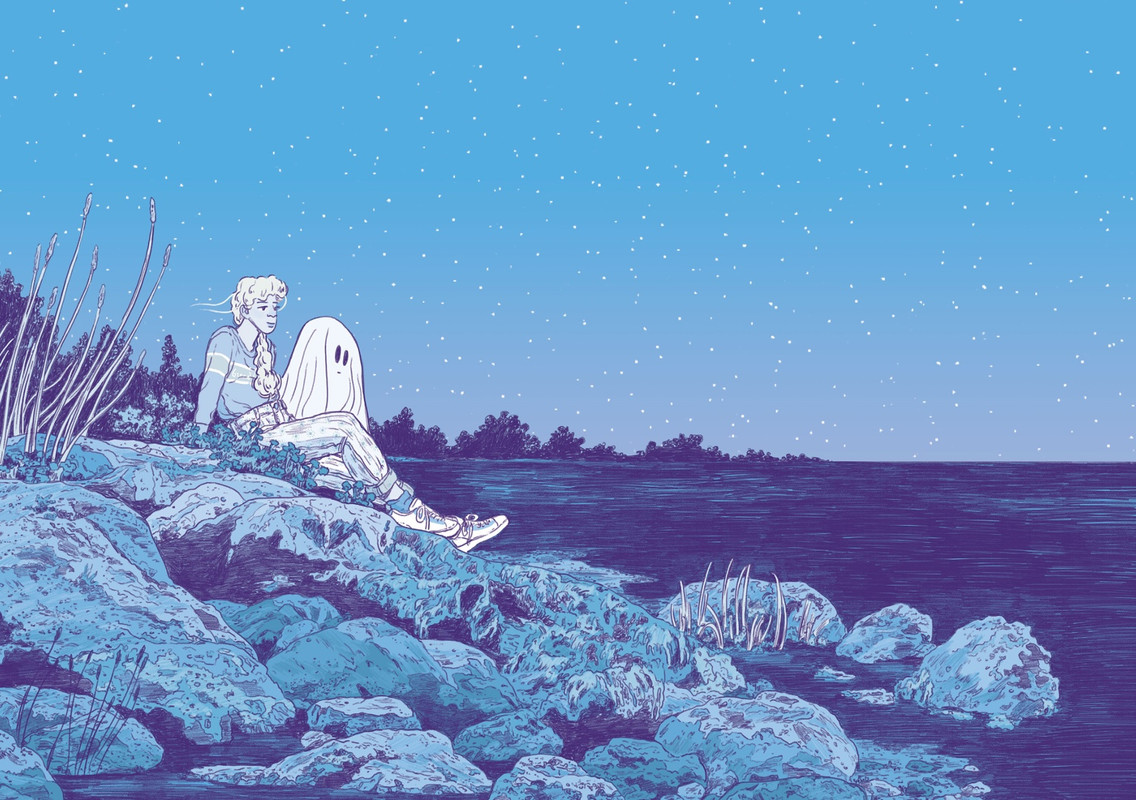
As I’ve come to expect from Brenna Thummler, the artwork was absolutely gorgeous. The characters’ expressions often speak louder than their words and, although it’s been a long time since I last read Sheets, the colour palette immediately drew me back into its world.
“You should never have to hide who you are.”
Thank you very much to NetGalley and Oni Press for the opportunity to read this graphic novel.
⭐⭐⭐⭐
Rating: 4 out of 5.
Once Upon a Blurb
Marjorie Glatt’s life hasn’t been the same ever since she discovered a group of ghosts hiding in her family’s laundromat. Wendell, who died young and now must wander Earth as a ghost with nothing more than a sheet for a body, soon became one of Marjorie’s only friends. But when Marjorie finally gets accepted by the popular kids at school, she begins to worry that if anyone learns about her secret ghost friends, she’ll be labeled as a freak who sees dead people. With Marjorie’s insistence on keeping Wendell’s ghost identity a secret from her new friends, Wendell begins to feel even more invisible than he already is.
Eliza Duncan feels invisible too. She’s an avid photographer, and her zealous interest in finding and photographing ghosts gets her labeled as “different” by all the other kids in school. Constantly feeling on the outside, Eliza begins to feel like a ghost herself. Marjorie must soon come to terms with the price she pays to be accepted by the popular kids. Is it worth losing her friend, Wendell? Is she partially to blame for the bullying Eliza endures?
Delicates tells a powerful story about what it means to fit in, and those left on the outside. It shows what it’s like to feel invisible, and the importance of feeling seen. Above all, it is a story of asking for help when all seems dark, and bringing help and light to those who need it most.




 Schizanthus Nerd